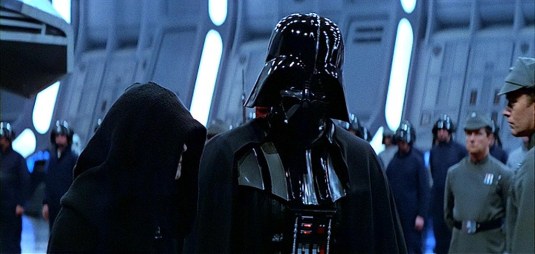
from comical Bond villain to dreadful oppressor

For those that make the fervent case that we need Facebook in the business of deleting fake news, I give you in response a perfect example of why we don’t want that. It’s a rather short road from policing fake news to policing all reasonable speech. As we’ve previously written, Facebook (specifically Zuckerberg) has been in the sucking up to China’s dictatorship business for some time now.

And how! Courtesy of the New York Times (who like the Post occasionally bothers to engage in actual journalism):

The social network has quietly developed software to suppress posts from appearing in people’s news feeds in specific geographic areas, according to three current and former Facebook employees, who asked for anonymity because the tool is confidential. The feature was created to help Facebook get into China, a market where the social network has been blocked, these people said. Mr. Zuckerberg has supported and defended the effort, the people added.

How would this delightful tool of oppression work?

Well, for example, say a belligerent blog author took it upon himself to publish some thoughts on how Xi Jinping, Dictator & Overlord of the Chinese People, rose to power as one of the most corrupt dudes on the planet to the tune of billions in cash. And made the point that Xi’s current anti-corruption campaign is the biggest hypocrisy since Stalin called Hitler “a bad bloke”. Xi and his family made billions, but now Xi’s suddenly a paragon of virtue. So one can only come to the conclusion that he’s using anti-corruption efforts to purge those who oppose him.

Then say said blog author posted that on Facebook. And then say one of that blog’s six demented followers liked that post? Well, using Zuckerberg’s fancy new tool, Xi’s goons could preconfigure the system so that it would automatically purge from the planet. Nobody in China would ever read those words because the following terms would not be allowed in any post seen in China:

Xi Jinping

Dictator & Overlord

Delicious Stout Beer

Hypocrisy

Amateur Jai-Alai Extraordinaire

Kleptocrat

Stalin

Kute Kitties

Hitler

You know, one can occasionally hate Google equally as a partial anti-liberty bully. But on this count, Google’s conduct has been quite admirable. For well over half-a-decade Google has fought China on censorship. The result is Google’s profits and scope in China are in the tank. But at least they’ve made a stand. In contrast Zuckerberg is just drooling for those extra one billion eyeballs, because $. And if freedom of speech loses in the process? Oh well.

I don’t understand this line of thinking. If you’re in the free speech business, how do you ultimately increase your future bottom line by getting into the anti-free speech business? That’d be like Coca Cola sending an employee into the White House to restock the machines with Coke, then he goes into the Oval Office to campaign for an ultra-tax on sugary drinks. Zuckerberg’s behavior makes no sense. That is, unless you see it through the lens of Silicon’s Valley’s cynical elite. As in, Zuckerberg and Xi are both in the extreme 0.1% of all humanity. And that means they have more in common with each other than the rest of us. So they think they can cut a deal, and damn the consequences.

My final point, any company should be wary of selling its soul to do business in China. It’s a trap. If Facebook got into China without restrictions tomorrow, it’d probably get it’s clock cleaned by China’s own businesses. Uber China no longer exists for a reason. If the vicious-rule-breaking-barbarians at Uber can’t even break into the Chinese market, what chance does Facebook (or anybody else) have? WeChat already has 700 million Chinese users and is specifically tailored to China’s users, by folks who live there and understand the culture. Zuckerberg can’t compete with that. But he appears happy to mortgage his honor to try.

Uh [shakes head], the problem with comical Bond villains is that in cold reality, outside the scope of fun movies, they’re actually dreadful oppressors.

Hat tip, to the Facebook employee who’s honor is intact, for leaking this info to the New York Times. We who are free, salute you.

22FACEBOOK2-master768.jpg

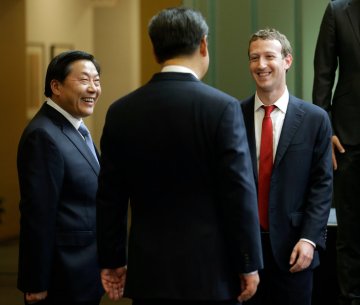
“Why yes Mr Xi, yes Sir!  I am selling out.  Are you buying?”

who gets to decide what’s fake?

We got through most of this entire lunatic campaign season without nary a word about fake news sites. I find this amusing as for the most part I consider Fox, MSNBC, CNN, etc, etc, to all essentially be fake news sites. They don’t actually report news so much as they seek to shape public opinion to serve whatever interests they champion. There’s also the ever delicious The Onion which is usually a good place for a decent laugh, though even they have an obvious slant they push, but they’re obviously an admitted satire site.

But what folks are actually talking about are the sites that are totally off the deep end. They have no purpose except to play people for morons to move the election needle. Some of the examples I’ve heard over the last week were popular articles that said something along the lines (my paraphrase) of, but all of these were lies:

– The Pope had endorsed Trump

– Trump had commuted to Valhalla before the campaign ended

– Machines will not be our Masters

– Trump won the popular vote

– Going vegan makes you happy

– Trump was seen at Putin’s dacha alongside six former Olympic gymnasts (I too thought this one 99% accurate)

– The Walking Dead is a good television show

So now that the election is over a whole bunch of folks are stating that these fake news posts were in some way responsible for altering the course of the election. This point of view is mostly for those in the Hilary camp who ascribe some of the last minute push towards Trump as caused by said nakedly vicious pro-Trump fake news. Facebook, Google, and your local school newspaper are now thus under pressure to filter and delete said fake news stories from their feeds. The idea is that you the voter will no longer see this fake news so you can know the news you read online is legit.

First off, I feel sorry for Facebook and Google on this because no matter what they do everybody is going to hate them for it. One side will claim they’re not doing enough to police fake news or hate speech, the other side will claim censorship. Both sides will be simultaneously right and wrong. Facebook and Google will be caught in the middle of the broader cultural wars. Zuckerberg will become progressively more frustrated and insane, thus laying the groundwork for his impending slide into the oblivion of Bond villain darkness.

Because honestly who gets to decide what’s fake? As I understand what Facebook and Google are being asked to do, they have to hire somebody to edit their feeds. Then that person upon viewing some news they deem fake is supposed to delete it so folks can’t see it. Well, what’s fake?

– The Pope had endorsed Trump, fake, delete.

– Okay, what about The Onion? Well, that’s fake too, but that’s satire, so, do not delete? I guess. Well, what’s satire and what’s fake news? Who determines the difference?

– Okay, what about Salon or National Review? Well, they’re flamethrower sites for the acolytes, so it’s analysis and not technically news, so, do not delete? I guess. Who gets to determine the best way for remembering where you put your keys?

– What about that random Facebook post by normal average human that becomes popular but is chock full of lunacy, lies, and opinion? Well, but that’s not from a news site, so, we do not delete? But it’s still fake, so shouldn’t that person be made to shut up? Even if that person is just an average person they’re still shaping public opinion, aren’t they? Who decides who is made to shut up?

– But what if somebody reposted that person’s post as if it was news? Do we delete them too? What about somebody’s random blog post, is that news? Who decides what’s a blog post and what’s fake news? Who decides if Lady Gaga is hot or not?

– What about a 1930’s Looney Tunes cartoon clip with Speedy Gonzalez, is that hate speech worthy of deletion? Who determines what is hate speech, what is stupidity, what is fake news, and what’s just normal average painful human discourse to resolve our problems? Have you contemplated your future bleached skeleton status lately?

– What about a scene from Frozen which falsely gives the impression via fake news that Elsa would not have been put to death by the Catholic Church for witchcraft in real life? Shouldn’t we delete that too?

And on and on and on.

Where does this end? Where do you draw the line on what should be seen and deleted? What is fake and what’s not? The answer always will end up being the opinion of some screener, likely guided by policy that a bunch of folks from Facebook and Google got together and wrote. And thus, a bunch of random people you’ve never met get to determine what you’re allowed to say and read. This is not healthy in any aspect.

Facebook and Google are private companies and can essentially do whatever they want within the law. For example, if Google decided it hated cats and deleted all cat content from its site I’m pretty sure there’s nothing anybody could do to stop them. But Facebook and Google are also so ubiquitous to society you could make an argument they’re becoming an intrinsic part of our culture, infrastructure, lives. Do we really want two of the global Internets backbone sites to be in the censorship business? For any reason at all?

I come down to two points on this:

1) I am an open season kind of person on free speech and thus to all the Internets. Facebook, Google, Twitter should not be in the business of removing content whether it’s fake, hateful, whatever. This means you can post fake Trump news, evil ISIS propaganda, incorrect tips for how to properly cook an egg, Tweet how much you despise [insert anything here], and so on. Dealing with all this nonsense is a price worth paying rather than living in an online society where strangers get to police thought.

2) Humans as free individuals are responsible for what they do and do not read and how they process information they acquire online, in newspapers, from ads, from their neighbors, from their imaginary friend, from their own fears, from their own dreams. If somebody read fake news and believed it, that’s their own problem and responsibility. Living in a free society is hard work. It requires you to think for yourself, do your own research, and make your own decisions. It’s not the responsibility of society to do that job for the citizen. Indeed, if society did, then said citizen would never be truly free.

And I want us all to live free.

Milwaukee – Pabst Mansion

My Grandfather was so into Pabst beer that he named his dog after it.  This supposedly scruffy little mutt had a sharp personality.  So he fit well with his originally rough Milwaukee based namesake brew.  I think this also explains much of my obsession with all things beer, much to my detriment at times.

I suppose both my Grandfather and his dog would be rather troubled to see what’s become of Pabst now.  For you see, the tale of Pabst beer and of Frederick Pabst himself is a winding journey.  I think it emphasizes some of the best, worst, and weirdness of modern America.  I don’t know why all this fascinates me but please bear with my degenerate mind for this post is going to be a long one.

The man

Pabst was born in 1836 Prussian Germany to a poor local farm couple.  When he was 12 they immigrated to the American Midwest during a time where nobody was checking papers at the border.  This was still a time where America was a harsh, dangerous, and backward place.  Within a year Pabst’s mother died of cholera.  Pabst spent his teenage years working menial odd jobs just to survive and eat.  Somehow, he ends up with a lucky gig onboard a Great Lakes vessel.  Without an education or connections, he works his way up the maritime ladder and by 21 he’s a steamship captain with a name people know.  If you want yet another example to understand how American economic mobility is different nowadays, imagine what it would take for a 16 year old high school dropout waiter to become a ship captain within five years.

Pabst remained close to his roots and the German émigré community.  He spoke German at home his entire life.  He thus meets a fellow German in Phillip Best, marries his daughter, and ultimately uses his equity in the steamship trade to buy half of Best’s brewery.  From then on, Pabst is a brewer, though he maintains the title “Captain” Pabst for the rest of his life.  Thus proving once again that it’s awesome to be a captain, just ask Patrick Stewart’s ghost.  By the end of the Nineteenth Century the brewery is one of the planet’s most successful.  Pabst is Milwaukee’s leading citizen, he owns properties, resorts, banks, a theater, and on and on.  Though he came from nothing, he’s literally at the peak of American society.  He checks out to the next realm in 1904 as one of the more respected men on the planet.

The beer

By 1874 thanks largely to Pabst’s genius the brewery was the largest in America.  You could likely make the argument that by volume this meant they were the largest in the world.  Though I’m sure this is not provable given the dearth of statistics at the time.  I’m positive some dude in Bavaria was brewing ten times that amount in his basement closet alone.  In the traditional American style Pabst maintained their signature lager which ultimately became known worldwide as Pabst Blue Ribbon (PBR).  Of note, they never won a blue ribbon or anything.  Pabst being the businessman he was just put a blue ribbon on the beer bottle as a marketing gimmick to indicate quality.  This gimmick has survived over a century and a half so I guess it worked.  It is also for this reason that if your local mayor or councilor tells you they’re solving a problem via a “blue ribbon” committee that you should immediately impeach them.

The PBR name and style survived prohibition as well as the post war era.  As the light American lager that it was, you can count on all the goods and bads that come with that designation: reliability, consistency, quality, safety (which was a big deal back then), but ultimately a relative lack of taste and variety.  In our new modern beer era folks tend to hammer this style of beer.  I don’t go that far.  It’s good for what it is.  It’s my preference for drinking on weeknights.  And it’s important to remember in our over-hopped, lunatic beer world of today, that once upon a simpler time folks were just happy to have decent, quality beer before they had to wake up in the morning and clock in at a tire factory.

Eventually though, things began to fall apart for this legendary company.  In a timeline of horrors not uncommon to other Midwestern businesses, in 1985 Pabst is bought in a hostile takeover by another self-made man turned beer baron Paul Kalmanovitz.  One can imagine that Kalmanovitz would have run the brewery well, but instead he died two years after the sale and it appears his trust made a true hash of it afterwards.  Sales plummeted and by 1996 in a nightmare haze Pabst brewing enters the contract brewing stage and the original Milwaukee brewery is closed.

For those unfamiliar with contract brewing, this is where the brand doesn’t actually own the brewery and hires some guy outside their company to actually make their beer (usually under the supervision of the brand’s brewmasters).  Lots of companies do contract brewing well, such as Sam Adams or various Japanese brands for their American sales.  But it can also be a true descent into frat boy style poor quality.  For example, at the recreational football league I play in somebody brought a 30 pack of Kirkland Light Beer (read Costco) as their contribution.  This was made for Costco by a contract brewer in Wisconsin and was awful.  Though beer being beer, and football being football, we did drink it.

Many will be well familiar with Pabst’s recent return to prominence via the hipster rage of going back to do things which were once cool.  This bizarre trend has enabled PBR to become somehow high quality whereas say Budweiser is perceived as not.  I don’t entirely understand this way of thinking but acknowledge that it does exist and has a somewhat legitimate feel to it.  After all, if my Grandfather loved this beer and named his dog after it, why not me too?  But it’s important to remember that Pabst basically isn’t in touch with the roots that the hipsters worship.  PBR circa 1968 is not PBR today.  What Pabst exists as today is its own independent LLC, headquartered in Los Angeles, financed by a private equity firm, and still only a contract brewer.  One wonders what Captain Pabst would think about this arrangement?  Where it has essentially no ties to Milwaukee, no basis in the self-made path he walked, and only a facade of the identity it once had.  And yet, still immensely popular.

Pabst Entry.JPG

Pabst Mansion Entry.

The house

In 1892 at the pinnacle of his life Pabst decided to build his retirement home.  After two years of construction he moved into Pabst Mansion still located at 2000 West Wisconsin Avenue in Milwaukee.  In Pabst’s day, Wisconsin Avenue was called Grand Avenue and was home to the dozens of mansions that housed Milwaukee’s elite.  The other mansions are gone now and most of this stretch is home to Marquette University.  The Pabst Mansion remains intact largely due to its purchase by the Archdiocese of Milwaukee which bought it from Pabst’s children in 1908 and occupied it through 1975.  Following that, a bunch of truly dedicated and scrappy historical preservationists put their time, money, and reputation on the line to preserve the mansion.  These same people are mostly at it today.

The house itself is not fully renovated and in many ways isn’t quite the pristine piece of history that one wants when visiting such a place.  But they do a mostly great job of making it happen given their limited financial resources and the actual state of the house.  The Catholic Archbishops made extensive changes during their time including the painting of all walls, bathrooms upgrades, repurposing of rooms, and so on.  In order to acquire cash to progressively reconstruct the house back to its original condition, they’re forced to do some weird things like host weddings and receptions on the second floor in the old master bedroom area.

Photography isn’t permitted inside the house.  If you want to see what it looks like, the Internets offer you a variety of clean images.  I’ll roughly paraphrase here.

The tour begins on the ground floor reception hall with its adjoining parlor and music rooms.  There’s also the kitchen (tiny by today’s standards), dining room, and Pabst’s own office.  They advertise the mansion as 20K square feet of space.  I don’t think this is an accurate number unless you include all the closets, basement, and attic.  I think the true amount of livable space is less than half that.  My first impression was how relatively small the place is.  Don’t get me wrong, this is a massive house, but the dining room would barely seat a dozen folks in tight quarters.  The parlor about the same.  Pabst’s office is only slightly bigger than my cubicle.  I get the idea that this house reflects the style and temperament of Pabst and his family.  He came from nothing, so he wanted a tight, intimate existence.  Not the massive, airy, aloof nature of say a British country house of this era.  The wealth is instead displayed not in the house’s size but in the way it’s decorated.  The painting of the walls, the trim, the intricate wood carvings, the touches of silver or gold all give each room an immensely unique character.

The second floor houses the rooms of Pabst’s daughter and granddaughter, the family sitting room, and the Pabsts’ master bedroom.  Almost all of this second floor is renovated as well, though because of their renting requirements the master bedroom area is almost entirely empty.  In a shocker for the 1890’s, but what we’d mostly take for granted today, the house was unique in having a bathroom assigned to almost every bedroom.  Hot water and heating came via natural gas.  However air conditioning was a long future invention, the house is designed to funnel heat up and out an intricately designed trap door in the attic.  In a uniquely American touch that would appall the British counterparts of the day the servants quarters are toward the back of the house but on the same second floor where the Pabsts slept.  The third floor is populated by a series of bedrooms that were meant for the guests and for Pabst’s grown sons who would occasionally stay there.  Most of the third floor is not reconstructed and there’s just not much to see up there yet.  Though they have a vision for how it’s all going to look.  They said it’ll take years if not decades before the house is entirely reconstructed toward its original look.

Pabst Back.JPG

Pabst Mansion from the back.  The backyard (where the coach house once stood) is now a hotel parking lot with satellite dishes from the local ABC station.

The present

What are we to make of Pabst?  If a man’s primary purpose in life is to provide for his family’s future Pabst wins that unreservedly.  His children, grandchildren, and ancestors never had to struggle the way he and his parents did.  There’s not much to read on the current Pabst family.  Though if the tour guides were any indication they all seem fairly well off and help maintain the Pabst mansion with occasional support and the return of old artifacts.  Even if Pabst’s descendants aren’t at the pinnacle of society anymore, you can surely count it a success that the family rolls on.

The beer company is entirely different.  Its legacy is nothing along the lines of what he’d imagined except for the blue ribbon.  One of things that capitalism engenders is the idea that nothing is sacred.  Companies, brands, names live and die like it’s nothing.  It’s why the companies that have been around for centuries are so special and held with such awe.  But for the other 99% of brands or ideas, they’re all going to eventually die.  Pabst’s beer was a vessel for the success of his family, and then he and his family moved on, and now only its shell remains.  Not as a means to perpetuate the Pabst brand or ideas, but as a means for an LLC and private equity to make a ton of money off an identity somebody else created.  This is the reasoning that forced me to conclude that if I ever started a business of my own, that I had to have in mind to discard the sucker in a heartbeat without losing my mind.  Modern capitalism means you have to essentially not give a damn because you or your neat brand or cool idea will almost always eventually get bought out, you sell out, or it dies or fails.

I wonder, if because of this, a great amount is lost to the American ideal though.  The distance of modern capitalism to the ideas of Pabst’s day goes a long way to explain in my mind why we have such a disconnect between the elite and everybody else.  Pabst had a global brand, but was a Milwaukee man.  He had business and charitable interests throughout the city.  He helped improve the town and make it modern.  When he died and his brand left the city, a connection was lost.  I sincerely doubt the current Pabst LLC gives any damn whatsoever about Milwaukee from their LA headquarters.  Corporate tax methods, overseas profits, quarterly earnings, leveraged buy outs, faceless private equity firms & hedge funds, and whatever do not lend themselves to the type of community capitalism that Pabst practiced.

It’s one reason (among many, many) why so many of the Midwest’s businesses have failed in the last fifty years.  It explains why Pabst is no longer brewed in Milwaukee.  And, I dare say, it also explained (at least in some part) the black lives matter protest that was walking down the street as a exited the Pabst mansion tour.  I couldn’t help but think that if Pabst had been alive looking out his own window and seen that?  That his reaction would have been to tackle and battle the problems afflicting the city that he lived in, built, and loved.  That he would have had the temperament and clout to bring all the sides together, to forge a tough compromise, bang heads, to put his name and effort on the line to move the needle of society a little bit in a better direction.  We could do with some more of his kind today.  I think we desperately need it.

Pabst Front.JPG

Pabst Mansion from West Wisconsin Avenue (with the protest behind me).

This is Pabst’s letter to his children, read after his death.  It gives you an idea of what I’m talking about.  They hand these out on the tour.  Well worth it.
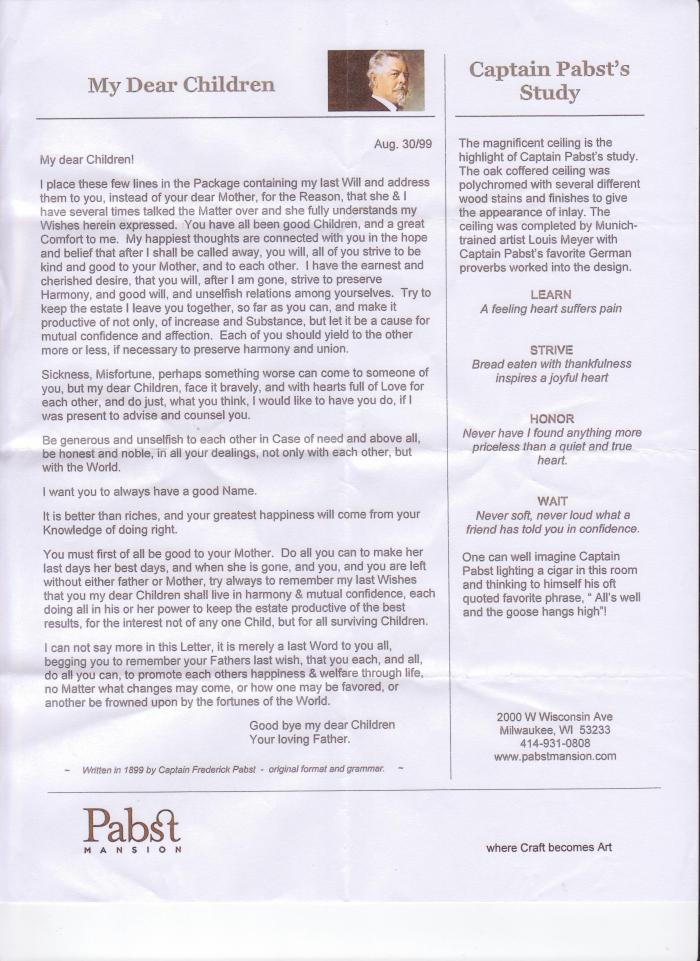
Pabst Letter.jpeg

we prepare to do battle with the Moon

Apparently this large thing in the sky is called a “Supermoon”. I don’t really understand why it has to be Super. Other than that in today’s culture everything has to be epic. For example, I now generally hear on the news several different ways to describe various weather phenomenon or patterns when we used to simply say, “It’s going to be cold tomorrow.”

But hell, I’ll go along with this. It’s a Supermoon. Got it. It’s harmless, right? Wrong. For you see, the Moon is not to be trusted. It has powers. Super powers. Why else would they call it a Supermoon?

This is the closest the Moon has been to Earth since 1948. The thing about astronomy is it has the power to cause you to briefly consider your own forthcoming bleached skeleton state. The Moon won’t be this close again until 2034. Think of all the things you could endure between now and then. Halley’s Comet won’t be back until 2061. Which means just about every person alive on this planet today has (at most) one more shot with Halley’s before their pending commute to Valhalla.

Last night said Supermoon was in the rise phase as I drove home at dusk. It certainly did look bigger. But according to the BBC, this is mostly an optical illusion:

“To observers, it will appear about 7% larger than normal and about 15% brighter – although the human eye is barely able to discern that difference.”

I tend to give us humans a little more credit than that. The Moon doesn’t just look bigger because folks are calling it a Supermoon. I think our brains and eyes can inherently detect that it’s 7% bigger and 15% brighter. We look at the Moon all the time. When it’s that different, our brains will tell us, even if it’s subtly.

I was thinking, that it looked so close and clear last night you could almost reach out there and touch the darn thing. That from my eyes to the Moon’s surface was one clear line, one straight shot. 221,524 miles is a long way, unless you can imagine that it’s not.

The Moon’s always been up there like that while we humans mess around down here. Some Roman Senator or Chinese Imperial bureaucrat pretty much saw the same thing. Some of us have actually been up there. When you really think about it, it’s quite special that a few of us have actually reached out there and touched it. We’ve made that journey. And it really does say something about how little we dream anymore or how much we’ve lowered optimism in our collective psyche that we haven’t been back in five decades.

Where’s our promised Moon colony or Bond villain Moon Base? I mean, technically I guess the Moon Base could have existed without us knowing it. And Bond already blew it up. But I’m betting that didn’t actually happen.

Anyways, either way, I’ll do battle with this Supermoon tonight. I’ll arm myself with a decent coat, a beer, and my camera. My dogs will wield a knife, handgun, or belly full of kibble, whichever they prefer. And we’ll get a shot (camera) at taking on this Supermoon. Moonrise is shortly after my return from work. So it’ll play out well.

If I survive, I’ll try and remember to post a picture on this degenerate blog. I might get distracted, because I have to do a ton of work for second job after I get home tonight. But I’ll try and make it happen. But if I don’t make it, make sure to take your revenge on the Supermoon for me. For you see, the Moon is not to be trusted. It has powers. Super powers.

Update: The Moon was obscured by clouds and light rain.  We couldn’t get a shot.  What does this Supermoon have to hide?  We’re on it.  We’re on the case to find out.  We’ll get right on it.  [cracks beer]  [sips]  [stares blankly at bare wall]

we belligerently break down what the hell just happened

1) The outcome: people are pissed

This is a global phenomenon. There is an entire subset of humanity (half the population) in the democratic world who rightly or wrongly feel they’ve been left behind. They’ve got no skin in the game of a modern globalized, multicultural, interconnected world that the politicians, businessmen, and the media have built. Said politicians, etc, have tended to dismiss the concerns of these people as resistant to change on the kind end, and things like racist on the unkind end. Abject dismissal was always going to be a poor way to address the concerns of a substantial portion of society’s citizens. People who genuinely believe their children will have it worse off than they’ve had it don’t appreciate being called backward. The establishment (the other half of the population) have taken it for granted that the newfangled world they’ve built was always the right answer. And so it’s been a only natural that everybody should get aboard and reap the benefits. The problem is that the benefits haven’t trickled down to everybody. Not enough effort was expended to aid workers who lost their future to globalization. Too many elites spend more time worrying about corporate tax policy or transgender bathrooms than a opioid addiction that’s literally bleeding whole areas daily. These things matter. In any democracy, when half the electorate feels that both political parties are essentially ignoring their core interests, don’t be surprised when they get pissed and back fringe lunatics. This happened with Brexit, it happened with Trump, it might happen soon with Marine Le Pen. It will continue to happen until those that govern make it a point to work for all citizens, not just the narrowly defined slice of the country that happens to be inside the system.

2) Hillary was Donald’s Hillary

The prevailing wisdom of this campaign was that Trump was the perfect candidate for Clinton. She’d sail to victory because he was such a lunatic. I tend to think it was rather the other way around. Clinton was the perfect candidate for Trump to battle against. Where Trump was the anti-establishment guy, you could not have conjured a more inside the system player than Clinton. Where Donald could connect with voters in his own crazy way, Clinton probably couldn’t even properly connect with her own campaign staff. Everybody got aboard the fact that Clinton was going to make history as the first woman president. She even planned her coronation beneath a glass ceiling building. The problem with this line of thinking is that nobody bought it outside the bubble of politics. To the average voter, Clinton was always going to be there just because she was the other Clinton’s wife. The real glass ceiling of this election was that a lot of folks wanted somebody to break the glass on establishment dynasties, be it Bush or Clinton. In an election where well over half the country thinks things are going in the wrong direction, what people were definitely not looking for is more dynasty. They were not looking for a person who’s been in politics for forty years. Imagine if you will, how different this would have all played out had Sanders, Warren, or even poor Jim Webb been on the ticket. Any one of these people would have likely beat Trump. Anybody could have beat Trump. But not Clinton, she was the keen match he needed.

3) The division

After all of this, after all this mess, the answer is 60 million Americans pulled one lever, 60 million Americans pulled another lever, and 6 million Americans (like yours truly) threw their vote away. Statistically speaking, you could not imagine a more divided electorate. This is a rather troubling existence for the nation. The American system is built to produce divided government. But I wonder if it’s built to handle a consistently divided nation. Each side is talking past the other. Nobody wants to listen anymore. If 60 million folks think the other 60 million folks are not just wrong, but nefarious, we’re in for a death spiral. History tells us that tribal alliances can progressively break down and destroy a culture. And what we have here are truly tribal feelings. As an example, for the very, very limited amount of time I watched live election coverage I was troubled to observe:

a) An analyst on PBS who stated that the election was only playing out the way it was because of the “South” and it’s continuing capture of the broader political forces of America. In other words, if you lived in Ohio and voted for Trump, you didn’t do so because you’re protesting that the elites forgot about you. Instead, you were doing so because you were inherently racist. This is the idea that Trump won because a full 60 million Americans were too stupid to vote for anybody else or are just racist, or sexist, or whatever. Everybody surely remembers Hillary’s “deplorables” comment, right?

b) An analyst on Fox who stated that the election was only playing out the way it was because of “Conservatism” and it’s return to recapture America from the dark forces of liberalism. In other words, if you lived in New York and voted for Clinton, you didn’t do so because you were appalled by Trump or believed in the progressive ideas Clinton stated. Instead, you were do so because you wanted to destroy the old America to remake a new one. This is the idea that a full 60 million Americans wanted Clinton to win so they could detonate the country and remake it at the expense of the other 60 million. Or that 60 million Americans only want to milk the nation of the other 60 million. Everybody surely remembers Mitt’s “47 percent” comment, right?

I don’t know how you resolve the feelings of (a) and (b) without a lot of turmoil. I do worry, friends.

4) The reality

As stated, the American system is built to produce divided government. Whoever you voted for, either Clinton or Trump was going to run against the brick wall of this reality. The American President might be the least powerful Executive in the modern democratic world. It was designed to be this way from the beginning. People who think Trump’s going to rule as some unhinged dictator should not forget that the system is constructed specifically to prevent such a thing from happening. However badly you thought about Clinton or Trump, I assure you, American has previously survived far, far worse than these two idiots. I suspect, either way, that we’ll be sitting here four years from now with much the same situation on our hands. I could be wrong, but if you remember back in 2008, the Democrats were equally in control of all the arms of government power. What came of all that? You could say Obamacare, a few key Supreme Court decisions, etc. But largely, I don’t think most folks would say in the last eight years America has undergone earth shaking radical change. I loosely predict it’ll be the same result by 2020 or 2024.

Whether it’s a good thing or a bad thing, I just don’t see much changing for the average man or woman on the street. Trump voters are going to be rather disappointed to realize that their local mayor has far more power over their lives than Trump. They’ll be disappointed to see they can’t have problems that have taken decades to create wished away by a maniac who shouts loudly. Clinton voters are going to be rather relieved to see that even this guy can’t do the level of damage they feared. The needle will move, but for the most part people’s lives aren’t going to change. The system, the broader waves of our culture, are bigger than this election or Trump or Clinton. Where is our reality headed? As I’ve stated above, I’m worried, I don’t know. But I’ll tell you this, in the broader path of where we are bound, this election is little more than a rounding error. I wish, I wish we’d take a step back and think about the bigger picture. Instead, I fear, we’ll soon be wrapped up talking about small fry nonsense like the intricate details of Executive Order Whatever or Senate Filibuster Verbiage. This is disappointing, but also, rather comforting. One way or the other. Life goes on.

Nautilus Kitty revealed

I’ve been trying to get a shot of this cat for years.  I don’t know exactly how long, but it’s been a long, long time.  Then for whatever reason cat sits down next to the car and decides not to move.  This is after continuously running away from me forever.

No idea why.  Didn’t care.  But rather than snapping this with the phone, which has a megapixel count worthy of the original Nintendo, I pushed my luck and got the camera.  Kitty was still there.  Somehow it worked out.

All Hail Nautilus Kitty.

Nautilus Kitty.JPG

the rarest of foods and the future non-rareness of Star Wars

South of my remote office that works has me travel to is a quaint town that deserves the title of village.  It’s like something out of a time warp where restaurants, antique shops, Andy’s office, a small town non-evil lawyer, town hall, Skip’s Hammer & Nails, and the local fire station all surround an open park that families play in with their children.  I’ve not seen this kind of thing much in all my travels.  I’m not sure this idyllic existence was ever that common to the human race.  It sure seems pretty sweet though.  Everybody in this village is very friendly, if they do still possess a little bit of arrogance.  But hell if I lived like that I’d probably think I was awesome too.

Anyways, one of the restaurants around this park I’d been to before.  I got their tasty Asian themed burger last time.  It was great.  So naturally they no longer offer that.  Instead, the chef seems inclined to go high end.  And so a whole bunch of fancy and/or rare foods were on the menu.  I normally don’t go down the road.  I likes what I likes.  But the menu was short (which is fine) and so I decided to try things I’d not had before.  I cook all the time, but for the most part it’s just basic stuff.  I don’t usually buy or use too many fancy ingredients.  So all of this was new to me, in particular: black truffles, duck eggs, and bone marrow.

The result: I basically shrugged.  People I greatly respect in the food world talk up this bone marrow thing like it’s the nectar from the Sinai.  It was different, it was good, but it wasn’t something I’d have again over say, a good steak.  Maybe this village joint just didn’t do it right?  I’m not sure.  What I do know is that I didn’t understand the hype on any of this.  It was rather unfulfilling.  The night after I went to another town and a place I’d been before and went the burger route.  That worked out well.  I was satisfied.

bone-marrow.jpg

I will say, mine didn’t look like this.  So maybe they did indeed not do it right.

But the thought arrived in my crude brain, is rarity a delight in its own right?  Why yes, I think it is.  Sort of.  Let’s take these few belligerent examples.  To understand where I’m going, pretend for a moment that you’re a pretentious asshole.  As in, imagine you work for Goldman Sachs (offers finger to gilded palace level):

1) You are offered an omelet made of endangered condor eggs

2) You are presented beer brewed with water from The Moon

3) All the forces of science were used to cheat nature by recreating the dodo, just so they could kill it and you could eat it

dodo bird food.jpg

Coming soon to a plate near you.  Seriously, in your lifetime, somebody will attempt to do this.

We don’t have to necessarily go down this weird road though.  How about:

a) You drink a microbrewery’s beer.  It’s fairly decent, but nothing exceptional.  But you come back a month later and they’re out of business.  You will never be able to drink that beer again.  Was it that more special?

b) In your travels you experiment with a dish that cooks pork in a unique way you’ve never seen before or will again.  It’s nothing crazy, it’s just freaking pork, but it’s different, it’s good.  Will you miss this rareness a decade down the road?

To me, rareness or uniqueness is more along the lines of (a) and (b).  This kind of thing appeals to me.  (1) through (3) or bone marrow, eh, not really.  Not sure what that says about me, but that’s my take.

So then, the thought also crosses my feeble mind of what occurs when rareness disappears.  Even if you think bone marrow is liquid life, what happens to you if you have it every single darn week?  I suspect it loses the edge.

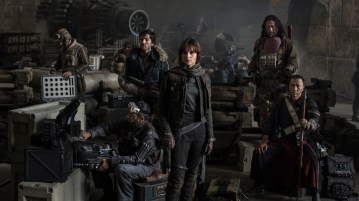
Everybody is once again on the cliff’s edge about Star Wars.  Yesterday, I saw a guy driving a Nissan Rogue where he had stenciled in cursive handwriting the word “One” after the Rogue lettering.  This means he’s even more of a loser than I.  A brief aside, how has Nissan gotten away without the evil corporate stigma that VW has?  Nissan has openly admitted to cheating fuel standards recently too, but nobody cares?  Whereas VW is the devil?  Eh, maybe folks just love to hate the Krauts?

Anyways, soon Stormtroopers and Darth Vader will be everywhere again.  You’ll stroll out toward your car in the dark of the morning and Boba Fett’s going to be standing by your mailbox smoking a cigarette.  And you’ll just shrug and start your engine because you expect it.  Here’s the thing though, I think it’s going to die down.

star wars admirals.jpg

These two dudes are going to show up to cut your grass.  You’ll shrug and give them the check.

Star Wars 1977 to 1983 was special.  Then George destroyed it.  So when Force Awakens appeared folks were just begging for some kind of victory.  They mostly got it, the world stopped for it.  Now everybody is looking for the ride to continue with Rogue One.  But, what happens when that rareness disappears?  Disney has 17 Star Wars films in development as we speak.  I suspect that rarity’s going to disappear.  You can only swallow so much bone marrow or Star Wars before you can only shrug.  It’s human.  In the best of our nature, we love to try things that are different.  We seek the adventure.  Things we eat or watch repeatedly can become less special, less unique.

Or maybe I’m just an idiot.  Maybe I’m wrong.  For example, I do love those burgers.  You can make a burger exactly 2,748 different ways.  I’ve only tried 73 of them.  I want to try the rest.  So maybe, just maybe Star Wars has 135 films left in it before everybody stops caring.  I assure you, Disney has it in them.  So we’ll find out, one way or the other, whether I’m right.

red shirts.jpg

Most if not all of these Red Shirts are going to die.  They told us so in the original movies.

Sicario – the film that hits you repeatedly with a plastic bat

You hear a movie’s great. Then you see it and didn’t like it. What does that say? Well, a couple of options are in play:

1) Everybody else is right, the movie’s great

2) You’re too stupid to completely understand the movie

3) Aliens and/or alcohol drugged you so much you couldn’t follow the movie properly

4) Everybody else is wrong, the movie’s complete garbage

At any given point, all or one of the above apply to my movie viewing experiences. But for Sicario, I’m going with option (4).

Sicario.jpg

Blunt, Brolin, and del Toro view the film creator’s designs for the most pristine of plastic bats.

Everybody loves this movie. It’s some kind of award winning masterpiece. And I’ll admit, it has some top notch features. It’s well shot, has a beautifully dark score, contains mostly interesting scenes, and has swell acting. I think this is why folks think the movie is awesome. On the surface it’s well done. But when you peel back the onion everything underneath is just wrong. It’s like those onions that bring the fruit flies into your humble abode.

If I could name one key gripe with this flick, it’s the unjustified suspension of reality. Not all movies need to be knife edged real. Movies are all about escapism. They take you somewhere special, or they bend the truth to make a point, or explore possibilities that otherwise wouldn’t exist. But Sicario makes it clear almost immediately that it has a larger purpose. It’s a running commentary on the war of drugs, American policy, morals, etc, etc. About 1/3 of the way through the movie I said to mine doggies, “This flick is Syriana II”. And so it is. And Syriana sucks too.

In order for you to buy the film’s message that our reality is wrong, you’d think the movie would have to be grounded in some kind of its own reality, right? Otherwise the message would get clouded by lunacy? Nope.

Kindly observe this limited list so that you can understand why I think this movie hits you repeatedly with a plastic bat and asks you to not think. They just want you to admire the beauty of the film, swallow the message, and not think too much.

1) In the first five minutes we’re asked to accept that one can store 40 corpses in a suburban Arizona home if only you hide them behind drywall. There’s even three guys just hanging out in there like it’s nothing. Eh, I’m pretty sure drywall aside, that this home would smell like five blocks away. But it’s dramatic, so they put it in there.

2) Juarez is depicted as a vacation spot worse than Mosul. Blunt looks on from a nighttime El Paso roof to see the Juarez skyline alight with explosions and machine gun tracer fire. Eh, I looked at that skyline almost every night I was in El Paso for years. I never saw any of that nonsense. In the years I was out there, I never heard one gunshot. Contrast that with my fairly standard east coast suburban hovel where I’ve heard at least a dozen gunshots over the years. Granted, most of those shots are jackasses shooting trees in the small woods adjacent to my back yard, but the comparison remains valid.

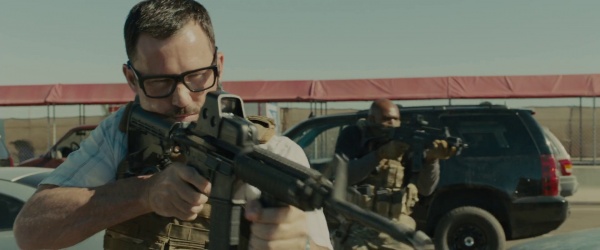
3) Blunt, del Toro, and Brolin alongside a dozen stereotypical American commandos (scruffy beards included) erase eight cartel gunmen and one corrupt Mexican cop on the Bridge of the Americas in front of several hundred people. We the audience are then treated to a throwaway line via the team radio about how this incident is so common it won’t even be news in El Paso. Oh, how cynical! This movie is so darkly intriguing. Give those geniuses an award. Eh, I’m pretty sure if nine men die on the Bridge of the Americas that the whole planet would know in about four minutes.

bridge-of-the-americas

Gee, I wonder what occupation these bearded gentlemen must have?

4) We find that the CIA’s plan to assassinate a cartel boss apparently can only entail the use of a former Medellin killer who can infiltrate the bad guy’s compound to exact his revenge. Eh, this would come as comical news to the Mexican Marines who have killed or captured dozens of cartel bosses over the last decade in deadly raids. At great cost to themselves and their families.

Mexican Marines.jpg

Mexican Marines (not depicted in Sicario), escorting El Chapo to his second opportunity to die in prison.  No matter what you do in life, you will never be as awesome as these men.

5) Ultimately, Brolin admits to Blunt in a plot twist that’s quite humorous that the CIA’s grand strategy to defeat the Mexican cartels is to help the Medellin and/or Columbian cartels regain turf because they provided more stability. Truly! In order to swallow this completely bullshit notion, you will need have never heard of the following concepts:

a) The evisceration of the Medellin cartel and the overall recovery of Medellin as a decent city

b) The capture of the Columbian drug trade by the FARC and the Columbian war against said entity

c) The belief that the Columbian cartels of the 1980’s and 1990’s were somehow not the agents of chaos and destruction that they really were

d) The very idea that an American whole-of-government operation can conduct any such secret evil plan without it ending up on the front page of the Washington Post

e) That the CIA will threaten to and/or actually suicide people who state that they’ll tell folks about this evil government conspiracy

Hey I’ve got news for all you conspiracy lunatics: Everybody talks. America is not Soviet or Putin Russia. Everybody talks. As one of my references, I draw your attention to the ultra-secret CIA run black site program conducted after 2001. This was as deep a conspiracy as you can get. Yet here we are about a decade later and you can read online and determine just about every aspect of the operation, right down to the price the CIA paid for the freaking Polish buildings.

Again, I wouldn’t bring up this absence of reality, except that Sicario takes itself so damn seriously. You’re meant to feel their message. The plastic bat is at work. You will be made to agree with this nonsense. Well, I will not. This movie is only mildly entertaining, but is overall, just not very good. My Guests and I would not recommend.

del Toro.gif

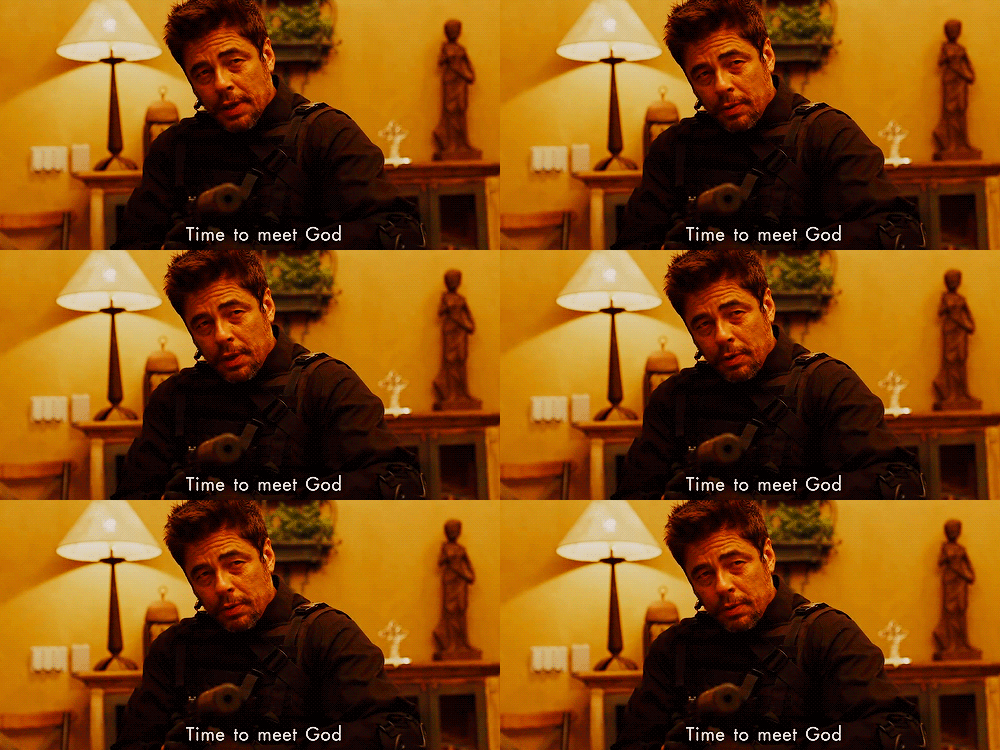
Sorry, God’s too busy to meet your shitty movie.

make sure you remember to unplug

I tend to be among the last to hear about trends.  In high school or at work I’m pretty much the last one to hear or realize that two people happen to be dating.  I guess part of the issue is I typically just don’t care.  I’m kind of set in my rhythms, as shall become apparent once again as I lay out this stuff here today.

Only in the last week or so have I become aware that this Amazon Echo trend thing exists.  For the uninitiated, the Echo is a new piece of technology that can respond to your voice, like that Siri lady does.  Only it’s not a phone, but a weird black cylinder that you can either put on your kitchen table, take into the shower with you, or snuggle under the covers with.

By giving the Echo voice commands, you can get it to play music, tell you the weather, call a cab, order explosives from a Belarusian junk dealer, check local traffic, compile a list of your favorite mustards, buy stuff from Amazon, construct an enemies list, and so on.  Much to my surprise (and apparently that of business insiders as well) the Echo has sold quite well.

amazon-echo.jpg

Oh no.

I don’t understand why this is a thing.  Why can’t people take out their mini-computer smartphones and check the weather using that instead?  Or why can’t folks just look out the window?  Is there really a benefit to one’s life by saving six seconds to audibly ask a machine what the weather is instead of doing it ourselves?

The Echo is also supposed to interface with other smart devices in your home.  So you can play music via other speakers, or have the Echo talk to your smart thermostat.  That way, instead of walking up to your thermostat to change the setting, you can just have the Echo do it for you thus saving you the nine seconds it would take you to get up off the couch to walk over to your thermostat to do it yourself.

Oh man, this Orwell cat had no idea when he wrote 1984, dude was totally clueless.  In his world, Echo would be used by the Giant Eye to enslave humanity.  In Amazon’s world, the Echo is a means to separate money from your wallet.  Here is how the brave new world is supposed to play out in the globe of Amazon:

1) Your smart refrigerator has sensors to determine what’s inside.  The fridge detects you’re running short on mustard.

2) The fridge tells the Echo that you are short of mustard.

3) Based upon your personal settings, the Echo either automatically buys more mustard or audibly asks you if you’d like more mustard.

4) Amazon sends you mustard and charges you for the trouble.

5) Amazon delivers mustard (and whatever else) to your doorstep via drone.

And thus, the end state is that you would always have mustard in your fridge.  All without ever thinking about it.  Without ever having to take any action yourself.  To some folks, I suppose this sounds liberating.  To me, this is quite weird.  From my perspective, I can just open up the fridge before I go shopping and realize I need more mustard.  Then I write that on a list and go get it.  It’s pretty straightforward.  Yeah, it does take some time, and going to the store can be a pain in the ass, but that’s called life.

I’m not entirely sure how humanity benefits from all this.  It’s not like people who are liberated from ever having to think about buying mustard again are going to use that extra time to solve groundbreaking math equations.  Folks would probably just use it to binge Netflix more or Snapchat friends.  I’d probably just play more video games.

In short, I don’t think the human race needs a tool like the Echo.  But Amazon is more than happy to provide it as extra credit to your life, for a price.  It’s the very definition of excess.  You don’t need this.  But you will buy it.  Please don’t resist.  Amazon thanks you for your cooperation.

palpy and vader.jpg

Palpy:  “For you see, Lord Vader, I’ve determined that the replacement Death Star is obsolete.  Instead, we’ll place Echoes into every home within the Empire.  Once the masses can get mustard without even thinking, our circle will be complete.  Our rule unchallenged.”  [cackles]  Vader:  “Yes, my Master.”

Then there are the privacy concerns that come with hooking up your fridge and Echo voice box to the Internets.  I’ve hit the dangers of this concept on this degenerate blog many times.  But I’ll go there again, thank you.  For example, just take a gander at the Wikipedia verbiage on the Echo.

Even though some of this text is clearly ghost written by somebody in the employ of Amazon, it’s still rather stark at what the Echo does:

a) “…can identify who is present in the home and who is not…”

b) “…though the device is technically capable of streaming voice recordings at all times, and in fact will always be listening to detect if a user has uttered the word…”

c) “…Amazon retains digital recordings of users audio spoken after the ‘wake up word,’…”

In other words, the Echo is a listening device that is always on, never turns off, and stores certain parts of what it hears in the Amazon Cloud, aka Amazon Web Services.

And since our Internets is always vulnerable, somebody can hack these things too.  Although I’m sure Amazon has tried rather hard to prevent that.  But whether folks are risking hackers, or happy to turn over things they say in their own home to the Amazon servers?  Either way, I guess I’m just surprised that millions of folks are perfectly comfortable putting a live listening device in their own home.  Just to make their lives a tad bit easier.

I guess I’ll make two closing points.  Both along the lines that we should all make sure to remember and unplug.

– Even if you go down this Echo, automated, smart route, please remember to unplug and do things the old way.  Just to keep life exciting and maintain an active brain.  For example, just for the hell of it, instead of using your smartphone to guide you on your next car trip to an unknown location, use your own brain.  Look at a map (an online one is fine) and write out your own route using a pen and paper.  Then use said pen and paper while you’re in the car to drive yourself there.  For those who can’t remember pen and paper, here’s what my own pen and paper look like:

quill-ink-pot-and-poetry-book.jpg

Or even if you use Echo to get mustard from now own, every once and a while just go buy it yourself.

– Make sure you unplug your wireless router at home when you’re not using online devices.  I do mean actually unplug it from the wall.  So when you’re cooking, reading, walking your dog, at work, asleep, etc, etc, physically go and unplug your router from the wall.  This saves power and makes it virtually impossible for any part of your life to be hacked.  You can afford to spend some time unplugged.  You’ll live, trust me.  And your brain and body will thank you for it.

Busan – hiking and the monk’s car

Some of the best days are the ones where you wake up and have absolutely no idea what you’re doing.  I’ve gone through these phases.  I used to plan nothing for trips, then I planned everything, and now I’m back to planning almost nothing.  Busan was the early days.  It was Korea, that was enough for me.  So we scheduled nothing in advance.

We wake up one day and the rest of the group doesn’t want to do much of anything.  Probably because they were hungover.  I’m sure I was too, but I was young then and didn’t need to lay around suffering.  So Tim and I decide we’re just going to leave everyone and go, somewhere.  I think we just picked some random temple off a map in the suburbs north of downtown Busan.  It was December, but not a completely freezing typical Korean winter just yet.  So we bundle up and roll out.

We had to take the train and then the bus to get there.  Neither of us spoke anything above bare bones Korean.  We quickly got lost and are just standing there on some random suburban street corner trying to figure out what bus to get on.  Then this middle aged woman walks up and in halting English asks us where we want to go.  We show her the temple on the map and she agrees to help us.

But she refused to give us directions.  Instead, in one of the most generous things I’ve ever seen in my life she decides to ride the buses and escort us to this temple.  Then she says she knows a good place for lunch next door to the temple.  So she walks us there and explains to the owner in staccato Korean probably how these two American idiots didn’t know what they were doing.

The two women essentially shrug and our kind escort wishes us luck and carried on with her day.  We couldn’t thank her enough but she treated it all very matter of fact, smiled, and was gone.  The lunch was incredible.  In the Korean style we each had the ten or so little bowls of various meats, vegetables, and sauces.  It’s probably in my lifetime top ten of meals.

shrine

I think this is the temple, I’m not so sure.  The shot is logged wrong by how my memory remembers this trip.  So who knows.  But I’m pretty sure this was it.

We walked around the temple for a bit and then Tim being the far more adventurous of the us simply states we should stroll up the nearby mountain.  So we point ourselves toward the hill and just start walking.  As we got higher we realized we’d stumbled upon a routed hiking trail and so we continued to follow it on up the mountain and across the peaks.

It’s hard to describe how mountainous a good chunk of Korea is.  Cities are perched precariously along the coast with ribbons of suburbs rolling out in the valleys.  The inclines of the hills are quite steep and it’s rather sobering to think that when Busan was the last holdout against the Communist siege in 1950 that these mountains held hundreds-of-thousands of young men who would decide the fate of Korea.

Looking Back.jpgLooking back toward Busan from the hills.

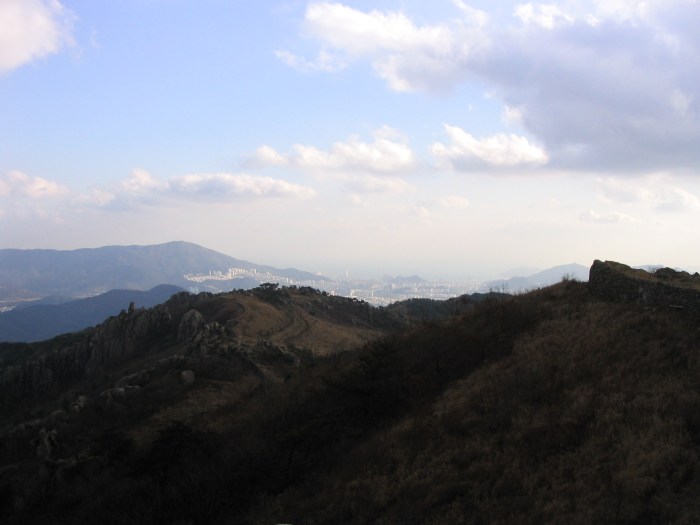
valley

Ribbons of suburbs and the Nakdong River.

back-downhill

We walked for miles and miles, probably at least over ten miles.  It’s a blast, the weather cooperates, the trails are dotted with other friendly hikers, and oh, ah, it’s getting into the late afternoon.  We’re in trouble.  There’s no way we can go back the way we came in time.  We have no desire to hike back on the trail in the dark lest we fall off the darn mountain.  Fortunately we happened upon a temple nestled up there that’s near the trail.  We figure if nothing else we can call a cab from there to take us back downtown.

Temple From Above.jpg

Temple Gate.jpg

I walk around a while admiring the temple while Tim somehow strikes up a conversation with a monk who speaks immaculate English.  Decked in pristine Buddhist orange and thick glasses he says there’s no need to call a cab because he’s driving downtown anyways and he’s glad to give us a ride.  He asks us to wait for a bit while he gets ready and he’ll go get the car.

I’m raised in the Catholic Church, and so I have this idea of poor Trappist monks on a farm like my Dad used to visit.  I expect this to be a hair raising ride through twisting mountain roads in a Yugoslavian knockoff beater.  Instead, the monk rolls up in a pristine black BMW that easily cost north of $50K.  Tim and I were just cracking up.

It was nearly dark as we set off for downtown.  Tim sat up front with the monk while I dozed in the back.  Tim and him chatted away about everything.  I wish I remembered more of their conversation but I was exhausted.  I do recall the monk was headed downtown to party with his friends.  I never did catch the reasoning for the dichotomy between the wealth, partying, and religious lifestyle of the monk.  In retrospect I just find it hilarious.

Back downtown, we managed to link up with our friends again.  I don’t remember the rest, probably for valid reasons.  But I do remember the hills well, and that monk and his crazy car.  It was quite the day not worth planning.

temple