controlled dreams

I remember few concrete things from the wacky Jetsons cartoon.  But certain things remain sharp.  They had robot football, this angered me.  They also had a machine that could control dreams.  You got to dream about whatever you wanted.  How cool would that be?

I find the older I get the more garbage my dreams are.  It’s a mess of bad nonsense.  I can barely remember a thing.  I think a pet dinosaur stole my television.  Whatever.

But Japan is there quite often in a way nowhere else is.  I have no idea why.  I haven’t been to Japan in ten years.  Money and time keep getting in my way.

I think it’s because I lived there.  I suppose I equally dream about places I lived growing up and just think nothing of it.  Japan’s different because it’s the outlier.

I’m usually like scaling mountains, or somewhere near the water, and always roto-sushi.  I’m always wandering around crowded streets trying to find a place to eat roto-sushi.  If I was a billionaire I’d first open my own brewery.  Then I’d open my own roto-sushi place so I could visit it forever.

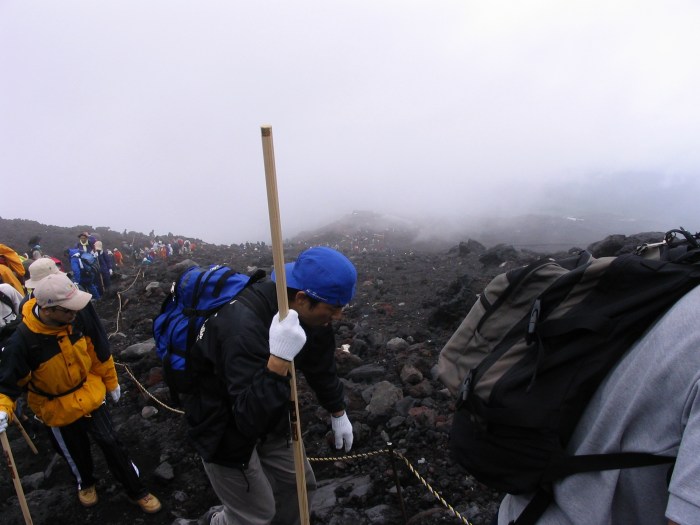
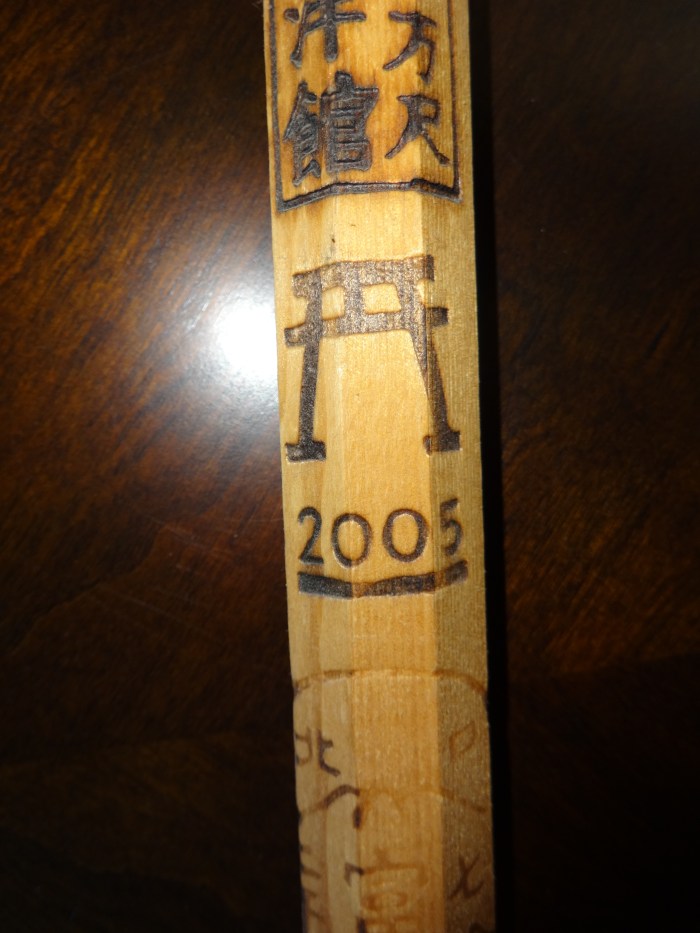
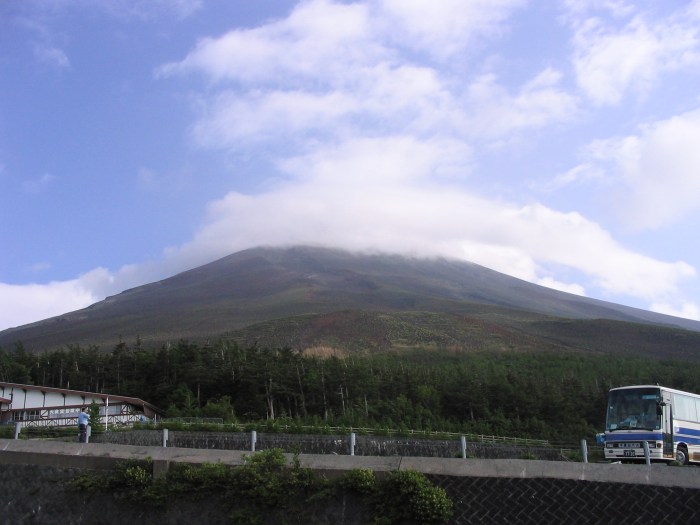
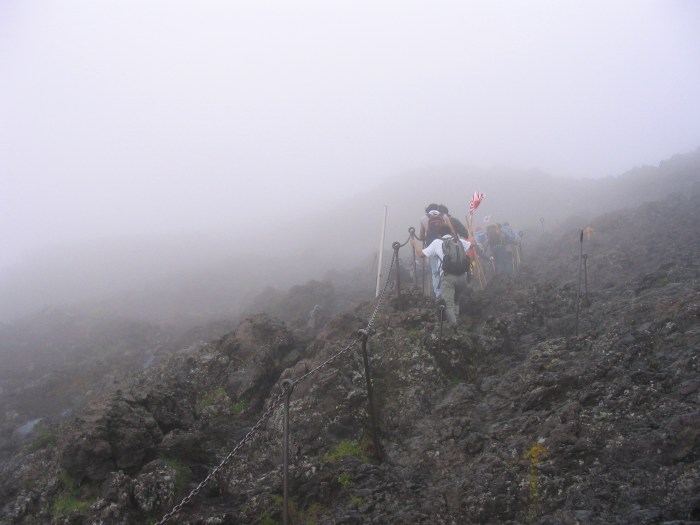
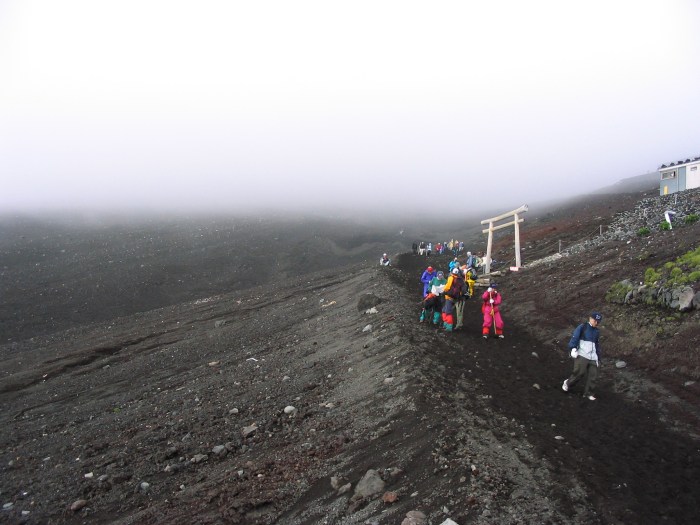
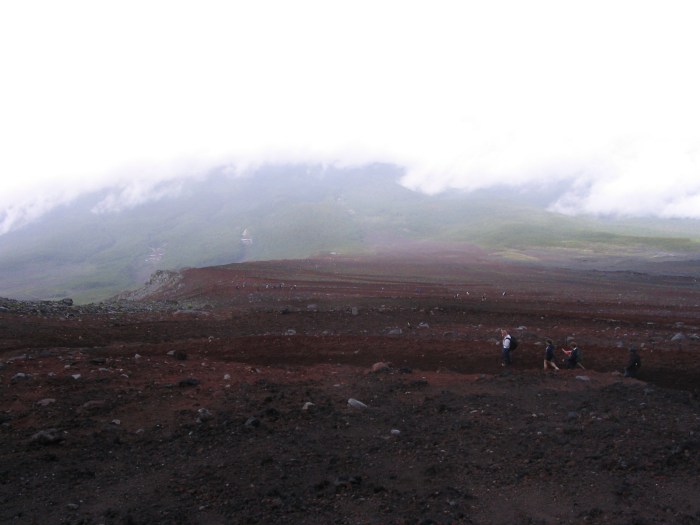
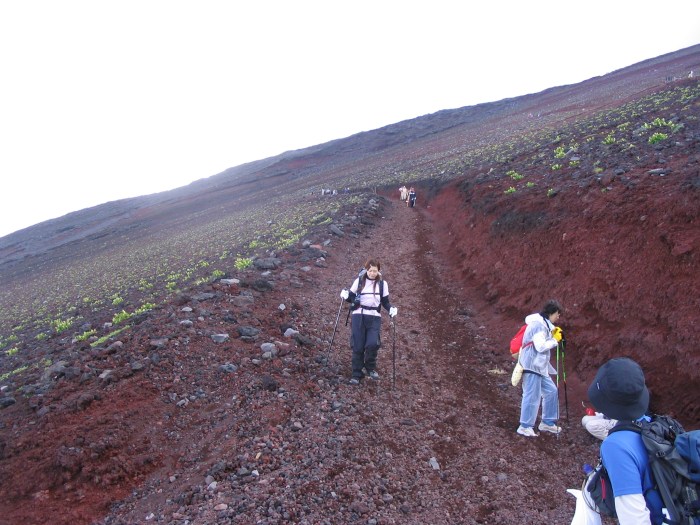
I don’t know what all this means.  Don’t really care.  So whatever, here’s a shot of Fugi in the fog I took back then.  This seems dream-like.  Win.

Looking Up.jpg

Turkey – Ephesus

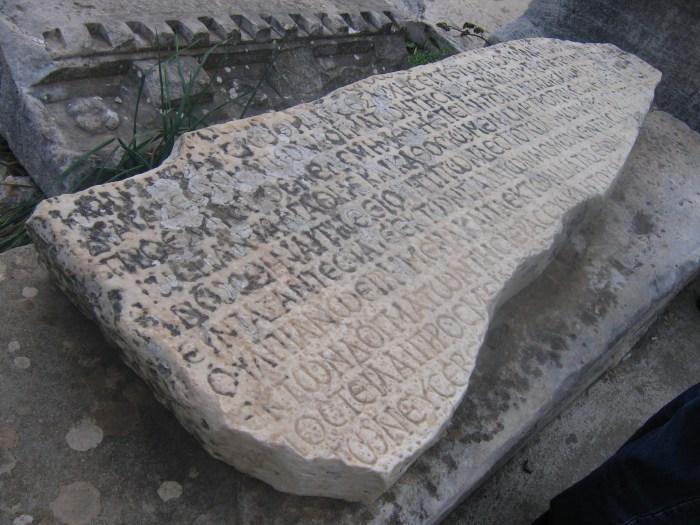
In 262 AD, having already raided large portions of Asia Minor, a Goth force descended upon Ephesus. Outnumbered (and by this point probably also outclassed) the Roman military was unable to offer any substantial opposition. The Goths sacked Ephesus and burned the Temple of Artemis to the ground. One of the Seven Wonders of the World ceased to exist alongside many other major structures within the city. It’s likely that a substantial portion of the population was killed, scattered, or enslaved. Ephesus never recovered.

It is as if aliens descended upon Europe tomorrow and sailed up the Thames or Seine to gut Paris or London alongside millions of people and all their major landmarks. Only in Aleppo could you find a rough template today to compare this to. Except that with Ephesus it was a factor of time. It has taken five years to lay waste to Aleppo, it’s people, and its historical landmarks. It probably only took a few days to burn Ephesus. All that’s left now is broken stone, rubble, and a ghost of what was once one of the major cities on Earth.

Trees grow on bare grass that was the ground floor of some rich trader’s mansion. The fallen columns of one of the greatest architectural masterpieces ever made were ground down for plaster to make lesser buildings. The written knowledge and cultural history of one of the great cities of history is so completely destroyed, so burned, so reduced to waste that it’s actually disputed which year (not which day or month) Ephesus was attacked by the Goths.

ephesus

When you go back and look at places such as Ephesus I’m inclined to divide the history of the human race into two geographic categories. You either live in a town, city, or country that has been a doormat of history or you do not. Those that caught the doormat category, even to this day, have to overcome the problems that trace their roots back thousands of years.

Despite turmoil, wars, and bombing raids, London was completely destroyed only once in 60 AD by Boudica during her revolt. Paris has never been razed to the ground. Depending on how you count, Ephesus was demolished at least seven times over thousands of years. It’s hard to build a long standing, secure culture, language, commerce, and politics when somebody shows up once every few hundred years and devastates it all. I think this goes a long way to explain why Britain and France are relatively stable democracies while Turkey’s still attempting to discover its identity.

London had the Celts, Romans, Saxons, a few Vikings, even fewer Normans, all eventually melded into English. Ephesus by contrast had to deal with this journey through history:

Arzawans

Hittites

Mycenaean / Ionians

Cimmerians

Greeks

Persians

Macedonians / Seleucids

Romans

Byzantines

Arabs

Seljuk

Ottomans

Turkish

Good luck trying to wrap your brains around how all that is supposed to create a stable safe place to live for multiple generations. Sometimes a sustained melding of cultures can create a truly special blend of humanity that enriches a people. Think of the unique joining of Moorish and Christian that Spain traces its roots. But other times there is no blending, there’s just history’s great eraser that does away with the old, and sometimes never replaces it with the new.

Kemal Atatürk’s vision was that history would be undone, his country remade. He wanted to wipe away the chaos described above. Turkey would be reborn into something new. Whereas religion was the one great binding principle, Turkey would become an ultra-secular state. The Turks would even get a brand new alphabet. What people could and would wear would be dictated. Those who lived in Turkey would become singularly Turkish, one way or the other. The Kurds were oppressed and the Armenians simply liquidated.

In retrospect, it seems clear that this was never going to work. It relied entirely on the personality of one man, and the ability of those with guns to enforce it. Whenever things got out of hand the army would simply step in to preserve Ataturk’s legacy. Turkey suffered more coups than most African states. If the planet’s last hundred years or so have shown anything, it’s that you cannot build long term prosperity in a country where the chief method of civil institution is violence. Eventually things come off the rails. But in the interim, folks can generally muddle through.

So in this sense, Recep Tayyip Erdoğan’s rule is actually the direct successor to Atatürk’s legacy. In that he’s running the show simply because he controls the most guns. The recent coup, while dramatic and bloody, never had widespread military support. Erdoğan controls the army, so he controls Turkey.

Modern democracy and prosperity require many civil institutions that were built up over centuries such as freedom of speech, rule of law, freedom of the press, and so on. How exactly would these have emerged in Ephesus when every once and a while every civil institution was doused in flames?

I’ll roughly wrap up this line of thinking, because I want to talk about Ephesus’s golden age, by saying I’m not optimistic about Turkey’s immediate future.

In the short term it’s the Erdoğan Show. This week he submitted to parliament constitutional amendments to give him unchecked executive level powers. He will get them. He will get them because he wants to be Sultan and Atatürk II. He will get them because he controls the guns. And the guns control the voting, education, media, and just about every other aspect of Turkish civil society. The Erdoğan Show will continue until he dies. After that, what?

It just depends. Sometimes a country can right itself after incompetent one man rule departs. But even if everybody realizes the nightmare was indeed a nightmare, it’s hard to fix things. Just look at what Venezuela, another broken democracy, is going through even though Hugo Chávez is long since dead. Even if Turkey’s ultimate future is bright, I think Erdoğan will ultimately set back progress by fifty years. What comes after that, is up to Turkey’s people.

ephesus-2

The ruins of Ephesus are at the foot of Selçuk, the modern Turkish town. In ancient times Ephesus was on the Aegean Sea. But over the centuries the Cayster River silted up and now the entire area is several miles inland. If one takes a more nuanced view of history than I describe above, you can simply make the argument that Ephesus died out once it lost access to the Aegean and was no longer able to serve as a major port.

A good first stop is the ruins of the Temple of Artemis which are a few hundred meters from Selcuk. What little is left is among the oldest of the places available for visitation. The temple underwent three phases. The Bronze Age shrine might be among the oldest on the planet. This original temple was lost to floods in the 7th Century BC and was replaced by the more recognizable Greek columned temple around 550 BC. In 356 BC a true fringe lunatic of a man burned it down. Starting in 323 BC it was slowly rebuilt to the final recognizable structure.

artemis

Ruins of the Temple of Artemis looking northeast with Selçuk in the background. The single freestanding column is rebuilt from various wreckage they found. Imagine the size of the temple by contemplating a structure that fully filled the entirety of the basin in this photo with 127 total columns. Note the Ionic fluting on the fallen column blocks. Also see in the front of the shot the square holes cut into the eroded column blocks. Each column had a wooden centerpiece which they stacked column blocks through as they built up the height, in the case of Artemis, 60 feet high. The blocks were then fitted, sanded down, fluted, and decorated to give the column a single cohesive look meant to last for thousands of years. The problem with ancient Greek temples was they required wooden roof beams to support the marble tiles that typically sat atop. The intricate concrete roof construction one sees in say the Pantheon didn’t exist yet. This left most ancient Greek temples very vulnerable to fire, despite their stone base and columns. This was the cause of many Greek temples losses, as of course with Artemis as well.

ephesus-map

One of the many maps of Ancient Ephesus. To the left you can see the bulge emerging from the west of what was once the harbor inlet from the Cayster River that lead to the Aegean. The Temple of Artemis and Selçuk are off to the northeast. Note the extent of the city walls. Depending on how you count, Ephesus surely had over one-hundred-thousand citizens. Always a major city state during the Hellenic eras, it reached its cultural, economic, and political heights during Roman rule. For reference in subsequent photos, the Library of Celsus is #20. The Great Theater is #25. Harbor Street is #26.

library-of-celsus

The Library of Celsus. A couple of things to keep in mind as you look at this. First, the façade is a complete reconstruction. Second, look back at the map. As impressive as the library is, it’s one of the smallest buildings that once called Ephesus home. Despite the building’s small size, the library was among the largest of the ancient world housing over ten-thousand scrolls. The interior was burned out by the Goth attack, the façade collapsed centuries later. How much more would we know of the ancient world if at least some portion of the library’s content had survived? Completed in 120 AD by a son to honor his father, both of whom where Roman counsels, it’s a structure that mirrored both its Greek and Roman roots.

grand-theater

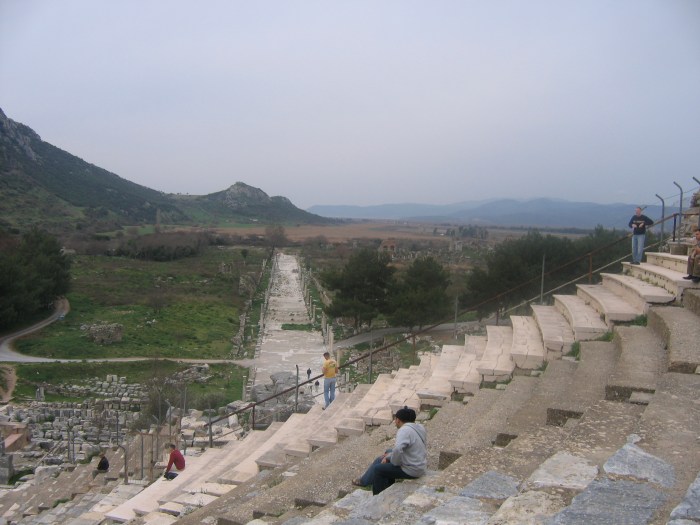
Grand Theater of Ephesus. Likely the largest theater in the ancient world, it could hold a crowd of 25,000 people. Greek theater was probably performed through its history and in the later Roman years people died there for the amusement of their fellow humans. I can’t begin to describe to you, but hope to loosely capture in pictures, just how big this place is. It rivals modern stadiums in its size and scale.

grand-theater-stands

harbor-street-above

From the Grand Theater seats looking west down Harbor Street. This must have been quite the view with all the buildings and the ships back in the day. The inlet to the Aegean and the Harbor Gate would have been at the end of this road.

Theater Stage.jpg

theater-backstage

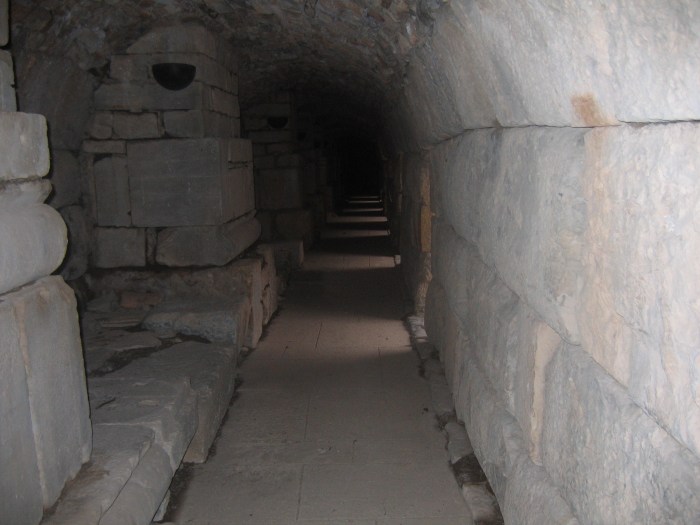
Backstage of the Grand Theater.

Harbor Street.jpg

Harbor Street. Not much is left, and so your brain is left to imagine what it would have looked like. All the way down to the harbor and the ships. The tens-of-thousands of people who walked this street and lived out their lives.

Mosaic.jpg

Turkey – Mount Koressos, House of Mary

When you travel in groups compromises are always necessary. When the group disagrees you can sometimes divide up or sneak off on your own for a while. Other times you just have to deal with it. When you share hotels, cars, buses, trains, and meals with your companions, it’s generally not a good idea to fight all the time. I’ve been on trips where this happens and it truly kills everything.

Being in Turkey I had about five-hundred things I wanted to do, history being at the top of my list. So when we were headed to Ephesus I was fired up. We only had one day there. I could spend six days in Ephesus and not get bored. But then, other members of the group wanted to take most of that one morning and visit the supposed House of Mary which is near Ephesus. I hear this and I’m like, “Oh, uh, …” [checks watch] (I did indeed wear a watch then, which seems strange now.)

I was raised Irish / English / Sicilian Catholic, so you know it’s seriously in my blood. But I was also raised with a light touch of it. My own Grandmother would frequently talk with us about this or that doctrine, Pope, etc, that she disagreed with, alongside her own take on life. It’s a very liberating American take on religion. Nowadays, depending on the barometric pressure outside, I can either truly believe or am an atheist or whatever. A lot of it depends on my mood. So basically I would not consider myself very religious, but I really do try. In this Turkey travel group though were several ultra-hyper religious types. So they wanted to go see the House of Mary and were very set upon it.

Given how much of Ephesus was on my brain I could have protested. I let it go in the name of cohesion. This was the right choice. I figured it would be nice to see the mountains, maybe say a prayer, and generally just enjoy the ride. This was exactly what happened. I don’t regret it.

The full titled House of the Virgin Mary sits atop Mount Koressos which is a few miles from Ephesus. It’s a small house and religious shrine. By which I mean it’s a religious shrine that reminded me a lot of the shrines in Asia, specially Japan. As in, it’s a commercial tourist destination. There’s very little religion about it. In say Japan, sometimes you’ll be walking around temple grounds and there’ll be these people hocking Hello Kitty fascism toys from stalls. I always found this odd, to me a dead quiet church is my pinnacle of prayer. But in many cultures it’s not a big deal to meld commercial and religious ideas on the same site. This is the case with Mount Koressos.

It’s like going to the Mary exhibit at Disneyland. There are several cafes, a wishing wall, tourist buses everywhere, magic water, it’s quite the atmosphere. And this place has quite the crazy tale as well. My first thought was, “There’s no way Mary was there.” I mean, what do I know? But still, it didn’t seem quite likely to me. I get it, Popes have visited this place, but still. Feast your brains upon this tale of discovery:

– Anne Catherine Emmerich, German nun, mystic, and later saint, has a bunch of visions which she imparts to the brains of others.

– Clemens Brentano, author, writes books based upon her visions about Jesus, etc, etc.

– In 1852, Brentano provides a rough description from a vision of a house near Ephesus that John supposedly built for Mary where she lived out her days.

– In 1881, French priest, Indiana Jones copycat, and lunatic Julien Gouyet uses this book’s description to find and identify the house on top of Mount Koressos. Nobody believes him.

– But by 1891 at the urgings of Sister Marie de Mandat-Grancey, folks get onboard with this idea and the house is made a shrine and taken under management. The first Pope shows up within a decade. Half-a-dozen other Popes have also visited.

So is one to believe this tale of visions, translated through a kook author, and a bunch of people wandering around the 19th century Ottoman countryside with a book in their hand? I’d have to say I don’t. I’m pretty sure that whatever Mary was that she died close to her birthplace and is buried out there. But whatever, it’s all good, people can pray anywhere. That’s the cool part about prayer.

And whatever the house is, it is indeed neat to visit. It’s very old and probably a good example of the style and architecture of ancient dwellings in this part of the planet.


Mary House.jpg

Side of the House of the Virgin Mary


When there, I kind of separated myself from the group and puttered around. When you go inside the house it’s a converted chapel, very small. I didn’t take a picture inside as it didn’t seem right. I prayed for a short bit and then was on my way. It was a nice moment, but not what I would call any kind of religious experience.


800px-House_of_Virgin_Mary2.jpg

Not my shot, taken from Wikipedia. Note the very ancient hallowed c-grade velvet rope, two Apostle endorsed codex plastic information placards, and Papal holy water blessed exit sign


Outside there is a wishing / prayer wall that folks can leave notes on. There are thousands of notes. There is also a water source that is said to heal or grant wishes or whatever. I did not drink the water

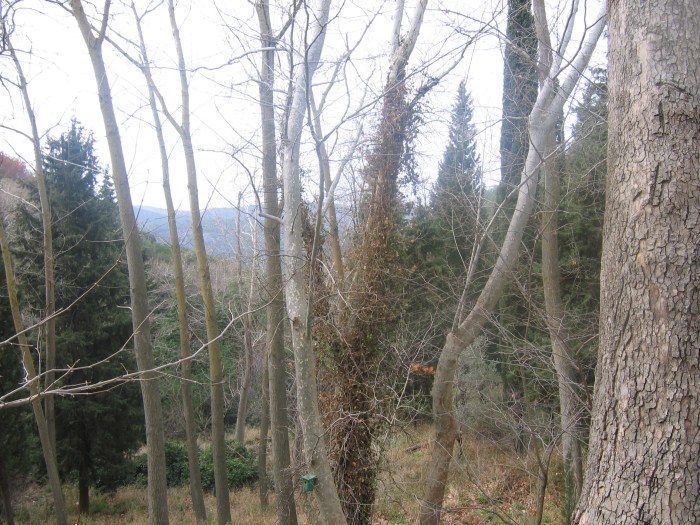
For me, the ground was the better experience. This was my chapel visit.  This was my Mount Koressos:

Forest.jpg

I’ve got dozens of various shots of nothing but the woods from all across the world. Two of my favorites are on my desk, one from American and one from Japan. I’m always struck by the differences and similarities between them. Wherever you are, the woods are always similar enough that you can recognize ideas, feelings, trends that join you to that remote location. In the sense that the woods near your own home and country do much the same. It’s that spark of fellowship and belonging that most closely identifies us as part of one human race and planet. It’s only there for a moment, but it’s a good feeling. Nature, God, whatever, does that to you. Amen.

Turkey – Marmaris harbor

The next three posts are going to be about my trip to Turkey and it’s history.  These will be a little personal for a variety of reasons.  This below shot is of my first day there, specifically Marmaris, which is where we landed.

Marmaris used to be a small fishing village but has essentially turned into the most tourist of tourist destinations.  It’s not a bad place, we had a good time, but it’s among the most aggressive I’ve seen in terms of fleecing the visitors.

For example, one of the best meals I’ve ever had was in Marmaris.  Turkish meats, prawns, the thing where they cook the fish inside a salt shell, Turkish beer, it was awesome.  Unfortunately the owner lied to our faces about his prices and tried to fleece us at the register.  We had to negotiate him down which was tiresome.  Overall, well worth the meal, just silly.

Marmaris has a pretty decent harbor and throughout history it’s been used by Greeks, Persians, Macedonians, Romans, Turks, and so on for both trade and military purposes.  Today’s it’s all tourism though, specifically Russians.

I would imagine that after Turkish pilots shot down the Russian jet and Putin cancelled tourist visas that Marmaris’ economy suffered immensely.  With Putin and Erdogan’s dictator’s détente, I figure they’re looking forward to a profitable upcoming tourist season.

marmaris-005

Sunset over Marmaris harbor


why does your luggage need to do your laundry?

I remain an outlier on many things, mostly because of my deranged nature. For luggage, ditto. On all my flights I figure 95% of fellow travelers are wielding the soft-side-roller-bags. I’ve still got me the 47 year old soft-duffel-bag. My prior-existence-ghost bought it for me from the Sears catalogue in 1969 and shipped it to my future self, Back to the Future style. It showed up on my doorstep one day about a decade ago with a short note saying, “Here you go,” written in blood red marker (at least I hope it was marker). The note also included various unwarranted written expletives and a big frowny face.

This bag is an awful shade of dark green, and as of about six months ago has a growing hole in the side of it. When the hole gets so big a pair of socks could ferociously escape my plan is to replace it. This bag has been kind to me. When that dark day comes, I’ll dispose of it in some kind of fitting ancient ritual involving fire, beer, and a worthy accelerant. That way, the bag’s spirit can live forever in Valhalla where a drunk thug will use it to hold his clubs and mead.

For its replacement, I won’t go with the roller bag though. I’ll still go get a fully soft-duffel-bag. Why?

1) I hate the way a roller bag constricts tight packing. The one roller bag I used for one or two trips could fit a pair of shoes, an outfit or two, and a toothpaste tube. That was it. By contrast, I can viciously cram 127 pounds of non-refined-coal into my soft bag if I so chose.

2) Poor maneuvering quality of roller bags. You could not imagine a more ridiculous design for moving forty pounds of cubic mass around a crowded airport. It’s easier to steer a canoe without an oar then turn a roller bag in traffic. I think the gross turning radius for your average rolling bag technically carries you directly through the nearby airport window and onto the tarmac. And the big baggage guy would just be standing there over your crippled frame, frowning, shaking his head, with his arms crossed.

3) Laziness. As best as I can figure, the primary advantage to using a roller bag is you can carry a lot of weight without having to hoist it upon your shoulders. In other unrelated news, 37% of American adults are chronically obese. I’ve never understood the acceptance to lose mobility, just so you can avoid throwing forty pounds on your back. Especially because people do this all the time. For example:

a) Hoist your five year old upon your shoulders through the airport.

b) Carry a bag of mulch from your car to the backyard, repeat twelve times.

c) Swipe a big bag of cat food from the till, running fast so you can get out the door before they notice your heinous crime.

d) Carry your laundry up and down the stairs, up and down the stairs, with a sock attrition rate of 17%.

e) When you were a little kid, you carried the equivalent ratio weight of forty pounds of books on your shoulders given your size at the time compared to today.

But now, all of a sudden we are incapable as a human race of carrying forty pounds for a 1/2 mile through the airport? Our future alien Overlords find this an appealing trait.

4) Carryon luggage. I’m just going to go ahead and say this (it’s okay if most of you or nearly all of you disagree), if I met the guy who invented the concept of overhead compartments, I’d punch him in the stomach repeatedly until I was physically restrained by a pack of elves. In order that the traveler may avoid an average of 11 minutes wait time upon arrival to said airport baggage claim area, the rest of us have to endure:

a) 17 extra minutes to departure time as people cram their trash into the overhead.

b) 23 extra minutes upon arrival time as people slowly and methodically retrieve their bags from the overhead.

c) Dummies trying to shove their bags into areas where a two year old would say, “won’t fit Daddi,” but they become aghast and angry at everyone when they keep trying to fit it, and it still doesn’t work.

d) Ultra-dummies who actually fight over bin space as if it were meat in a caveman world.

The only time I’ve used the overhead was when I did a whole four day trip using nothing but a small soft backpack. I had that thing so bulging there was nowhere else for it go. Otherwise, I have my small bag which goes underneath the seat, and the duffel gets checked. That’s it. Total inconvenience time towards fellow humans = less than zero.

I suppose you could make the argument that the airlines force folks’ hands due to the checked bag fee, and I kind of get that. But, I contend the overhead bin thing is not necessarily a checked bag fee fault. I mostly fly Southwest, which charges no fee, and yet I still see the same overhead bin insanity described above.

But hold on there, there’s more! Oh my, don’t you wish this post was over! Oh please, do kindly end this.

I have recently noticed, and this Post article confirms, the growing trend of hard-sided-roller-bags.

This is (apparently) to ensure the bags can take damage, you can stake your belligerent overhead bin claim like an Overlord, and a hard case allows introduction of technology. You heard me right, the tentacles of the tech world Giant Octopus aren’t content hooking up your toothbrush to the grid. Your luggage needs to get in on the action too. For whatever reason.

And so, for several hundred $ you can have luggage that contains USB ports, self-weight assessment, remote locks, does your laundry while stored within, possesses linked Wi-Fi options, location tracking, anti-squirrel defense net, battery charging, and the option to mind link with the nearest zoo animals.

Why does your luggage need to do your laundry? Bags exist to carry your stuff from one place to another. That’s it. Why is any of this technology needed in luggage? Except perhaps, as a means to separate $ from your wallet and deposit it into the account of a private equity firm.

Please do, please do join me. Return to your travel roots. Soft bags only. Fight the power, or whatever, I can’t think of a decent motto for my non-existent movement. Soft bags only. Just do it. Or else.

Milwaukee – Pabst Mansion

My Grandfather was so into Pabst beer that he named his dog after it.  This supposedly scruffy little mutt had a sharp personality.  So he fit well with his originally rough Milwaukee based namesake brew.  I think this also explains much of my obsession with all things beer, much to my detriment at times.

I suppose both my Grandfather and his dog would be rather troubled to see what’s become of Pabst now.  For you see, the tale of Pabst beer and of Frederick Pabst himself is a winding journey.  I think it emphasizes some of the best, worst, and weirdness of modern America.  I don’t know why all this fascinates me but please bear with my degenerate mind for this post is going to be a long one.

The man

Pabst was born in 1836 Prussian Germany to a poor local farm couple.  When he was 12 they immigrated to the American Midwest during a time where nobody was checking papers at the border.  This was still a time where America was a harsh, dangerous, and backward place.  Within a year Pabst’s mother died of cholera.  Pabst spent his teenage years working menial odd jobs just to survive and eat.  Somehow, he ends up with a lucky gig onboard a Great Lakes vessel.  Without an education or connections, he works his way up the maritime ladder and by 21 he’s a steamship captain with a name people know.  If you want yet another example to understand how American economic mobility is different nowadays, imagine what it would take for a 16 year old high school dropout waiter to become a ship captain within five years.

Pabst remained close to his roots and the German émigré community.  He spoke German at home his entire life.  He thus meets a fellow German in Phillip Best, marries his daughter, and ultimately uses his equity in the steamship trade to buy half of Best’s brewery.  From then on, Pabst is a brewer, though he maintains the title “Captain” Pabst for the rest of his life.  Thus proving once again that it’s awesome to be a captain, just ask Patrick Stewart’s ghost.  By the end of the Nineteenth Century the brewery is one of the planet’s most successful.  Pabst is Milwaukee’s leading citizen, he owns properties, resorts, banks, a theater, and on and on.  Though he came from nothing, he’s literally at the peak of American society.  He checks out to the next realm in 1904 as one of the more respected men on the planet.

The beer

By 1874 thanks largely to Pabst’s genius the brewery was the largest in America.  You could likely make the argument that by volume this meant they were the largest in the world.  Though I’m sure this is not provable given the dearth of statistics at the time.  I’m positive some dude in Bavaria was brewing ten times that amount in his basement closet alone.  In the traditional American style Pabst maintained their signature lager which ultimately became known worldwide as Pabst Blue Ribbon (PBR).  Of note, they never won a blue ribbon or anything.  Pabst being the businessman he was just put a blue ribbon on the beer bottle as a marketing gimmick to indicate quality.  This gimmick has survived over a century and a half so I guess it worked.  It is also for this reason that if your local mayor or councilor tells you they’re solving a problem via a “blue ribbon” committee that you should immediately impeach them.

The PBR name and style survived prohibition as well as the post war era.  As the light American lager that it was, you can count on all the goods and bads that come with that designation: reliability, consistency, quality, safety (which was a big deal back then), but ultimately a relative lack of taste and variety.  In our new modern beer era folks tend to hammer this style of beer.  I don’t go that far.  It’s good for what it is.  It’s my preference for drinking on weeknights.  And it’s important to remember in our over-hopped, lunatic beer world of today, that once upon a simpler time folks were just happy to have decent, quality beer before they had to wake up in the morning and clock in at a tire factory.

Eventually though, things began to fall apart for this legendary company.  In a timeline of horrors not uncommon to other Midwestern businesses, in 1985 Pabst is bought in a hostile takeover by another self-made man turned beer baron Paul Kalmanovitz.  One can imagine that Kalmanovitz would have run the brewery well, but instead he died two years after the sale and it appears his trust made a true hash of it afterwards.  Sales plummeted and by 1996 in a nightmare haze Pabst brewing enters the contract brewing stage and the original Milwaukee brewery is closed.

For those unfamiliar with contract brewing, this is where the brand doesn’t actually own the brewery and hires some guy outside their company to actually make their beer (usually under the supervision of the brand’s brewmasters).  Lots of companies do contract brewing well, such as Sam Adams or various Japanese brands for their American sales.  But it can also be a true descent into frat boy style poor quality.  For example, at the recreational football league I play in somebody brought a 30 pack of Kirkland Light Beer (read Costco) as their contribution.  This was made for Costco by a contract brewer in Wisconsin and was awful.  Though beer being beer, and football being football, we did drink it.

Many will be well familiar with Pabst’s recent return to prominence via the hipster rage of going back to do things which were once cool.  This bizarre trend has enabled PBR to become somehow high quality whereas say Budweiser is perceived as not.  I don’t entirely understand this way of thinking but acknowledge that it does exist and has a somewhat legitimate feel to it.  After all, if my Grandfather loved this beer and named his dog after it, why not me too?  But it’s important to remember that Pabst basically isn’t in touch with the roots that the hipsters worship.  PBR circa 1968 is not PBR today.  What Pabst exists as today is its own independent LLC, headquartered in Los Angeles, financed by a private equity firm, and still only a contract brewer.  One wonders what Captain Pabst would think about this arrangement?  Where it has essentially no ties to Milwaukee, no basis in the self-made path he walked, and only a facade of the identity it once had.  And yet, still immensely popular.

Pabst Entry.JPG

Pabst Mansion Entry.

The house

In 1892 at the pinnacle of his life Pabst decided to build his retirement home.  After two years of construction he moved into Pabst Mansion still located at 2000 West Wisconsin Avenue in Milwaukee.  In Pabst’s day, Wisconsin Avenue was called Grand Avenue and was home to the dozens of mansions that housed Milwaukee’s elite.  The other mansions are gone now and most of this stretch is home to Marquette University.  The Pabst Mansion remains intact largely due to its purchase by the Archdiocese of Milwaukee which bought it from Pabst’s children in 1908 and occupied it through 1975.  Following that, a bunch of truly dedicated and scrappy historical preservationists put their time, money, and reputation on the line to preserve the mansion.  These same people are mostly at it today.

The house itself is not fully renovated and in many ways isn’t quite the pristine piece of history that one wants when visiting such a place.  But they do a mostly great job of making it happen given their limited financial resources and the actual state of the house.  The Catholic Archbishops made extensive changes during their time including the painting of all walls, bathrooms upgrades, repurposing of rooms, and so on.  In order to acquire cash to progressively reconstruct the house back to its original condition, they’re forced to do some weird things like host weddings and receptions on the second floor in the old master bedroom area.

Photography isn’t permitted inside the house.  If you want to see what it looks like, the Internets offer you a variety of clean images.  I’ll roughly paraphrase here.

The tour begins on the ground floor reception hall with its adjoining parlor and music rooms.  There’s also the kitchen (tiny by today’s standards), dining room, and Pabst’s own office.  They advertise the mansion as 20K square feet of space.  I don’t think this is an accurate number unless you include all the closets, basement, and attic.  I think the true amount of livable space is less than half that.  My first impression was how relatively small the place is.  Don’t get me wrong, this is a massive house, but the dining room would barely seat a dozen folks in tight quarters.  The parlor about the same.  Pabst’s office is only slightly bigger than my cubicle.  I get the idea that this house reflects the style and temperament of Pabst and his family.  He came from nothing, so he wanted a tight, intimate existence.  Not the massive, airy, aloof nature of say a British country house of this era.  The wealth is instead displayed not in the house’s size but in the way it’s decorated.  The painting of the walls, the trim, the intricate wood carvings, the touches of silver or gold all give each room an immensely unique character.

The second floor houses the rooms of Pabst’s daughter and granddaughter, the family sitting room, and the Pabsts’ master bedroom.  Almost all of this second floor is renovated as well, though because of their renting requirements the master bedroom area is almost entirely empty.  In a shocker for the 1890’s, but what we’d mostly take for granted today, the house was unique in having a bathroom assigned to almost every bedroom.  Hot water and heating came via natural gas.  However air conditioning was a long future invention, the house is designed to funnel heat up and out an intricately designed trap door in the attic.  In a uniquely American touch that would appall the British counterparts of the day the servants quarters are toward the back of the house but on the same second floor where the Pabsts slept.  The third floor is populated by a series of bedrooms that were meant for the guests and for Pabst’s grown sons who would occasionally stay there.  Most of the third floor is not reconstructed and there’s just not much to see up there yet.  Though they have a vision for how it’s all going to look.  They said it’ll take years if not decades before the house is entirely reconstructed toward its original look.

Pabst Back.JPG

Pabst Mansion from the back.  The backyard (where the coach house once stood) is now a hotel parking lot with satellite dishes from the local ABC station.

The present

What are we to make of Pabst?  If a man’s primary purpose in life is to provide for his family’s future Pabst wins that unreservedly.  His children, grandchildren, and ancestors never had to struggle the way he and his parents did.  There’s not much to read on the current Pabst family.  Though if the tour guides were any indication they all seem fairly well off and help maintain the Pabst mansion with occasional support and the return of old artifacts.  Even if Pabst’s descendants aren’t at the pinnacle of society anymore, you can surely count it a success that the family rolls on.

The beer company is entirely different.  Its legacy is nothing along the lines of what he’d imagined except for the blue ribbon.  One of things that capitalism engenders is the idea that nothing is sacred.  Companies, brands, names live and die like it’s nothing.  It’s why the companies that have been around for centuries are so special and held with such awe.  But for the other 99% of brands or ideas, they’re all going to eventually die.  Pabst’s beer was a vessel for the success of his family, and then he and his family moved on, and now only its shell remains.  Not as a means to perpetuate the Pabst brand or ideas, but as a means for an LLC and private equity to make a ton of money off an identity somebody else created.  This is the reasoning that forced me to conclude that if I ever started a business of my own, that I had to have in mind to discard the sucker in a heartbeat without losing my mind.  Modern capitalism means you have to essentially not give a damn because you or your neat brand or cool idea will almost always eventually get bought out, you sell out, or it dies or fails.

I wonder, if because of this, a great amount is lost to the American ideal though.  The distance of modern capitalism to the ideas of Pabst’s day goes a long way to explain in my mind why we have such a disconnect between the elite and everybody else.  Pabst had a global brand, but was a Milwaukee man.  He had business and charitable interests throughout the city.  He helped improve the town and make it modern.  When he died and his brand left the city, a connection was lost.  I sincerely doubt the current Pabst LLC gives any damn whatsoever about Milwaukee from their LA headquarters.  Corporate tax methods, overseas profits, quarterly earnings, leveraged buy outs, faceless private equity firms & hedge funds, and whatever do not lend themselves to the type of community capitalism that Pabst practiced.

It’s one reason (among many, many) why so many of the Midwest’s businesses have failed in the last fifty years.  It explains why Pabst is no longer brewed in Milwaukee.  And, I dare say, it also explained (at least in some part) the black lives matter protest that was walking down the street as a exited the Pabst mansion tour.  I couldn’t help but think that if Pabst had been alive looking out his own window and seen that?  That his reaction would have been to tackle and battle the problems afflicting the city that he lived in, built, and loved.  That he would have had the temperament and clout to bring all the sides together, to forge a tough compromise, bang heads, to put his name and effort on the line to move the needle of society a little bit in a better direction.  We could do with some more of his kind today.  I think we desperately need it.

Pabst Front.JPG

Pabst Mansion from West Wisconsin Avenue (with the protest behind me).

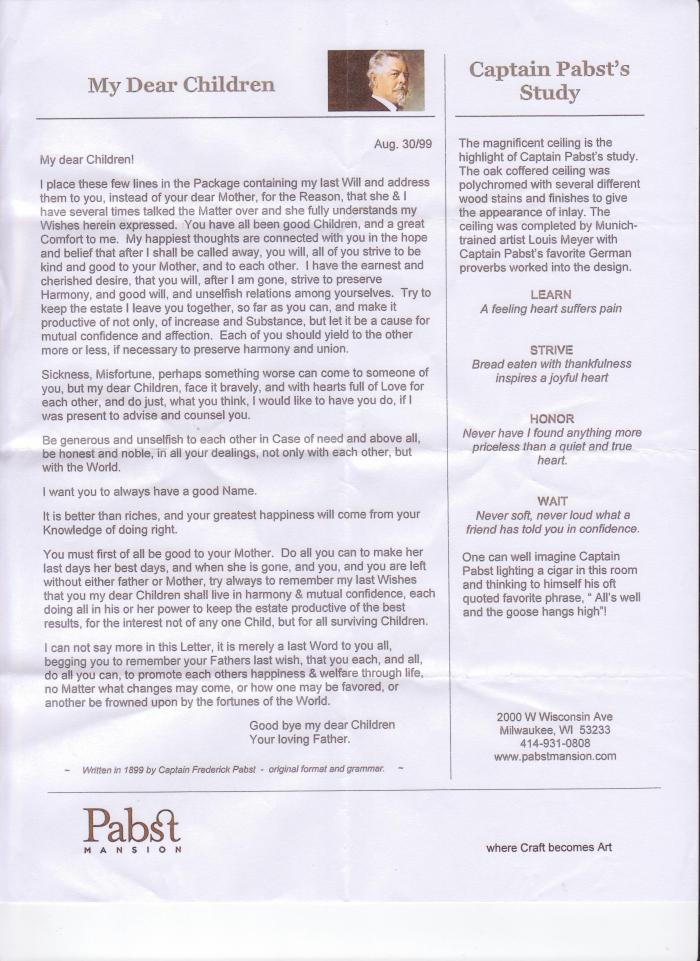
This is Pabst’s letter to his children, read after his death.  It gives you an idea of what I’m talking about.  They hand these out on the tour.  Well worth it.
Pabst Letter.jpeg

the rarest of foods and the future non-rareness of Star Wars

South of my remote office that works has me travel to is a quaint town that deserves the title of village.  It’s like something out of a time warp where restaurants, antique shops, Andy’s office, a small town non-evil lawyer, town hall, Skip’s Hammer & Nails, and the local fire station all surround an open park that families play in with their children.  I’ve not seen this kind of thing much in all my travels.  I’m not sure this idyllic existence was ever that common to the human race.  It sure seems pretty sweet though.  Everybody in this village is very friendly, if they do still possess a little bit of arrogance.  But hell if I lived like that I’d probably think I was awesome too.

Anyways, one of the restaurants around this park I’d been to before.  I got their tasty Asian themed burger last time.  It was great.  So naturally they no longer offer that.  Instead, the chef seems inclined to go high end.  And so a whole bunch of fancy and/or rare foods were on the menu.  I normally don’t go down the road.  I likes what I likes.  But the menu was short (which is fine) and so I decided to try things I’d not had before.  I cook all the time, but for the most part it’s just basic stuff.  I don’t usually buy or use too many fancy ingredients.  So all of this was new to me, in particular: black truffles, duck eggs, and bone marrow.

The result: I basically shrugged.  People I greatly respect in the food world talk up this bone marrow thing like it’s the nectar from the Sinai.  It was different, it was good, but it wasn’t something I’d have again over say, a good steak.  Maybe this village joint just didn’t do it right?  I’m not sure.  What I do know is that I didn’t understand the hype on any of this.  It was rather unfulfilling.  The night after I went to another town and a place I’d been before and went the burger route.  That worked out well.  I was satisfied.

bone-marrow.jpg

I will say, mine didn’t look like this.  So maybe they did indeed not do it right.

But the thought arrived in my crude brain, is rarity a delight in its own right?  Why yes, I think it is.  Sort of.  Let’s take these few belligerent examples.  To understand where I’m going, pretend for a moment that you’re a pretentious asshole.  As in, imagine you work for Goldman Sachs (offers finger to gilded palace level):

1) You are offered an omelet made of endangered condor eggs

2) You are presented beer brewed with water from The Moon

3) All the forces of science were used to cheat nature by recreating the dodo, just so they could kill it and you could eat it

dodo bird food.jpg

Coming soon to a plate near you.  Seriously, in your lifetime, somebody will attempt to do this.

We don’t have to necessarily go down this weird road though.  How about:

a) You drink a microbrewery’s beer.  It’s fairly decent, but nothing exceptional.  But you come back a month later and they’re out of business.  You will never be able to drink that beer again.  Was it that more special?

b) In your travels you experiment with a dish that cooks pork in a unique way you’ve never seen before or will again.  It’s nothing crazy, it’s just freaking pork, but it’s different, it’s good.  Will you miss this rareness a decade down the road?

To me, rareness or uniqueness is more along the lines of (a) and (b).  This kind of thing appeals to me.  (1) through (3) or bone marrow, eh, not really.  Not sure what that says about me, but that’s my take.

So then, the thought also crosses my feeble mind of what occurs when rareness disappears.  Even if you think bone marrow is liquid life, what happens to you if you have it every single darn week?  I suspect it loses the edge.

Everybody is once again on the cliff’s edge about Star Wars.  Yesterday, I saw a guy driving a Nissan Rogue where he had stenciled in cursive handwriting the word “One” after the Rogue lettering.  This means he’s even more of a loser than I.  A brief aside, how has Nissan gotten away without the evil corporate stigma that VW has?  Nissan has openly admitted to cheating fuel standards recently too, but nobody cares?  Whereas VW is the devil?  Eh, maybe folks just love to hate the Krauts?

Anyways, soon Stormtroopers and Darth Vader will be everywhere again.  You’ll stroll out toward your car in the dark of the morning and Boba Fett’s going to be standing by your mailbox smoking a cigarette.  And you’ll just shrug and start your engine because you expect it.  Here’s the thing though, I think it’s going to die down.
star wars admirals.jpg

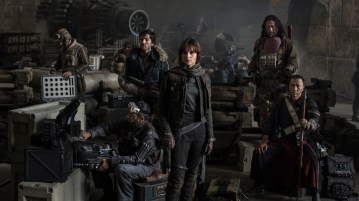
These two dudes are going to show up to cut your grass.  You’ll shrug and give them the check.

Star Wars 1977 to 1983 was special.  Then George destroyed it.  So when Force Awakens appeared folks were just begging for some kind of victory.  They mostly got it, the world stopped for it.  Now everybody is looking for the ride to continue with Rogue One.  But, what happens when that rareness disappears?  Disney has 17 Star Wars films in development as we speak.  I suspect that rarity’s going to disappear.  You can only swallow so much bone marrow or Star Wars before you can only shrug.  It’s human.  In the best of our nature, we love to try things that are different.  We seek the adventure.  Things we eat or watch repeatedly can become less special, less unique.

Or maybe I’m just an idiot.  Maybe I’m wrong.  For example, I do love those burgers.  You can make a burger exactly 2,748 different ways.  I’ve only tried 73 of them.  I want to try the rest.  So maybe, just maybe Star Wars has 135 films left in it before everybody stops caring.  I assure you, Disney has it in them.  So we’ll find out, one way or the other, whether I’m right.

red shirts.jpg

Most if not all of these Red Shirts are going to die.  They told us so in the original movies.

Busan – hiking and the monk’s car

Some of the best days are the ones where you wake up and have absolutely no idea what you’re doing.  I’ve gone through these phases.  I used to plan nothing for trips, then I planned everything, and now I’m back to planning almost nothing.  Busan was the early days.  It was Korea, that was enough for me.  So we scheduled nothing in advance.

We wake up one day and the rest of the group doesn’t want to do much of anything.  Probably because they were hungover.  I’m sure I was too, but I was young then and didn’t need to lay around suffering.  So Tim and I decide we’re just going to leave everyone and go, somewhere.  I think we just picked some random temple off a map in the suburbs north of downtown Busan.  It was December, but not a completely freezing typical Korean winter just yet.  So we bundle up and roll out.

We had to take the train and then the bus to get there.  Neither of us spoke anything above bare bones Korean.  We quickly got lost and are just standing there on some random suburban street corner trying to figure out what bus to get on.  Then this middle aged woman walks up and in halting English asks us where we want to go.  We show her the temple on the map and she agrees to help us.

But she refused to give us directions.  Instead, in one of the most generous things I’ve ever seen in my life she decides to ride the buses and escort us to this temple.  Then she says she knows a good place for lunch next door to the temple.  So she walks us there and explains to the owner in staccato Korean probably how these two American idiots didn’t know what they were doing.

The two women essentially shrug and our kind escort wishes us luck and carried on with her day.  We couldn’t thank her enough but she treated it all very matter of fact, smiled, and was gone.  The lunch was incredible.  In the Korean style we each had the ten or so little bowls of various meats, vegetables, and sauces.  It’s probably in my lifetime top ten of meals.

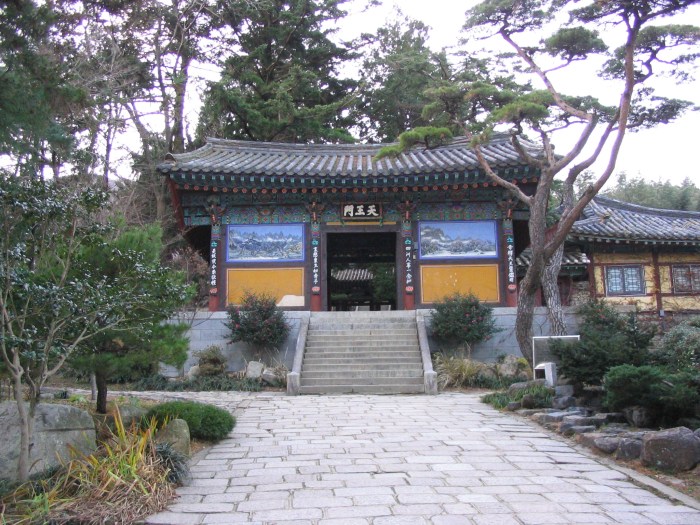
shrine

I think this is the temple, I’m not so sure.  The shot is logged wrong by how my memory remembers this trip.  So who knows.  But I’m pretty sure this was it.

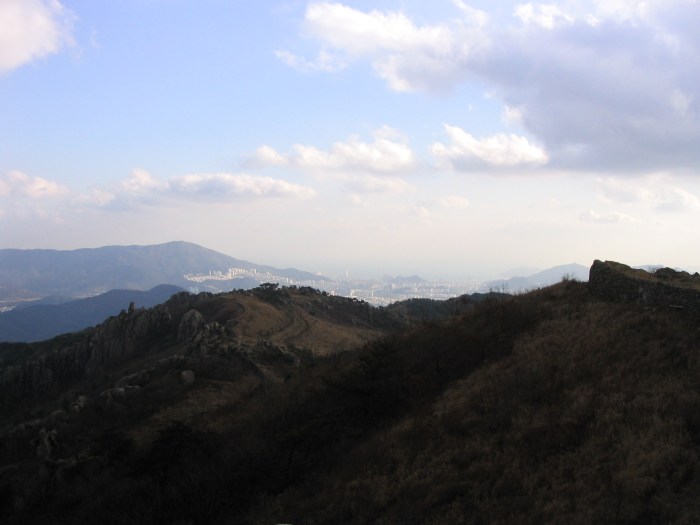
We walked around the temple for a bit and then Tim being the far more adventurous of the us simply states we should stroll up the nearby mountain.  So we point ourselves toward the hill and just start walking.  As we got higher we realized we’d stumbled upon a routed hiking trail and so we continued to follow it on up the mountain and across the peaks.

It’s hard to describe how mountainous a good chunk of Korea is.  Cities are perched precariously along the coast with ribbons of suburbs rolling out in the valleys.  The inclines of the hills are quite steep and it’s rather sobering to think that when Busan was the last holdout against the Communist siege in 1950 that these mountains held hundreds-of-thousands of young men who would decide the fate of Korea.

Looking Back.jpgLooking back toward Busan from the hills.
valley

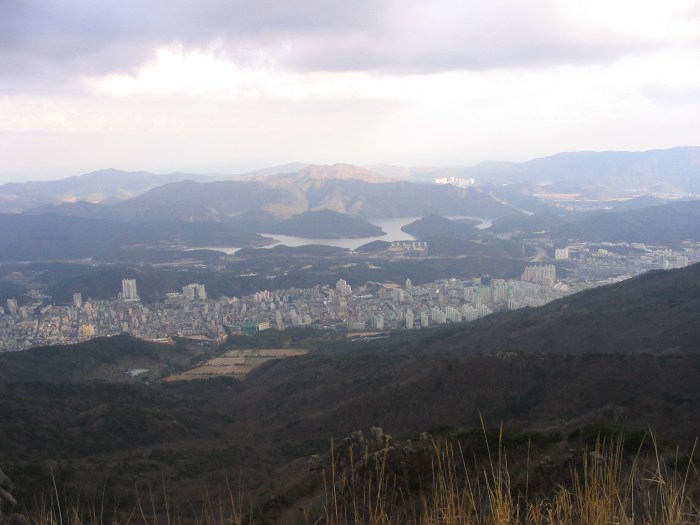
Ribbons of suburbs and the Nakdong River.

back-downhill

We walked for miles and miles, probably at least over ten miles.  It’s a blast, the weather cooperates, the trails are dotted with other friendly hikers, and oh, ah, it’s getting into the late afternoon.  We’re in trouble.  There’s no way we can go back the way we came in time.  We have no desire to hike back on the trail in the dark lest we fall off the darn mountain.  Fortunately we happened upon a temple nestled up there that’s near the trail.  We figure if nothing else we can call a cab from there to take us back downtown.

Temple From Above.jpg

Temple Gate.jpg

I walk around a while admiring the temple while Tim somehow strikes up a conversation with a monk who speaks immaculate English.  Decked in pristine Buddhist orange and thick glasses he says there’s no need to call a cab because he’s driving downtown anyways and he’s glad to give us a ride.  He asks us to wait for a bit while he gets ready and he’ll go get the car.

I’m raised in the Catholic Church, and so I have this idea of poor Trappist monks on a farm like my Dad used to visit.  I expect this to be a hair raising ride through twisting mountain roads in a Yugoslavian knockoff beater.  Instead, the monk rolls up in a pristine black BMW that easily cost north of $50K.  Tim and I were just cracking up.

It was nearly dark as we set off for downtown.  Tim sat up front with the monk while I dozed in the back.  Tim and him chatted away about everything.  I wish I remembered more of their conversation but I was exhausted.  I do recall the monk was headed downtown to party with his friends.  I never did catch the reasoning for the dichotomy between the wealth, partying, and religious lifestyle of the monk.  In retrospect I just find it hilarious.

Back downtown, we managed to link up with our friends again.  I don’t remember the rest, probably for valid reasons.  But I do remember the hills well, and that monk and his crazy car.  It was quite the day not worth planning.

temple


and so you shall stay where?

In Season 5 of Mad Men there’s a drawn out sequence where Don and Megan fight horribly over a variety of issues (mainly that they probably should have never married, idiots) while in a Howard Johnson’s restaurant during the height of its iconic days. If you haven’t seen it I won’t bust the plot, but suffice to say this entire episode is a horrific depressing mess that makes you want to cut yourself. It’s wrong even by Mad Men standards which says an awful lot. When this episode is over you need a shot and a shower.

don-draper


In any case, what you didn’t know when you were watching this episode years ago is that same feeling should have been also applied to Howard Johnson’s itself. When you watched the episode, you were like, “Oh, I remember Howard Johnson’s. That place was alright.” It may have evoked images of a happy family road trip when you were a kid. The place wasn’t a palace, but it had clean rooms and decent food. It was the consistent oasis that made it successful. But I bet when you had that nostalgic moment you didn’t realize that Howard Johnson’s was already on life support? Did you? I didn’t.


For you see, even though you or I hadn’t stayed in a Howard Johnson’s in decades you probably just assumed somewhere in the back of your brain that they were still around. That they were this eternal thing that was out there still, somewhere. They were not. A few weeks ago the one in Bangor, Maine closed. Now Lake George, New York hosts the only remaining restaurant. Essentially Howard Johnson’s is dead. What the hell happened?

howard johnson's.jpg


Well when I was a kid plane flights were very expensive. So the family would at times drive say 11 hours to get to our destination. Most of the time we’d do the drive all in one shot with my Ma and Dad rotating the driving duties, but not always. Sometimes we stopped along the way, thus the motel. What’s changed this reality today is that airline flights are just that much cheaper. Southwest can bargain basement you most places within half the country for a hundred bucks a ticket or less. Somebody from AAA will tell me this statement is garbage, but I suspect the percentage of families who drive north of ten hours to go somewhere has mostly tanked in the last two decades. So if you were Howard Johnson’s and you built your business model on long road trips, you were screwed.


Also the brief corporate history of Howard Johnson’s is that after Daddy died, the son appears to have made some horrible decisions on brand diversity. He opened a bunch of unrelated restaurant chains (all of which are now gone) and basically lost focus on the core business that made Howard Johnson’s successful. Then as people started to drive less Howard Johnson’s didn’t take the hint. They didn’t diversify or try new things or innovate. They stuck with the same Howard Johnson’s brand, even if they did eventually discard the neon orange roofs. In a culture that today values relatively fresh food, uses airlines when it can, and isn’t so tied to nostalgia? Maybe these guys were always doomed. Fast food joints and extreme discount motels are at the bottom end. Or you can get creepy rich food and burn $156 a night on the high end. What ground was there in the middle for Howard Johnson’s to continue to exist in?


Has something been lost though? I mean other than the basic nostalgia? In terms of the restaurant piece, I don’t think so. It’s not 1960 anymore where stop points might have been rarer. Regardless of what highway you’re on at any given time you likely have dozens of different restaurants to choose from in terms of cost and quality. If you don’t, you’re likely driving in an area where Howard Johnson’s never existed anyways. But in terms of the hotel loss, I think there might be.


Towards the end, Howard Johnson’s hotel side of the business was bought out by Wyndham. Wyndham also owns 14 other major hotel brands of varying size, style, and price. Marriott recently bought Starwood and thus created a hotel / motel colossus that owns over 30 major hotel brands. Howard Johnson’s might have been all over the place, but never in their wildest dreams were they ever this dominant. It’s part of a growing trend in American business where there are many brands, but only two or three actual owners to choose from. This of course cranks up the price because in a near virtual monopoly environment the customer loses, always. If you don’t think hotel chains collude on price just like the airlines do, you’re kidding yourself.  It makes one yearn for the quaint, family owned reliability of Howard Johnson’s.


And so you shall stay where? Without getting gouged? Well I guess first off, thank god for things like Airbnb. I hope the global commons takes the big hotel chains by the balls, I really do. Because there isn’t a global commons for large airliners, so at least we can have competition for hotel rooms. I bet if you look at all the local and state government efforts that are trying to crush Airbnb on missing taxes, that they’re all mostly funded by lobbyists hired by the big hotel chains. Also, no matter what, always consider different means to travel. If you’re like me and you’re almost always traveling on a limited budget, don’t get caught into the same routine every time. Always investigate new websites for new deals. Try different chains. Don’t always be ultra-loyal to a loyalty program without re-verifying it’s still your best deal. Because you never know when a chain’s going to get bought out without you hearing about it. Or that one of their rivals went bust and they jacked up the price on you. Do your research. Stay flexible. In a manner which Howard Johnson’s was not.

don draper again.png

Don explaining to Megan about the paddling Howard Johnson’s is predestined to take.

Boston Harbor – Harpoon Brewery

Some things or locations on my bucket list just kind of sit there and fester for years.  For whatever reason, this doesn’t usually bother me.  I’ll get around to it when I get around to it.  You would think I’d be more deliberate and plan things out.  I used to be this way.  But now unless I’m at work I kind of refuse to let my brain work that way, it’s tiresome.

So despite my worship of beer, I’d just never gotten around to visiting a brewery.  And I never really felt the need to force it.  I would think about it from time to time, but never make the effort to schedule it.  Ending up at Harpoon wasn’t some type of strategy either.  My Brother had been there years ago, so we decided to go again while in town for a wedding.  The discussion that led to this quick trip Downtown lasted thirty seconds, and I smirked to myself and them that this would be my first brewery ride.

dsc00557

He said when he went years ago that they didn’t really have a formal tour.  They just took you straight to the tasting room and asked if anybody had any questions.  From the tasting room you can see the brewery floor.  But now they take you in the front and up some stairs where they have a full bar and waiting area.  You buy your $5 ticket, wait, and drink beer.  They also have custom pretzels.  I know it sounds terrible, but somehow we managed.

DSC00558.JPG

Boston Irish Stout, Scotch Style Ale, & 100 Barrel Series #58 Secret Alloy Ale

DSC00559.JPG

The guide takes you back and she talks you through what I think is a relatively small sized brewery.  I think it took about a half hour.  It’s pallets of beer and monster sized brewing equipment.  I have a general understanding of how beer is made, but don’t really get how it’s done on an industrial scale.  The problem was the tour gal kept talking too fast so that a lot of the time we couldn’t really follow what she was saying.  This was the only downside of what was otherwise a quick, decent look at how these places operate.

dsc00560

I’d had Harpoon many times before.  I’ve always considered it to be decent, but nothing awesome.  Good stuff, but not great.  I’ve had a bunch more since we visited and my original impressions remain intact.  Although the Scotch and Alloy shown above were awesome.  They need to let some of their rarer varieties ship beyond Massachusetts.  They’re far superior to their regular fare.

DSC00562.JPG

After the tour you get about 15 minutes in the tasting room to have 2 oz after 2 oz from about 20 taps.  It’s a neat wrap up.  The walls are surrounded by beer from everywhere on the planet, a very nice touch.

Overall this was a worthwhile visit.  But I feel I can’t really compare or contrast it with anything.  Without visiting other breweries I can’t put Harpoon into context.  I guess I’ll have to visit more of them to figure it out.  Oh darn.

DSC00585.JPG

100 Barrel Series #56 Thunder Foam – I managed to stumble upon this at one of my local shops.  A dark and spicy stout, it was a fine wrap up to my evening.  Hopefully I can manage to find more of their kind at the same place the next time I shop there.