Turkey – Ephesus

In 262 AD, having already raided large portions of Asia Minor, a Goth force descended upon Ephesus. Outnumbered (and by this point probably also outclassed) the Roman military was unable to offer any substantial opposition. The Goths sacked Ephesus and burned the Temple of Artemis to the ground. One of the Seven Wonders of the World ceased to exist alongside many other major structures within the city. It’s likely that a substantial portion of the population was killed, scattered, or enslaved. Ephesus never recovered.

It is as if aliens descended upon Europe tomorrow and sailed up the Thames or Seine to gut Paris or London alongside millions of people and all their major landmarks. Only in Aleppo could you find a rough template today to compare this to. Except that with Ephesus it was a factor of time. It has taken five years to lay waste to Aleppo, it’s people, and its historical landmarks. It probably only took a few days to burn Ephesus. All that’s left now is broken stone, rubble, and a ghost of what was once one of the major cities on Earth.

Trees grow on bare grass that was the ground floor of some rich trader’s mansion. The fallen columns of one of the greatest architectural masterpieces ever made were ground down for plaster to make lesser buildings. The written knowledge and cultural history of one of the great cities of history is so completely destroyed, so burned, so reduced to waste that it’s actually disputed which year (not which day or month) Ephesus was attacked by the Goths.

ephesus

When you go back and look at places such as Ephesus I’m inclined to divide the history of the human race into two geographic categories. You either live in a town, city, or country that has been a doormat of history or you do not. Those that caught the doormat category, even to this day, have to overcome the problems that trace their roots back thousands of years.

Despite turmoil, wars, and bombing raids, London was completely destroyed only once in 60 AD by Boudica during her revolt. Paris has never been razed to the ground. Depending on how you count, Ephesus was demolished at least seven times over thousands of years. It’s hard to build a long standing, secure culture, language, commerce, and politics when somebody shows up once every few hundred years and devastates it all. I think this goes a long way to explain why Britain and France are relatively stable democracies while Turkey’s still attempting to discover its identity.

London had the Celts, Romans, Saxons, a few Vikings, even fewer Normans, all eventually melded into English. Ephesus by contrast had to deal with this journey through history:

Arzawans

Hittites

Mycenaean / Ionians

Cimmerians

Greeks

Persians

Macedonians / Seleucids

Romans

Byzantines

Arabs

Seljuk

Ottomans

Turkish

Good luck trying to wrap your brains around how all that is supposed to create a stable safe place to live for multiple generations. Sometimes a sustained melding of cultures can create a truly special blend of humanity that enriches a people. Think of the unique joining of Moorish and Christian that Spain traces its roots. But other times there is no blending, there’s just history’s great eraser that does away with the old, and sometimes never replaces it with the new.

Kemal Atatürk’s vision was that history would be undone, his country remade. He wanted to wipe away the chaos described above. Turkey would be reborn into something new. Whereas religion was the one great binding principle, Turkey would become an ultra-secular state. The Turks would even get a brand new alphabet. What people could and would wear would be dictated. Those who lived in Turkey would become singularly Turkish, one way or the other. The Kurds were oppressed and the Armenians simply liquidated.

In retrospect, it seems clear that this was never going to work. It relied entirely on the personality of one man, and the ability of those with guns to enforce it. Whenever things got out of hand the army would simply step in to preserve Ataturk’s legacy. Turkey suffered more coups than most African states. If the planet’s last hundred years or so have shown anything, it’s that you cannot build long term prosperity in a country where the chief method of civil institution is violence. Eventually things come off the rails. But in the interim, folks can generally muddle through.

So in this sense, Recep Tayyip Erdoğan’s rule is actually the direct successor to Atatürk’s legacy. In that he’s running the show simply because he controls the most guns. The recent coup, while dramatic and bloody, never had widespread military support. Erdoğan controls the army, so he controls Turkey.

Modern democracy and prosperity require many civil institutions that were built up over centuries such as freedom of speech, rule of law, freedom of the press, and so on. How exactly would these have emerged in Ephesus when every once and a while every civil institution was doused in flames?

I’ll roughly wrap up this line of thinking, because I want to talk about Ephesus’s golden age, by saying I’m not optimistic about Turkey’s immediate future.

In the short term it’s the Erdoğan Show. This week he submitted to parliament constitutional amendments to give him unchecked executive level powers. He will get them. He will get them because he wants to be Sultan and Atatürk II. He will get them because he controls the guns. And the guns control the voting, education, media, and just about every other aspect of Turkish civil society. The Erdoğan Show will continue until he dies. After that, what?

It just depends. Sometimes a country can right itself after incompetent one man rule departs. But even if everybody realizes the nightmare was indeed a nightmare, it’s hard to fix things. Just look at what Venezuela, another broken democracy, is going through even though Hugo Chávez is long since dead. Even if Turkey’s ultimate future is bright, I think Erdoğan will ultimately set back progress by fifty years. What comes after that, is up to Turkey’s people.
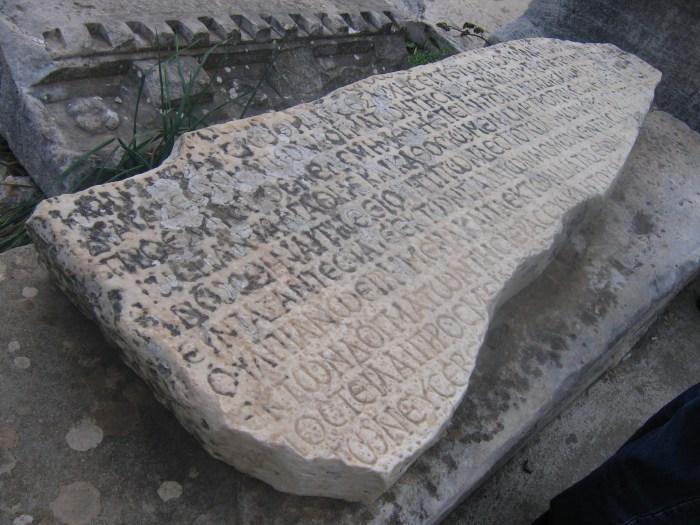
ephesus-2

The ruins of Ephesus are at the foot of Selçuk, the modern Turkish town. In ancient times Ephesus was on the Aegean Sea. But over the centuries the Cayster River silted up and now the entire area is several miles inland. If one takes a more nuanced view of history than I describe above, you can simply make the argument that Ephesus died out once it lost access to the Aegean and was no longer able to serve as a major port.

A good first stop is the ruins of the Temple of Artemis which are a few hundred meters from Selcuk. What little is left is among the oldest of the places available for visitation. The temple underwent three phases. The Bronze Age shrine might be among the oldest on the planet. This original temple was lost to floods in the 7th Century BC and was replaced by the more recognizable Greek columned temple around 550 BC. In 356 BC a true fringe lunatic of a man burned it down. Starting in 323 BC it was slowly rebuilt to the final recognizable structure.

artemis

Ruins of the Temple of Artemis looking northeast with Selçuk in the background. The single freestanding column is rebuilt from various wreckage they found. Imagine the size of the temple by contemplating a structure that fully filled the entirety of the basin in this photo with 127 total columns. Note the Ionic fluting on the fallen column blocks. Also see in the front of the shot the square holes cut into the eroded column blocks. Each column had a wooden centerpiece which they stacked column blocks through as they built up the height, in the case of Artemis, 60 feet high. The blocks were then fitted, sanded down, fluted, and decorated to give the column a single cohesive look meant to last for thousands of years. The problem with ancient Greek temples was they required wooden roof beams to support the marble tiles that typically sat atop. The intricate concrete roof construction one sees in say the Pantheon didn’t exist yet. This left most ancient Greek temples very vulnerable to fire, despite their stone base and columns. This was the cause of many Greek temples losses, as of course with Artemis as well.

ephesus-map

One of the many maps of Ancient Ephesus. To the left you can see the bulge emerging from the west of what was once the harbor inlet from the Cayster River that lead to the Aegean. The Temple of Artemis and Selçuk are off to the northeast. Note the extent of the city walls. Depending on how you count, Ephesus surely had over one-hundred-thousand citizens. Always a major city state during the Hellenic eras, it reached its cultural, economic, and political heights during Roman rule. For reference in subsequent photos, the Library of Celsus is #20. The Great Theater is #25. Harbor Street is #26.

library-of-celsus

The Library of Celsus. A couple of things to keep in mind as you look at this. First, the façade is a complete reconstruction. Second, look back at the map. As impressive as the library is, it’s one of the smallest buildings that once called Ephesus home. Despite the building’s small size, the library was among the largest of the ancient world housing over ten-thousand scrolls. The interior was burned out by the Goth attack, the façade collapsed centuries later. How much more would we know of the ancient world if at least some portion of the library’s content had survived? Completed in 120 AD by a son to honor his father, both of whom where Roman counsels, it’s a structure that mirrored both its Greek and Roman roots.

grand-theater

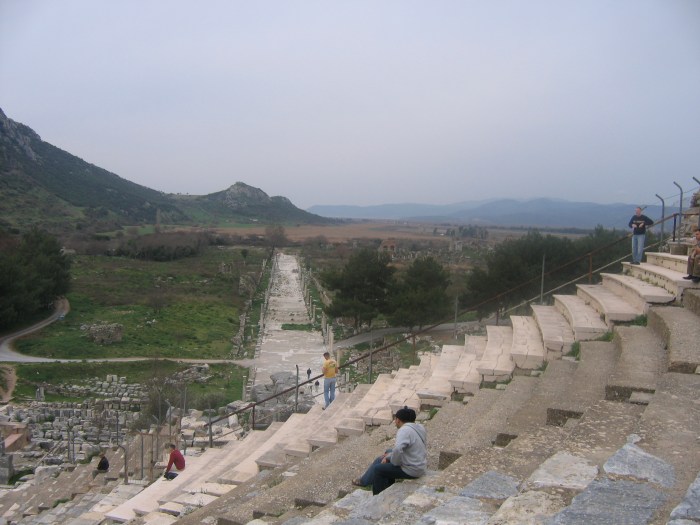
Grand Theater of Ephesus. Likely the largest theater in the ancient world, it could hold a crowd of 25,000 people. Greek theater was probably performed through its history and in the later Roman years people died there for the amusement of their fellow humans. I can’t begin to describe to you, but hope to loosely capture in pictures, just how big this place is. It rivals modern stadiums in its size and scale.

grand-theater-stands

harbor-street-above

From the Grand Theater seats looking west down Harbor Street. This must have been quite the view with all the buildings and the ships back in the day. The inlet to the Aegean and the Harbor Gate would have been at the end of this road.

Theater Stage.jpg

theater-backstage

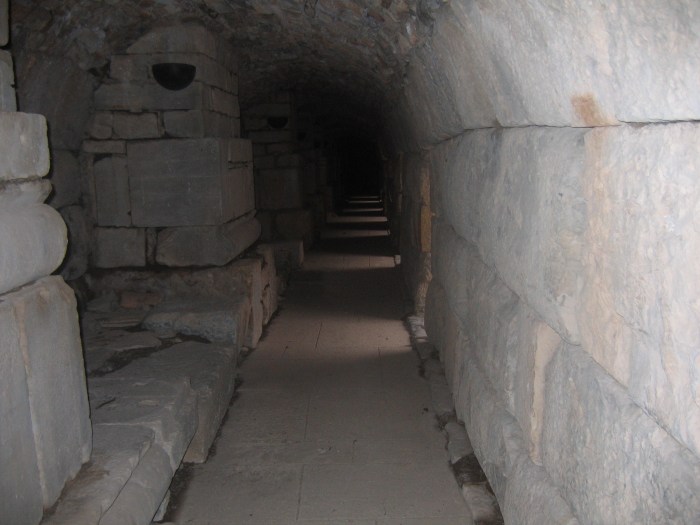
Backstage of the Grand Theater.

Harbor Street.jpg

Harbor Street. Not much is left, and so your brain is left to imagine what it would have looked like. All the way down to the harbor and the ships. The tens-of-thousands of people who walked this street and lived out their lives.

Mosaic.jpg

Turkey – Mount Koressos, House of Mary

When you travel in groups compromises are always necessary. When the group disagrees you can sometimes divide up or sneak off on your own for a while. Other times you just have to deal with it. When you share hotels, cars, buses, trains, and meals with your companions, it’s generally not a good idea to fight all the time. I’ve been on trips where this happens and it truly kills everything.

Being in Turkey I had about five-hundred things I wanted to do, history being at the top of my list. So when we were headed to Ephesus I was fired up. We only had one day there. I could spend six days in Ephesus and not get bored. But then, other members of the group wanted to take most of that one morning and visit the supposed House of Mary which is near Ephesus. I hear this and I’m like, “Oh, uh, …” [checks watch] (I did indeed wear a watch then, which seems strange now.)

I was raised Irish / English / Sicilian Catholic, so you know it’s seriously in my blood. But I was also raised with a light touch of it. My own Grandmother would frequently talk with us about this or that doctrine, Pope, etc, that she disagreed with, alongside her own take on life. It’s a very liberating American take on religion. Nowadays, depending on the barometric pressure outside, I can either truly believe or am an atheist or whatever. A lot of it depends on my mood. So basically I would not consider myself very religious, but I really do try. In this Turkey travel group though were several ultra-hyper religious types. So they wanted to go see the House of Mary and were very set upon it.

Given how much of Ephesus was on my brain I could have protested. I let it go in the name of cohesion. This was the right choice. I figured it would be nice to see the mountains, maybe say a prayer, and generally just enjoy the ride. This was exactly what happened. I don’t regret it.

The full titled House of the Virgin Mary sits atop Mount Koressos which is a few miles from Ephesus. It’s a small house and religious shrine. By which I mean it’s a religious shrine that reminded me a lot of the shrines in Asia, specially Japan. As in, it’s a commercial tourist destination. There’s very little religion about it. In say Japan, sometimes you’ll be walking around temple grounds and there’ll be these people hocking Hello Kitty fascism toys from stalls. I always found this odd, to me a dead quiet church is my pinnacle of prayer. But in many cultures it’s not a big deal to meld commercial and religious ideas on the same site. This is the case with Mount Koressos.

It’s like going to the Mary exhibit at Disneyland. There are several cafes, a wishing wall, tourist buses everywhere, magic water, it’s quite the atmosphere. And this place has quite the crazy tale as well. My first thought was, “There’s no way Mary was there.” I mean, what do I know? But still, it didn’t seem quite likely to me. I get it, Popes have visited this place, but still. Feast your brains upon this tale of discovery:

– Anne Catherine Emmerich, German nun, mystic, and later saint, has a bunch of visions which she imparts to the brains of others.

– Clemens Brentano, author, writes books based upon her visions about Jesus, etc, etc.

– In 1852, Brentano provides a rough description from a vision of a house near Ephesus that John supposedly built for Mary where she lived out her days.

– In 1881, French priest, Indiana Jones copycat, and lunatic Julien Gouyet uses this book’s description to find and identify the house on top of Mount Koressos. Nobody believes him.

– But by 1891 at the urgings of Sister Marie de Mandat-Grancey, folks get onboard with this idea and the house is made a shrine and taken under management. The first Pope shows up within a decade. Half-a-dozen other Popes have also visited.

So is one to believe this tale of visions, translated through a kook author, and a bunch of people wandering around the 19th century Ottoman countryside with a book in their hand? I’d have to say I don’t. I’m pretty sure that whatever Mary was that she died close to her birthplace and is buried out there. But whatever, it’s all good, people can pray anywhere. That’s the cool part about prayer.

And whatever the house is, it is indeed neat to visit. It’s very old and probably a good example of the style and architecture of ancient dwellings in this part of the planet.


Mary House.jpg

Side of the House of the Virgin Mary


When there, I kind of separated myself from the group and puttered around. When you go inside the house it’s a converted chapel, very small. I didn’t take a picture inside as it didn’t seem right. I prayed for a short bit and then was on my way. It was a nice moment, but not what I would call any kind of religious experience.


800px-House_of_Virgin_Mary2.jpg

Not my shot, taken from Wikipedia. Note the very ancient hallowed c-grade velvet rope, two Apostle endorsed codex plastic information placards, and Papal holy water blessed exit sign


Outside there is a wishing / prayer wall that folks can leave notes on. There are thousands of notes. There is also a water source that is said to heal or grant wishes or whatever. I did not drink the water

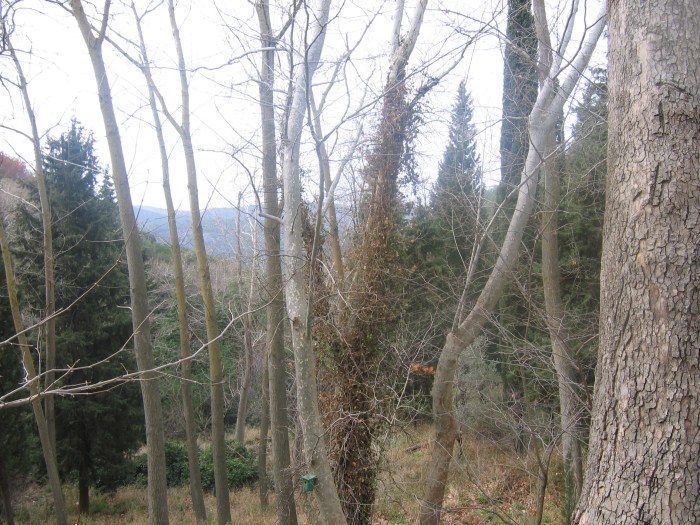
For me, the ground was the better experience. This was my chapel visit.  This was my Mount Koressos:

Forest.jpg

I’ve got dozens of various shots of nothing but the woods from all across the world. Two of my favorites are on my desk, one from American and one from Japan. I’m always struck by the differences and similarities between them. Wherever you are, the woods are always similar enough that you can recognize ideas, feelings, trends that join you to that remote location. In the sense that the woods near your own home and country do much the same. It’s that spark of fellowship and belonging that most closely identifies us as part of one human race and planet. It’s only there for a moment, but it’s a good feeling. Nature, God, whatever, does that to you. Amen.

Turkey – Marmaris harbor

The next three posts are going to be about my trip to Turkey and it’s history.  These will be a little personal for a variety of reasons.  This below shot is of my first day there, specifically Marmaris, which is where we landed.

Marmaris used to be a small fishing village but has essentially turned into the most tourist of tourist destinations.  It’s not a bad place, we had a good time, but it’s among the most aggressive I’ve seen in terms of fleecing the visitors.

For example, one of the best meals I’ve ever had was in Marmaris.  Turkish meats, prawns, the thing where they cook the fish inside a salt shell, Turkish beer, it was awesome.  Unfortunately the owner lied to our faces about his prices and tried to fleece us at the register.  We had to negotiate him down which was tiresome.  Overall, well worth the meal, just silly.

Marmaris has a pretty decent harbor and throughout history it’s been used by Greeks, Persians, Macedonians, Romans, Turks, and so on for both trade and military purposes.  Today’s it’s all tourism though, specifically Russians.

I would imagine that after Turkish pilots shot down the Russian jet and Putin cancelled tourist visas that Marmaris’ economy suffered immensely.  With Putin and Erdogan’s dictator’s détente, I figure they’re looking forward to a profitable upcoming tourist season.

marmaris-005

Sunset over Marmaris harbor


ordinary average German citizen attains bestseller status

Can book royalties cross over to the next realm and enrich a person within Valhalla? If so, I’m not sure how this would play out. First off, I assume (I hope) that Hitler’s purpose in Valhalla is for archery practice. When he showed up on 01 May 1945 I figure the Jarls took one look at him and were like, “Ah, welcome friend, we’ve been expecting you for some time.” And Hitler smiles all sheepishly, hoping these weird next life dudes don’t really know who he is. But then four drunk thugs step up and grab him and he realizes he’s done. At this point he starts to whine like a little chipmunk, “Nein. Nein!”. They take him to the range and strap him to a post. Every day drunk thugs practice their bow skills on Hitler. He’s doomed for an eternity to die, be reborn, and die again each day. So if book royalty checks do show up, they’d probably just take the money and buy more mead with it. Hitler never sees a mark.

For those who were unaware, the copyright held by Bavaria on Mein Kampf expired last year. So folks could publish the book again. There was serious discussion about passing a law or twisting it to prohibit further publication of the book. Thankfully this didn’t happen and the book’s on the street again. To me, history should be in people’s faces. So I’m glad they let it publish again. Let Hitler’s book sit in open view. Folks should read it (somewhat) and learn. History can’t benefit humanity when we sweep it under the rug. There are important lessons to be learned. In the case of Mein Kampf, one of the most clear is that men generally tend to mean what they say repeatedly.

Regular readers of this degenerate blog know I sure do hate the mass destruction wielded upon people by the haters for even the most minor of perceived slights. But trends become trends over time. When Sultan Erdogan said over a decade ago, “Democracy is like a train, you get off once you have reached your destination,” it would appear he meant every bit of it. There is nothing Hitler put out post 1933 that he didn’t originally write down in Mein Kampf. His distain of and future overthrow of parliamentary democracy, his intent to lay waste to Russia and the Slavs, his hatred of the Jews, it’s all in there.

For example, take these very specific passages:

“…the nationalization of our masses will succeed only when, aside from all the positive struggle for the soul of our people, their international poisoners are exterminated…”

“If at the beginning of the war and during the war twelve or fifteen thousand of these Hebrew corrupters of the nation had been subjected to poison gas…”

Not much subtlety there. Hmm, I wonder what he hand in mind? It’s important to remember that at the time Germany was (and still is) a pinnacle of modern culture and technology. Germans were not dumb people. So in my mind a few things happened here:

1) They didn’t read his book

2) They read his book and didn’t think he was serious

3) They figured he wrote the book in 1926, and it’s 1933, so he’s hopefully a changed man

4) They didn’t care one way or the other, they wanted a winner to restore Germany from the gutter

All of these views were mistakes. And thus, we eventually get Hitler’s, “You, gentlemen, are no longer needed…”. And the journey was on from that point. It took twelve years to resolve the forces of that conflict. The roots of it began well before Hitler published his book, and in many ways he was just a catalyst. But also in many ways he was an extremely unique and powerful man. One wonders what would have happened to Germany and Europe had history’s fate not cursed the landscape with somebody so evil, so perverted, and yet so talented in the ways of organization and persuasive leadership.

* Because tis the inauguration season, and I hate all humanity, I’ll just throw out the caveat that nothing I’ve written above is meant to apply to Trump. That’s an entirely different situation. History has many of the same notes, but it’s a different sheet of music. Maybe I’ll write more about this later, but suffice to say, America has a far more mature and robust constitutional system than post World War One Germany, a country that had only experimented with democracy for about a decade before Hitler tore it down.

There’s a lot of the purging of history lately. A lot of smart people didn’t want Mein Kampf republished. Folks want to take former slave owners statues off the American street. I’m sure eventually somebody’s going to get around to fully censoring entire books from the school system because they offend four or five folks down by the Sizzler.

But to me, I applaud that Mein Kampf is out there. I’m glad it’s a bestseller. I want all humanity to read, learn, and remember history’s lessons. I want a former slave owner governor’s statue to sit right there. So that when a young kid asks his Dad who that statue guy is, the Dad can be like, “Well, he used to be the governor, he did some neat things, but he also owned slaves and didn’t free them so he was an asshole.” And then the son and Dad have a further good discussion about history.

Putin is not Putin

I get the idea that 73% of the planet now believes Vlad is about seven feet tall, wears a pristine three piece suit, while dual wielding a pair of machine pistols, followed by a troupe of supermodels, and leaves all his enemies dead in his wake.

Yeah, I’m pretty sure none of this is true.  In any aspect, this guy just gets too much credit.  There’s Putin the idea, and Putin the man.  Putin the idea does not actually exist.  The man himself is basically just a gangster dictator.  Putin is not Putin.

Russia is powerful, it influences events worldwide and especially in it’s own backyard.  It has nuclear weapons, and a whole bunch of oil and gas.  But Russia is ultimately a troubled mess.  The economy is in the tank, demographic decline means by 2075 there will be like four Russians left, and generally speaking there’s nobody to carry on the party after Putin goes.

So when folks make Putin or Russia out to be this goliath, it’s not healthy.  It gives credence to a situation that’s not there.  Oh, Russia influenced the United States election?  I’m sure they did.  Did this single act cause Trump to win?  No.  And in any case, is everybody so blind to history?  Soviet Russia has influenced every U.S. election since 1917.  Please kindly go read history.

But when it’s made out that Putin alone has influenced the election, or even changed the outcome?  I’m sorry, but all that does is feed an image that doesn’t reflect reality.  Russia or Putin just simply isn’t that powerful.

You know once upon a time, the idea was that the United States shrugged off the rounding error threats from lesser nations led by gangsters.  But I guess, in today’s social media driven world, that we have to respond with hashtag anger to every petty little slight.  In 1984 or 1996, we’d have just shrugged at this.

White Christmas?

Within the confines of the hovel at my new gig I can hear music played lightly by the gal next door. This is a new concept for me as at the last place playing music without headphones was banned under penalty of confining one to the cubicle overnight while a merger of Bieber and Kanye was played via massive loudspeaker for eight straight hours. Needless to say, nobody violated this regulation. But here it’s considered okay.

This doesn’t bother me as much as I would have expected. Half the time she plays classical music which is soothing to hear as I grind away and contemplate what’d be like to actually one day have a job I enjoy. Sometimes she plays weird pop rock or whatever and I have to break out my headphones to drown it out with music of my own. This is fine too. But being the season, she’s progressed to the occasional Christmas music.

I’m not sure if I can handle this. Christmas is a long 12 days away. A lot of Christmas music is great, classic stuff. But when you really think about it a whole bunch of Christmas music is terrible. The ones where somebody whines about their relationship during the Christmas season are the worst. Nobody cares people, dating is just as much a wheat thresher in May as it is in December. Live with it.

But also, to me Christmas music is an intensely personal experience. At the height of its powers, it evokes memories of childhood where we would all pile into the van to drive to Grandma and Granddad’s place. In the dark, cold Christmas night my Dad would invariably switch over to Christmas music on the radio for the length of the drive. These are nice memories. All my grandparents and my Dad have moved onto the next realm, so the music is especially poignant. As it is, Christmas music almost becomes kind of sad for me, like a requiem.

Lots of people aren’t in the Christmas spirit either this year I guess. Go ahead and read anything online or in the papers recently and apparently the universe is over. Earth is finished. Christmas is cancelled. You’re a walking bleached skeleton. By June of this year, machines or aliens (or both) shall be our masters, dogs and cats will have lived together and procreated creating a master race of pet, The Walking Dead will have somehow become a good television show, and Trump will have become that guy in Star Wars with the wrinkled creepy monster face.

Gee wiz, I had no idea we were that doomed? Though I sadly suppose it’d be the same hysteria regardless of what loser won this last election. Hey you know I didn’t vote for either of them, both of them were terrible, but I never (and still don’t) had it in my mind that either one of them could actually destroy anything. Go read the Constitution, or contemplate how little Obama has been able to accomplish after eight years.

The way I look at, is to default back to my Grandma and Granddad. For you see, they did four Christmas days at war. Think living under Trump or Clinton would have been bad? Trying living through Christmas Day 1942. Unless you happen to live in Syria, we cannot comprehend the struggle and terror of those Christmases where whole cities and countries were being swallowed whole. My Granddad did Christmas Day 1944 under fire at the front within the Battle of the Bulge. Merry Christmas! Signed, your friend, Adolf.

This was a war that killed 300K Americans, probably around 100 million worldwide. One in nine Americans served in uniform. The equivalent number today is if four years from now 30 million Americans were in the military. This is beyond our comprehension.

So later on in their lives I have this idea that Christmas 1956, 1972, or 1986 was always very special for them. They could go back and look at their kids and grandkids and remember just how bad it’d been. Instead of all that nightmare, they could lean back on the couch, sigh deeply, and truly appreciate the joy of Christmas that surrounded them. More than anything, that war defined a whole lifetime’s existence.

Of this, I offer as further evidence the 1954 movie White Christmas. If you haven’t seen this movie, gather the kiddies and those you love, and watch this movie. It’s just too wholesome good not to watch. It’s got a great fun plot, decent music, good dancing, and is basically just an enjoyable time. But at its heart this is a movie about two guys who got shelled together doing everything they can to aid their former general and his failed business. And they get hundreds of their war buddies to help out. It’s a story where memory of the war bleeds through.

white christmas.jpg

I think that White Christmas connection lasted about seven decades. In an equally godawful presidential election of 1972, you could have voted for Nixon (liar, lunatic) or McGovern (dreamer, lunatic). But regardless of who won, you would have remembered that after Christmas 1943, it couldn’t be much worse.

And indeed, Nixon rightly got his ass kicked out of office and the country somehow didn’t implode. And if your neighbor in 1973 had voted for the other guy, then that was okay because they’d been 19 miles to your left on the front lines and so they were an alright dude regardless of who they voted for.

Now, 75 years later that type of deep societal connection is just about gone. There is literally nothing holding the vast majority of the American psyche together. This is another bother for me with Christmas music. All the good ones were written with this 1956, 1972, or 1986 mindset. These songs were written for people who’d literally been through hell, and could fully enjoy the Christmas meaning and spirit.

angry trump.jpg

“Merry Christmas, Motherfuckers!”

Who would write an appropriate hit Christmas tune today? No Kanye rapper or Bieber-like-man-child has it in them. Even if they did, would anybody listen or would people just hear it and get sad because they’re too mentally wrapped up in what Trump said about the percentage of glycerol in Twinkies on Twitter?

Do you hate your neighbor and fellow human? Maybe you should. Let’s hate everybody! Christmas spirit? Nonsense! Christmas is yet another day on the calendar to contemplate how awful everything is.

happy hilary.jpg

“Hmm, 60 million have had Christmas ruined because I should never have run.  Hmm, eh, fuck it.”  [lights cigar with $1K bill inside $27.3M mansion]

I have in mind, to write this Star Trek episode. It’s a Christmas episode special. In it, Kirk, Picard, Spock, and Data roll down to some waste planet accompanied by four Red Shirts. They go exploring around. Red Shirt 1 accidently blows himself up with his own phaser. Red Shirt 2 dies from food poisoning after last night’s failed turkey mole dish (true story). Red Shirt 3 gets dragged behind a rock by what the audience sees as a crab-like shadow.

Red Shirt 4 whilst walking upon a ledge gets scared by a monster neither he or the audience can see, and he falls off the cliff to his death. So then there are Kirk, Picard, Spock, and Data investigating the ledge where Red Shirt 4 fell.

Data scans the area and he’s like, “Captain, my scans show there to be zero evidence of alien activity in this sector. It is thus reasonable to conclude, that Ensign Timmy was alone here. Before he fell.”

Data_with_pipe.jpg

Spock nods, and he’s like, “I agree, Captain. Fascinating. It is thus logical to conclude, that whatever Ensign Timmy saw, was contained solely within the confines of his mind.”

spock-speaking

Then Picard, looking straight at the camera, earnestly, with campy Christmas music playing, in a scene worthy of 1979 says, “Why, it would seem, that even in this Christmas season, our darkest fears can overcome us, blind us, and lead us across a fatal line. Perhaps, it is time, during this season above all, to look deep within ourselves. For our own optimism, our own guidance, our own Christmas joy.”

picard_asks_for_help

And all four guys nod happily at this revelation as the music reaches its crescendo.

Then, out of nowhere a giant crab monster jumps out from behind a rock. It attacks Kirk and rips open his shirt.

ripped-shoreleave-2-r.jpg

Then the crab pulls a knife.

sword-fighter-crab-__-knife-attacl

https://www.youtube.com/watch?v=gJ9FdpLfL98

Kirk spends four and a half minutes going hand-to-hand with the crab monster, ultimately beating him to death with a rock. And Kirk’s screaming and panting over the mangled crab monster corpse. Picard, Data, and Spock are just looking at him, like, “Dude, calm down.”

Eh, either way.

White Christmas? My friends, it is your choice. In the next 12 days you’ll be bombarded with the black, the dark, the unpleasant. Choose the White. Choose optimism, to love your neighbor, to be kind even to your enemies. This is what it’s about. We need more of it. Now more than ever.

we have a long history of loving dictators

So this Castro guy finally transferred his lunatic self to the next realm this last weekend.  I mostly just shrugged because to me this was a forgone conclusion.  The dude’s been a functioning corpse for the better part of a decade after he handed power over to his brother Raul.  Fidel occasionally surfaced to speak his mind here and there, but Raul’s been calling the shots.  But man oh man, did a whole bunch of people take this event to the stratosphere.  The universe had the opportunity to remind the universe how much they felt Castro was either a hero or a barbarian.

I tend to fall in line with the barbarian crowd.  But mostly, this weekend gave me the opportunity to become depressed at how many people in the West are all too happy to still gloss over the dark realities of people they happen to like.  Especially because a lot of these folks are running Western institutions.  I’ll go ahead and give Justin Trudeau a partial pass for his lovey comments on Fidel.  It’s generally okay to like a guy when he carries your Dad’s casket.  It’ll let that one go.  But if you want to understand why Brexit happened and the EU is tanking, look no further than Jean Claude Juncker’s comment that Castro was seen as a “hero”.  Hey Jean, you have problems with your brain buddy.  It’s time to retire, okay bro.  The EU needs like, people who aren’t a mess like you.

I only get this Castro worship as some kind of twisted complex that old people or hipsters use to take their brains back to 1967.  As in, to them it’s the idea of Castro being The Man’s nemesis, weed still being rebellious, and electric guitars.  Think of the dude smoking hash today in Denver, whilst wearing a Che shirt, drinking PBR, and commenting to his buddies about how much he truly, truly hates [insert anything here].  Okay, I guess, but you have to look past nostalgia and live in the real world.  Particularly if you’re in the business of running Canada or the EU.

Castro goes into my column as the consummate example of a guy who pours honey potion into your ear while he rams a stiletto dagger into your kidney.  The dude’s appeal to the bulk of humanity was all talk.  Castro talked a good game of social justice and equality.  Then he turned around and enriched his own personal elite and destroyed his country.  Depending on how you count, thousands or tens-of-thousands of Cubans were executed during his reign.  Tens-of-thousands more died at sea fleeing his utopia.  Also depending on how you count, perhaps 10-20% of Cubans left during the last five decades.  The equivalent number is if around 30 million Americans felt the country was so bad they moved to Canada, with the understanding that say two million would die during the journey.

It’s all well and good to have universal healthcare and education, but what do these matter when your doctors only make $23 a month (actual fact) or all that education doesn’t allow the student to actually think freely or speak their mind?  These are not the hallmarks of an enlightened regime or a decent ruler.  Castro was a brutal dictator, worthy of disgust.

But hey, it’s all good, for this is in our blood, sadly.  I’ve been reading Greek history again lately.  A few days ago I caught the tale of the Greek general and politician in Theramenes, Circa 411 BC.  This guy grows up in Athenian democracy, at a time when 0.0043% of the planet’s population had the pleasure of living under anything better than Vicious Overlord #43,298.  So what does Theramenes do with his life?  Well:

– Conspires to overthrow the Athenian democracy with the Persians and succeeds

– Somehow manages to separate himself from the oligarchy’s garbage reputation and is abroad as general / admiral when democracy is restored

– He’s let off the hook (for some reason) and then spends his time as a highly successful military commander

– But, after the Athenian naval victory at Arginusae he’s accused of fumbling the rescue of shipwrecked Sailors

– He shifts the blame off himself and onto six other Athenian admirals, then sits back and watches them go to trial and get put to death

– He helps negotiate Athens’ surrender to Sparta, then gets himself appointed as part of the new oligarchy / dictatorship

– The new oligarchy then proceeds to mill human flesh, execute Athenians just to confiscate their property, murdered non-Athenians in the city to get their money, and so on

– Theramenes eventually crosses the other oligarchs and they team up and put him to death to be rid of him; he dies like a boss though, insulting and mocking his rival Critias right after he drank the poison

I guess my point of this tale is for over a decade Theramenes plays at the pinnacle of Athenian society, politics, and culture before somebody finally decides it’s time for him to go.  You would have thought after that first coup somebody would have been like, “Hey, uh, Theramenes is a bad man, he’s probably got to go.”  But no, he sticks around, he continues to do harm.  I’m sure after he died, a whole bunch of Athenians were sad to see him go.  A nice old couple probably called him a “hero”, even though Theramenes’ goons had visited their neighbors the night before and killed them.

I’m not sure what to make of all this, really, other than to state we have a long history of loving dictators.  It’s weird.  It’s wrong.  But, it’s also human.  Whatever that means.

Milwaukee – Pabst Mansion

My Grandfather was so into Pabst beer that he named his dog after it.  This supposedly scruffy little mutt had a sharp personality.  So he fit well with his originally rough Milwaukee based namesake brew.  I think this also explains much of my obsession with all things beer, much to my detriment at times.

I suppose both my Grandfather and his dog would be rather troubled to see what’s become of Pabst now.  For you see, the tale of Pabst beer and of Frederick Pabst himself is a winding journey.  I think it emphasizes some of the best, worst, and weirdness of modern America.  I don’t know why all this fascinates me but please bear with my degenerate mind for this post is going to be a long one.

The man

Pabst was born in 1836 Prussian Germany to a poor local farm couple.  When he was 12 they immigrated to the American Midwest during a time where nobody was checking papers at the border.  This was still a time where America was a harsh, dangerous, and backward place.  Within a year Pabst’s mother died of cholera.  Pabst spent his teenage years working menial odd jobs just to survive and eat.  Somehow, he ends up with a lucky gig onboard a Great Lakes vessel.  Without an education or connections, he works his way up the maritime ladder and by 21 he’s a steamship captain with a name people know.  If you want yet another example to understand how American economic mobility is different nowadays, imagine what it would take for a 16 year old high school dropout waiter to become a ship captain within five years.

Pabst remained close to his roots and the German émigré community.  He spoke German at home his entire life.  He thus meets a fellow German in Phillip Best, marries his daughter, and ultimately uses his equity in the steamship trade to buy half of Best’s brewery.  From then on, Pabst is a brewer, though he maintains the title “Captain” Pabst for the rest of his life.  Thus proving once again that it’s awesome to be a captain, just ask Patrick Stewart’s ghost.  By the end of the Nineteenth Century the brewery is one of the planet’s most successful.  Pabst is Milwaukee’s leading citizen, he owns properties, resorts, banks, a theater, and on and on.  Though he came from nothing, he’s literally at the peak of American society.  He checks out to the next realm in 1904 as one of the more respected men on the planet.

The beer

By 1874 thanks largely to Pabst’s genius the brewery was the largest in America.  You could likely make the argument that by volume this meant they were the largest in the world.  Though I’m sure this is not provable given the dearth of statistics at the time.  I’m positive some dude in Bavaria was brewing ten times that amount in his basement closet alone.  In the traditional American style Pabst maintained their signature lager which ultimately became known worldwide as Pabst Blue Ribbon (PBR).  Of note, they never won a blue ribbon or anything.  Pabst being the businessman he was just put a blue ribbon on the beer bottle as a marketing gimmick to indicate quality.  This gimmick has survived over a century and a half so I guess it worked.  It is also for this reason that if your local mayor or councilor tells you they’re solving a problem via a “blue ribbon” committee that you should immediately impeach them.

The PBR name and style survived prohibition as well as the post war era.  As the light American lager that it was, you can count on all the goods and bads that come with that designation: reliability, consistency, quality, safety (which was a big deal back then), but ultimately a relative lack of taste and variety.  In our new modern beer era folks tend to hammer this style of beer.  I don’t go that far.  It’s good for what it is.  It’s my preference for drinking on weeknights.  And it’s important to remember in our over-hopped, lunatic beer world of today, that once upon a simpler time folks were just happy to have decent, quality beer before they had to wake up in the morning and clock in at a tire factory.

Eventually though, things began to fall apart for this legendary company.  In a timeline of horrors not uncommon to other Midwestern businesses, in 1985 Pabst is bought in a hostile takeover by another self-made man turned beer baron Paul Kalmanovitz.  One can imagine that Kalmanovitz would have run the brewery well, but instead he died two years after the sale and it appears his trust made a true hash of it afterwards.  Sales plummeted and by 1996 in a nightmare haze Pabst brewing enters the contract brewing stage and the original Milwaukee brewery is closed.

For those unfamiliar with contract brewing, this is where the brand doesn’t actually own the brewery and hires some guy outside their company to actually make their beer (usually under the supervision of the brand’s brewmasters).  Lots of companies do contract brewing well, such as Sam Adams or various Japanese brands for their American sales.  But it can also be a true descent into frat boy style poor quality.  For example, at the recreational football league I play in somebody brought a 30 pack of Kirkland Light Beer (read Costco) as their contribution.  This was made for Costco by a contract brewer in Wisconsin and was awful.  Though beer being beer, and football being football, we did drink it.

Many will be well familiar with Pabst’s recent return to prominence via the hipster rage of going back to do things which were once cool.  This bizarre trend has enabled PBR to become somehow high quality whereas say Budweiser is perceived as not.  I don’t entirely understand this way of thinking but acknowledge that it does exist and has a somewhat legitimate feel to it.  After all, if my Grandfather loved this beer and named his dog after it, why not me too?  But it’s important to remember that Pabst basically isn’t in touch with the roots that the hipsters worship.  PBR circa 1968 is not PBR today.  What Pabst exists as today is its own independent LLC, headquartered in Los Angeles, financed by a private equity firm, and still only a contract brewer.  One wonders what Captain Pabst would think about this arrangement?  Where it has essentially no ties to Milwaukee, no basis in the self-made path he walked, and only a facade of the identity it once had.  And yet, still immensely popular.

Pabst Entry.JPG

Pabst Mansion Entry.

The house

In 1892 at the pinnacle of his life Pabst decided to build his retirement home.  After two years of construction he moved into Pabst Mansion still located at 2000 West Wisconsin Avenue in Milwaukee.  In Pabst’s day, Wisconsin Avenue was called Grand Avenue and was home to the dozens of mansions that housed Milwaukee’s elite.  The other mansions are gone now and most of this stretch is home to Marquette University.  The Pabst Mansion remains intact largely due to its purchase by the Archdiocese of Milwaukee which bought it from Pabst’s children in 1908 and occupied it through 1975.  Following that, a bunch of truly dedicated and scrappy historical preservationists put their time, money, and reputation on the line to preserve the mansion.  These same people are mostly at it today.

The house itself is not fully renovated and in many ways isn’t quite the pristine piece of history that one wants when visiting such a place.  But they do a mostly great job of making it happen given their limited financial resources and the actual state of the house.  The Catholic Archbishops made extensive changes during their time including the painting of all walls, bathrooms upgrades, repurposing of rooms, and so on.  In order to acquire cash to progressively reconstruct the house back to its original condition, they’re forced to do some weird things like host weddings and receptions on the second floor in the old master bedroom area.

Photography isn’t permitted inside the house.  If you want to see what it looks like, the Internets offer you a variety of clean images.  I’ll roughly paraphrase here.

The tour begins on the ground floor reception hall with its adjoining parlor and music rooms.  There’s also the kitchen (tiny by today’s standards), dining room, and Pabst’s own office.  They advertise the mansion as 20K square feet of space.  I don’t think this is an accurate number unless you include all the closets, basement, and attic.  I think the true amount of livable space is less than half that.  My first impression was how relatively small the place is.  Don’t get me wrong, this is a massive house, but the dining room would barely seat a dozen folks in tight quarters.  The parlor about the same.  Pabst’s office is only slightly bigger than my cubicle.  I get the idea that this house reflects the style and temperament of Pabst and his family.  He came from nothing, so he wanted a tight, intimate existence.  Not the massive, airy, aloof nature of say a British country house of this era.  The wealth is instead displayed not in the house’s size but in the way it’s decorated.  The painting of the walls, the trim, the intricate wood carvings, the touches of silver or gold all give each room an immensely unique character.

The second floor houses the rooms of Pabst’s daughter and granddaughter, the family sitting room, and the Pabsts’ master bedroom.  Almost all of this second floor is renovated as well, though because of their renting requirements the master bedroom area is almost entirely empty.  In a shocker for the 1890’s, but what we’d mostly take for granted today, the house was unique in having a bathroom assigned to almost every bedroom.  Hot water and heating came via natural gas.  However air conditioning was a long future invention, the house is designed to funnel heat up and out an intricately designed trap door in the attic.  In a uniquely American touch that would appall the British counterparts of the day the servants quarters are toward the back of the house but on the same second floor where the Pabsts slept.  The third floor is populated by a series of bedrooms that were meant for the guests and for Pabst’s grown sons who would occasionally stay there.  Most of the third floor is not reconstructed and there’s just not much to see up there yet.  Though they have a vision for how it’s all going to look.  They said it’ll take years if not decades before the house is entirely reconstructed toward its original look.

Pabst Back.JPG

Pabst Mansion from the back.  The backyard (where the coach house once stood) is now a hotel parking lot with satellite dishes from the local ABC station.

The present

What are we to make of Pabst?  If a man’s primary purpose in life is to provide for his family’s future Pabst wins that unreservedly.  His children, grandchildren, and ancestors never had to struggle the way he and his parents did.  There’s not much to read on the current Pabst family.  Though if the tour guides were any indication they all seem fairly well off and help maintain the Pabst mansion with occasional support and the return of old artifacts.  Even if Pabst’s descendants aren’t at the pinnacle of society anymore, you can surely count it a success that the family rolls on.

The beer company is entirely different.  Its legacy is nothing along the lines of what he’d imagined except for the blue ribbon.  One of things that capitalism engenders is the idea that nothing is sacred.  Companies, brands, names live and die like it’s nothing.  It’s why the companies that have been around for centuries are so special and held with such awe.  But for the other 99% of brands or ideas, they’re all going to eventually die.  Pabst’s beer was a vessel for the success of his family, and then he and his family moved on, and now only its shell remains.  Not as a means to perpetuate the Pabst brand or ideas, but as a means for an LLC and private equity to make a ton of money off an identity somebody else created.  This is the reasoning that forced me to conclude that if I ever started a business of my own, that I had to have in mind to discard the sucker in a heartbeat without losing my mind.  Modern capitalism means you have to essentially not give a damn because you or your neat brand or cool idea will almost always eventually get bought out, you sell out, or it dies or fails.

I wonder, if because of this, a great amount is lost to the American ideal though.  The distance of modern capitalism to the ideas of Pabst’s day goes a long way to explain in my mind why we have such a disconnect between the elite and everybody else.  Pabst had a global brand, but was a Milwaukee man.  He had business and charitable interests throughout the city.  He helped improve the town and make it modern.  When he died and his brand left the city, a connection was lost.  I sincerely doubt the current Pabst LLC gives any damn whatsoever about Milwaukee from their LA headquarters.  Corporate tax methods, overseas profits, quarterly earnings, leveraged buy outs, faceless private equity firms & hedge funds, and whatever do not lend themselves to the type of community capitalism that Pabst practiced.

It’s one reason (among many, many) why so many of the Midwest’s businesses have failed in the last fifty years.  It explains why Pabst is no longer brewed in Milwaukee.  And, I dare say, it also explained (at least in some part) the black lives matter protest that was walking down the street as a exited the Pabst mansion tour.  I couldn’t help but think that if Pabst had been alive looking out his own window and seen that?  That his reaction would have been to tackle and battle the problems afflicting the city that he lived in, built, and loved.  That he would have had the temperament and clout to bring all the sides together, to forge a tough compromise, bang heads, to put his name and effort on the line to move the needle of society a little bit in a better direction.  We could do with some more of his kind today.  I think we desperately need it.

Pabst Front.JPG

Pabst Mansion from West Wisconsin Avenue (with the protest behind me).

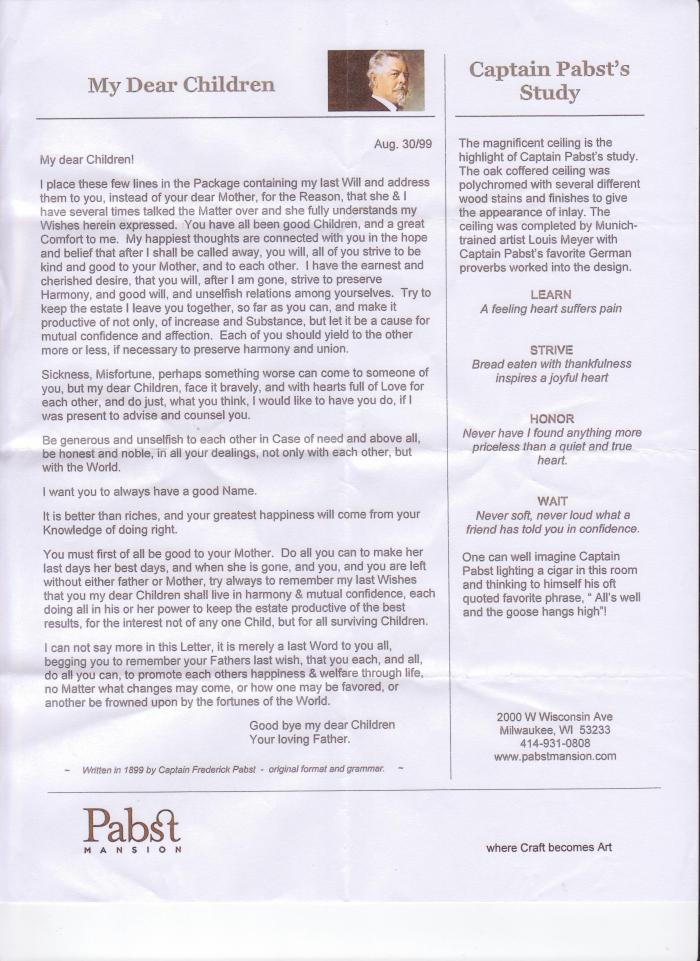
This is Pabst’s letter to his children, read after his death.  It gives you an idea of what I’m talking about.  They hand these out on the tour.  Well worth it.

Pabst Letter.jpeg

clowns have always been evil, why is this news?

When my age was still in the single digits I had the unfortunate experience of accidentally catching a television scene where a clown brutally stabs a fellow human in a manner that’d probably be considered horrific even by today’s degenerate tv standards.  It melted my little child brain.  I couldn’t sleep for days.  My parents were freaking out.  Can’t sleep.  Clown will eat me.  It was at one of my relative’s houses and I figure somebody accidentally left it on a channel not appropriate for the kiddies.

Suffice to say, from that day forward I’ve always hated clowns.  So now lunatics dressed as clowns are walking around scaring people all across the country.  People are freaking out.  Oh, clowns are now all of a sudden evil?  What took you all so long to realize this?  Remember those party clowns when you were a kid?  Evil.  Who actually thinks clowns are happy, funny creatures anyways?  I seriously have never gotten this.  Here, just look at these random clowns:

clown.jpg

Closet serial killer

french clowns.jpg

Cheese eating surrender monkeys

ronald.jpg

Evil robber baron

the joker.jpg

Upstanding ordinary average Gentleman

I always remember The Simpsons having it right.  This is what I thought clowns were like:

bart clown.png

Can’t sleep.  Clown will eat me.

Clowns or fools have been around since Caveman Overlord Steve turned his bitter rival Former Caveman Overlord Carl into his fire pit fool.  These jesters or whatever didn’t dress like creepy murderers though did they?  Where did this modern incarnation come from?  I’m guessing the circus.  Early in the 20th Century I’m sure all clowns looked like this, so it became part of the culture and that was that.  I guess I’ve just never understood why such a look became associated with fun or happiness.  I’m clearly not alone in this thought process because clowns are all over horror movies.

So now that social media has enabled the rest of the human race to see clowns my way, it’s turned into mass hysteria.  I don’t understand why.  Look, on any given day you could walk by a complete psychopath on the street.  He or she could be just wearing jeans.  You’d never know they were evil.  But now, since this clown thing is a thing, the psychopath’s are very helpfully dressed up as clowns.  Now we know they’re lunatics just based off their choice of attire.  It’s win-win!

We should support this.  And thus, anybody wearing a clown suit should be immediately arrested by the secret police and sent to a special island.  China’s building all those new islands in the South China Sea, right?  What we do is buy one of those new islands and put all the clowns on it.  Can you imagine the horror of an island with 9,634 clowns?  The thought sends chills into my soul.  But it’s okay.  If we get too freaked out by this, we can always get China to bomb the island.

evil-clown

The sweet & tangy taste of human flesh appeals to this man

Detroit – because work said so

Someday somebody way smarter than me is going to write a book where Detroit is a metaphor for all of America. You can trace the tale from the earliest French settlers, to British rule, frontier America, transition from an agrarian to industrialized economy, full blown dominance (Detroit probably single handedly out produced Nazi Germany), followed by collapse & depopulation, followed, by what?

Well, one would hope rebirth. Rather than continued slow decline. Since 1950 Detroit has lost almost 2/3 of its people. A similar trend stalks Cleveland, Milwaukee, and countless other Midwestern cities. Literally, Detroit used to be the center of the world alongside New York and London. Will it ever return to its former glory? Is it even possible? I’m not sure. So much of what drove this greatness no longer exists. What America is and does is so very different than in 1950.

Maybe I’ll try and write about it later on. But for now I’ll let the photos speak for themselves. Or at least to also offer that Detroit has some of the worst traffic I’ve ever experienced, which says a lot considering the parking lots I’ve driven in (Tokyo, Washington, New York, LA, etc). And also Detroit’s suburbs have some of the best Lebanese food on the planet, truly legit awesome stuff.

Work sent me to Detroit for all of three days. I only ended up snaking a few hours to drive around. Sadly I didn’t get to do anything reasonably fun. So I guess that means I’ll have to go on back on my own dime.

Woodward & Guardian

One Woodward Avenue (left) and the Guardian Building – One Woodward was completed in 1962, note its applicable stale awfulness.  Guardian Building dates to 1929 and is apparently beautiful inside.   Also note the weirdo sky bridge which linked the two since the 1970s.  In 2012, Rock Ventures LLC bought One Woodward.  Rock Ventures owns Quicken Loans, a bunch of sports teams and casinos, and about a 100 other companies.  I suppose it’s an example of the types of companies that Detroit has to attract in order to rebuild.


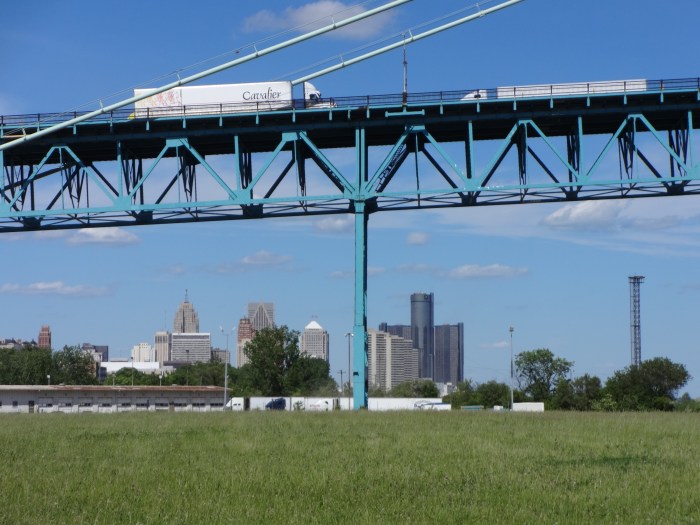
Ambassador Bridge.JPG

Ambassador Bridge & Downtown Detroit – The busiest border crossing in North America, the bridge carries 1/4 of all trade between America and Canada.  The separate Detroit River Tunnel carries rail traffic.  In a bit of weirdness the bridge is actually privately owned by a guy who appears to behave like an evil monopoly man cartoon caricature.  A second bridge is scheduled for completion by 2020.


Windsor.JPG

Detroit River & Windsor, Canada


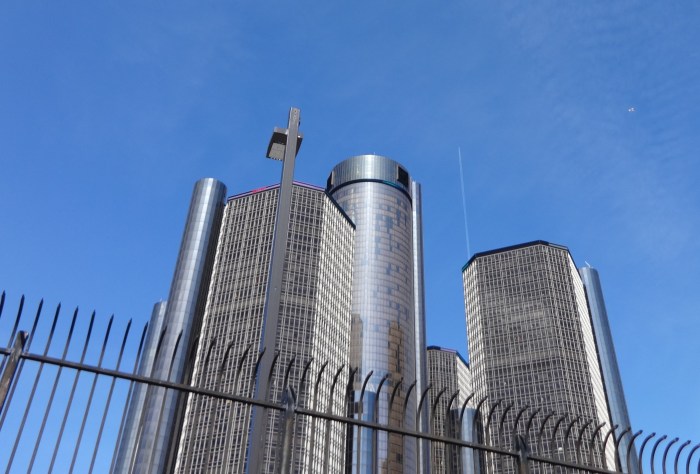
GM Building.JPG

GM Renaissance Center – appropriately enchained behind a fence for GM’s cheating death off the backs of the taxpayer


Packard Plant.JPG

Ruins of the Packard Automotive Plant – Completed in 1911, it built cars until 1958.  By 1966 Packard had evaporated as a car company.


The next three shots are of ruined houses just a few blocks away from the Packard Plant.  Once upon a time, an American farm worker could move to Detroit and get an entry job at the Packard Plant.  Thirty years later he could retire as a supervisor with a decent pension, and go buy himself one of these beautiful houses to live out his days as a grandfather.  Now it’s all gone, the Plant, the house, and this very concept of employment as part of the American Dream.  I wonder if they could have ever imagined how bad it would get?  Understanding why this all came about, and where to go from here, is central to Detroit’s future.  And perhaps America’s as well.


House


House1


House 3.jpg