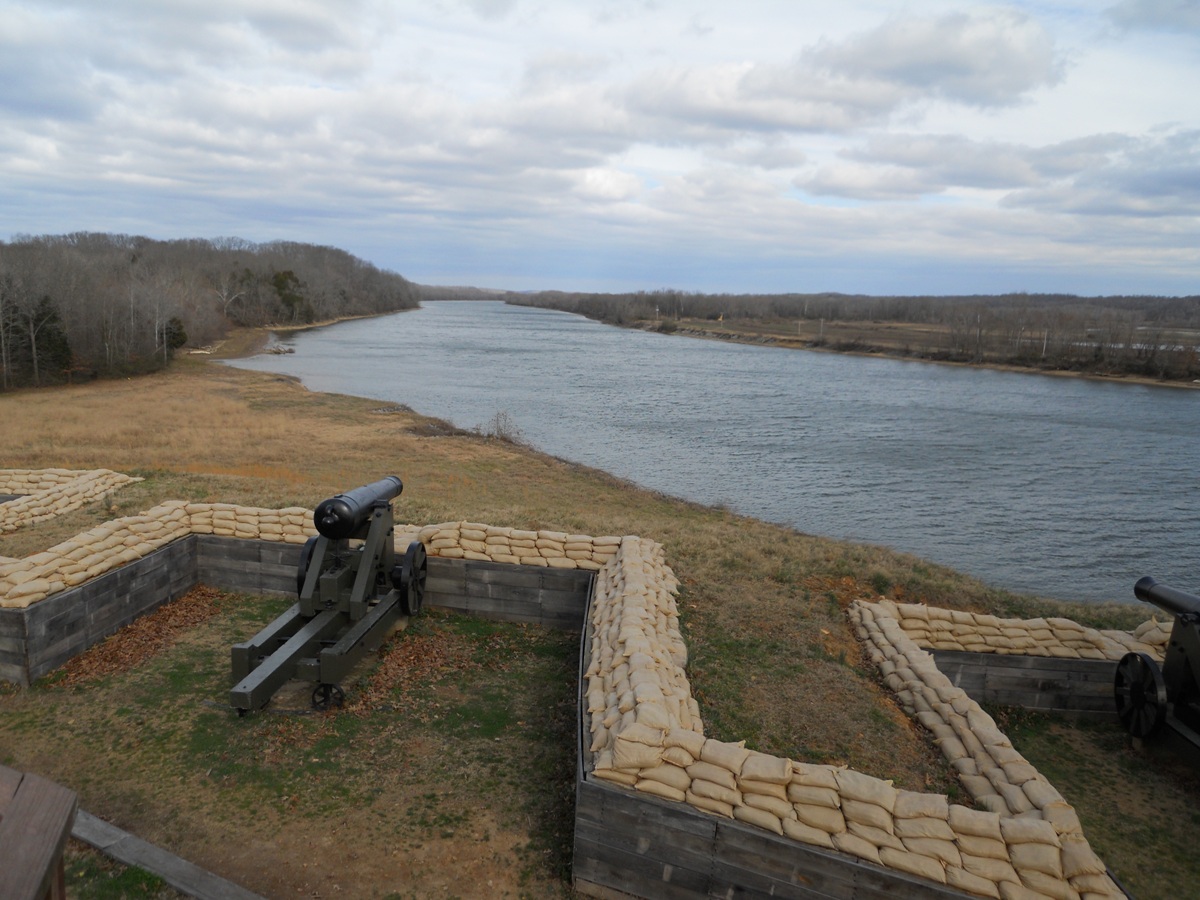
I was reflecting on things earlier today since it’s getting colder tis the season. I remembered my Grandfather did Christmas 1944 at the Bulge. A human brain cannot possibly imagine the frigid temperatures, lack proper food and water, the ferocity of the battle on both sides. It’s beyond us. And yet, all those on all sides did it.
In Terminator 2, Arnold delivers one of his best lines ever. Made even more poignant by the fact he’s a robot delivering the sentence in an absolutely total deadpan way. While the children play with toy guns in the background, in slow mow. “It’s in your nature to destroy yourselves.”
[please excuse any typos; I am transcribing from a book (remember those?)]
Private Day, Company B, 25th Massachusetts, 07 November 1862:
By morning the storm had abated but there were about two inches of soft snow or slush and some of the boys were barefoot, having worn out their shoes and a good many were nearly, or quite sick. The surgeons looked over the regiments, sending the sick and bare-footed abord the gunboats for Plymouth, for which place the troops were bound. The order of exercises for today was a march back to Williamston … but I had been a little under the weather for a day or two and I was with the others aboard the little gunboat Hetzel where we were greatly sympathized with the Marines who seemed to think we had a pretty hard time of it and show us every favor …
The Civil War was a just war. But for the average soldier it was misery. Absolute misery. I could go on and on; but I’ll let Private Day’s words speak for themselves.
Why is the sound of a rooster so much a part of popular culture? Or, at least when there was a thing called popular culture before culture disintegrated into 734 different things. The answer is of course in 328AD there were no clocks or watches. You got up when the rooster woke up, or when the Sun came up. That was it. Human brains were dialed into it.
It wasn’t until like the 18th Century when doing your own timekeeping became a thing. In the early industrial age, factory towns would have the factory sound the whistle to signal that it was time to get up and go to work. How gross was that? It’s like having your Monopoly Man boss wake you up with a revolver to your head and telling you to get up whilst also telling you that the milk in your ice box is super nice.
We’re back! After an unexplained 3,287 year absence. Why? We have no idea. Other than that my Guests somehow found another phone book. But if we disappear again, don’t be surprised. I have the procrastination factor that a sloth would envey.
I’ve been having a lot of trouble sleeping right lately. When the alarm clock on my cell goes off, I turn it off and want to sling that thing out the window so hard that squirrels will file felony assault charges on me.
But you know what? It’s really weird. It’s like my body is used to getting up before the alarm clock goes off. Either because the Sun comes up, or the birdies start chirping. That’ll get me up. Where I live, the birdies can start chirping around 5am. And not in a way that send me to squirrel court. It’s a little weird, even ancient, and I like it. Will it last, who knows, but I hope it does.
I’ve been reading a lot lately, and thus have finally gotten around to a long held goal to read (or in some cases) reread Shakespeare. I got me The Oxford Shakespeare: The Complete Works, 2nd Edition. It has a wonderful introduction but does not annotate the plays themselves which is both a good thing and a bad thing. I’m about halfway through this brick of a book. They arrange the plays by chronology, or at least the chronological order the editors believe Shakespeare wrote them. Which fascinatingly, is not an easy thing to determine.
What I like about this construct is I can read one play in about two to three hours and it’s a nice bite sized chunk of happy without overwhelming my brain. The last one read was Henry V. This guy’s story should be (but no longer is) well familiar to all of Western culture. It’s one of Shakespeare’s most well known, and maybe most quoted plays. It’s not 100% to the truth of history, but that’s never what Shakespeare was aiming for.
Having never read the whole play at once, I can say it’s probably the closest thing to an action movie that Shakespeare ever wrote. This play puts the pedal down from the start and never lets up. It’s an intesnse experience. The play itself (of course) has garnered a lot of negative thoughts from modern, arrogant types who don’t like that it’s a piece of jingoism. Probably because it is in fact a play written for a patriotic English auidence that very much wanted to hear a story about how Henry puts his boot on the French throat and drives the sword through the eyepiece.
That’s what Shakespeare intended. He clearly writes Henry V as his, the, model of an excellent, decisive ruler. But make no mistake, Shakespeare doesn’t hold his punches from anybody. Like a lot of history’s great people, Henry is both a hero and a maniac all rolled into one. He is unphased by battle, takes extreme risks, and ultimately see his victory through immense battlefield skill and leadership.
This same man also pontificates about how he might rape, pillage, and murder an entire city. Actually has his men begin to execute unarmed prisoners during a time of crisis. And in as many words (while disguised as a common man walking amongst his troops in the dark) that the king has the right to spend his men’s lives like currency whenever the fuck he wants to. In other words, Henry is indeed a man of his time, a good king, but still a ruler from the 15th Century.
The epilogue also reminds the audience (not that anybody at the time needed a reminder) that Henry died young (at 35) and after him all his gains in France were lost by subsequently poor English leadership which ultimately led to the War of the Roses, a polite term for a very violent, vicious, and multi-decade English Civil War. One could take the cynical view that everything Henry accomplished was for nothing, but that’s going too far for my tastes. Nobody knows what history brings next. You can only influence and act when you’re on the stage. After that, it’s outta your hands.
And then I remembered this scene from TNG where Picard has Data in fact act out a scene from this play. Specifically the one where Henry is in disguise at night:
This scene is the opening shot for Season 3, Episode 10, The Defector. In this scene a keen eye will see the Patrick Stewart plays Williams, Simon Templeman plays Bates, while Data gets the disgused king. It’s a neat little vingette, a great opening to one of my favorite episodes of TNG in general. The Defector was done when TNG was at the height of its powers. It’s a masterpiece episode that is both moving and brutal.
So let’s take the opportunity to once again remember just how utterly bad new Trek is. At least here, we shall always believe the creators of Discovery, Picard, (and the seven other new Trek shows they’re making whose names we can’t remember) should all be imprisoned. It has also recently come to my attention that Stewart (a near two decade veteran of the Royal Shakespeare Company) was very heavily involved in making Picard. So I guess he belongs in jail too. What a disappointment. I guess after thirty years you lose the magic. In TNG, Stewart is a master of his craft, in Picard he’s a garbage man working for a board room of Paramount suits. And Stewart’s seated at the same table.
Back to Henry V. There’s also the 2019 Netflix movie The King which is Netflix’s take not only on Shakespeare’s Henry V but also Henry IV Part 1 and Henry IV Part 2. My contempt for this movie knows no bounds. So like new Trek,we must place it into the garbage category. Not only does the movie completely alter the history, it completely alters the Shakespeare. Plus Emo Queen Timothée Chalamet is just about the last person on the planet who should being playing Henry V.
So in other words, the people who wrote / made this movie, they thought they were smarter than Shakespeare. I mean, Hollywood alters history more times than Trek changes the space time continuum. But did these arrogant garbage men really, really understand how crass it is to rip up a story written by William Shakespeare? Maybe it’s just me, but I don’t have the gall, I’d be like: “Uh, yeah, we’d better not do that, guys. No really, let’s not do that.”
Perhaps the most eggregious sin of The King is how they screw up Agincourt. Which is probably on the top ten of most important singular battles in human history. How do you screw up Agincourt? Easy. You get Netflix to hire a bunch of hacks to make a bad movie.
I thus conclude I probably in good faith owe two future posts. One should be a review of The Defector. And the second should be a post about Agincourt. I don’t always keep my future post promises, I get distracted like a meth addled squirrel, but maybe I’ll stick to this promise.
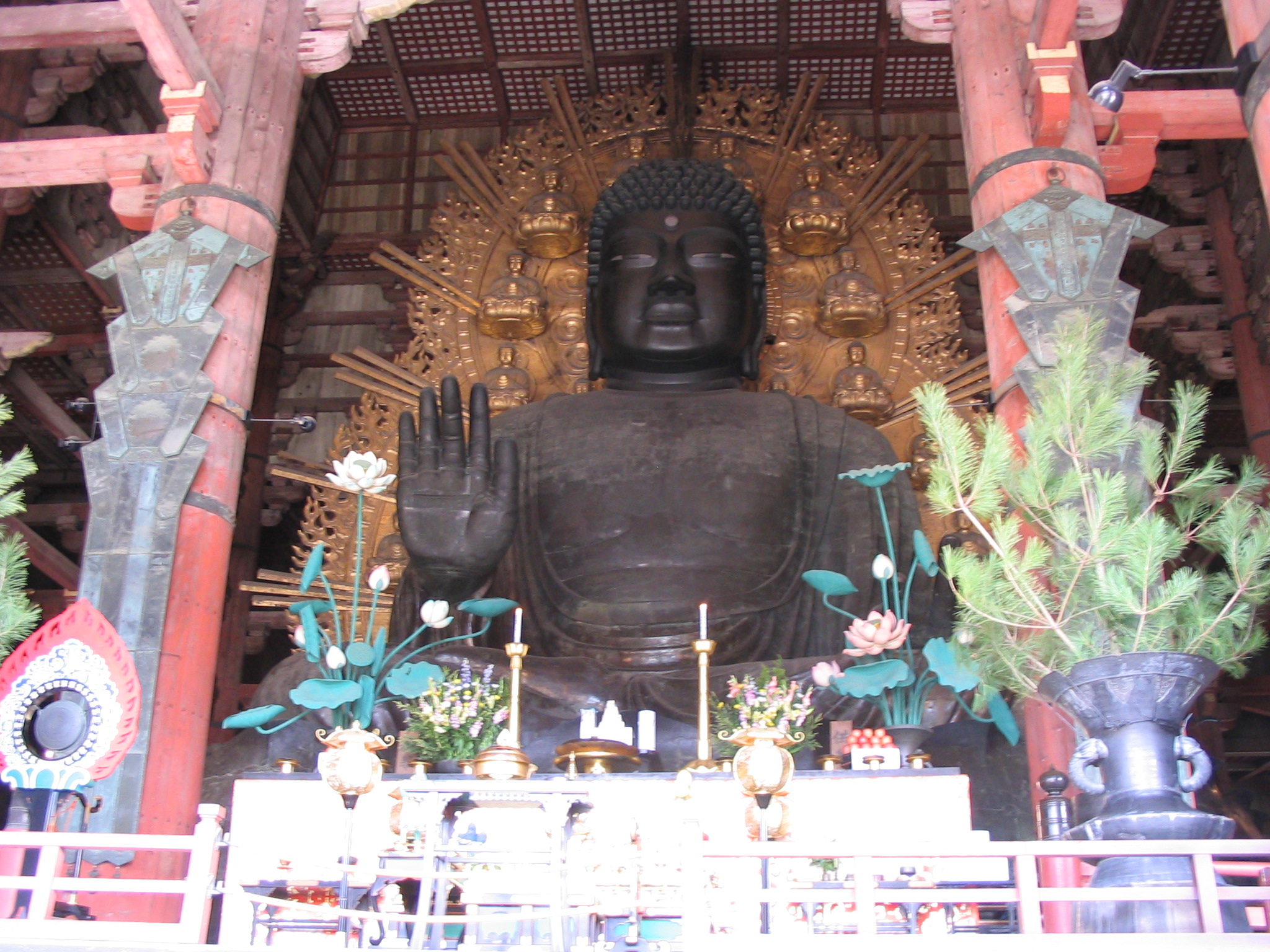
As a draw on my old photos sometimes I’ll hit upon a trip and I distinctly remember being there when my Parents visited me. These are good memories, and not to be taken for granted. Daibutsuden is the Great Buddha Hall in Nara. The overall complex is Todai-ji or Todaiji. Daibutsu is the largest copper Buddha in the world. As with all major Japanese temples, this one has a tale.
Originally the site was a 8th Century temple built by Emperor Shomu to honor his infant son’s death. This is when Nara was Japan’s capital, though the country was not totally united during this era. The larger temple, and chiefly the Daibutsu came later, between 738-752. It seems (by legend) that in order to finance such a grand undertaking Shomu had to cut a deal. The Buddhist monk Gyoki would help, but only if he was allowed to teach Buddhism to the people. This was part of a very complicated transition in Japanese religion where traditional Shinto beliefs began to evolve alongside Buddhism and they merged into a very unique Japanese version of both religions.
But as with all things religion, this transition had its opponents. But money talks, and Shomu wanted what Shomu wanted, so he cut a deal with Gyoki who got what he wanted. Here’s a relatively rare (my opinion) in history where an absolute sovereign and an important religious figure resolved their differences with compromise instead of bloodshed. Contrast this with Henry II and the splattering of some random guy’s brains inside a random cathedral.
It didn’t come cheap. Gyoki and his followers scoured the country for money and materials. The statue itself brought financial difficulties to the entire country and gobbled up much of the country’s entire copper supply. Weight: 500 tons, or the size of a decent sized ship by today’s standards. Back then, it’d have been the largest ship in the world if it could have floated.
the man himself
his home
Like many temples in Japan, the original Hall burned down many times. The current hall was finished In 1709, Great Buddha Hall, Daibutsuden, which houses the Daibutsu. Bizarrely, it’s actually 1/3 smaller than the wooden building it replaced. Even so, until the turn of the 20th Century it was still the world’s largest wooden building. And like the temple, the statue itself has been repaired and redone many times over the years due to fire and earthquake damage, plus wars.
Plus it’s 1,270 years old and is thus beyond comprehension. I’m a big believer that the human brain has limits and the idea that any one of us can properly conceive of 1,270 years inside our brains is asking too much. It’s a long, long time, with countless lives and dreams riding along the waves of time all while Daibutsu hangs out and watches. Bronze statues can’t talk. But maybe if you listen, even if your brain can’t comprehend it, you can still learn from it.
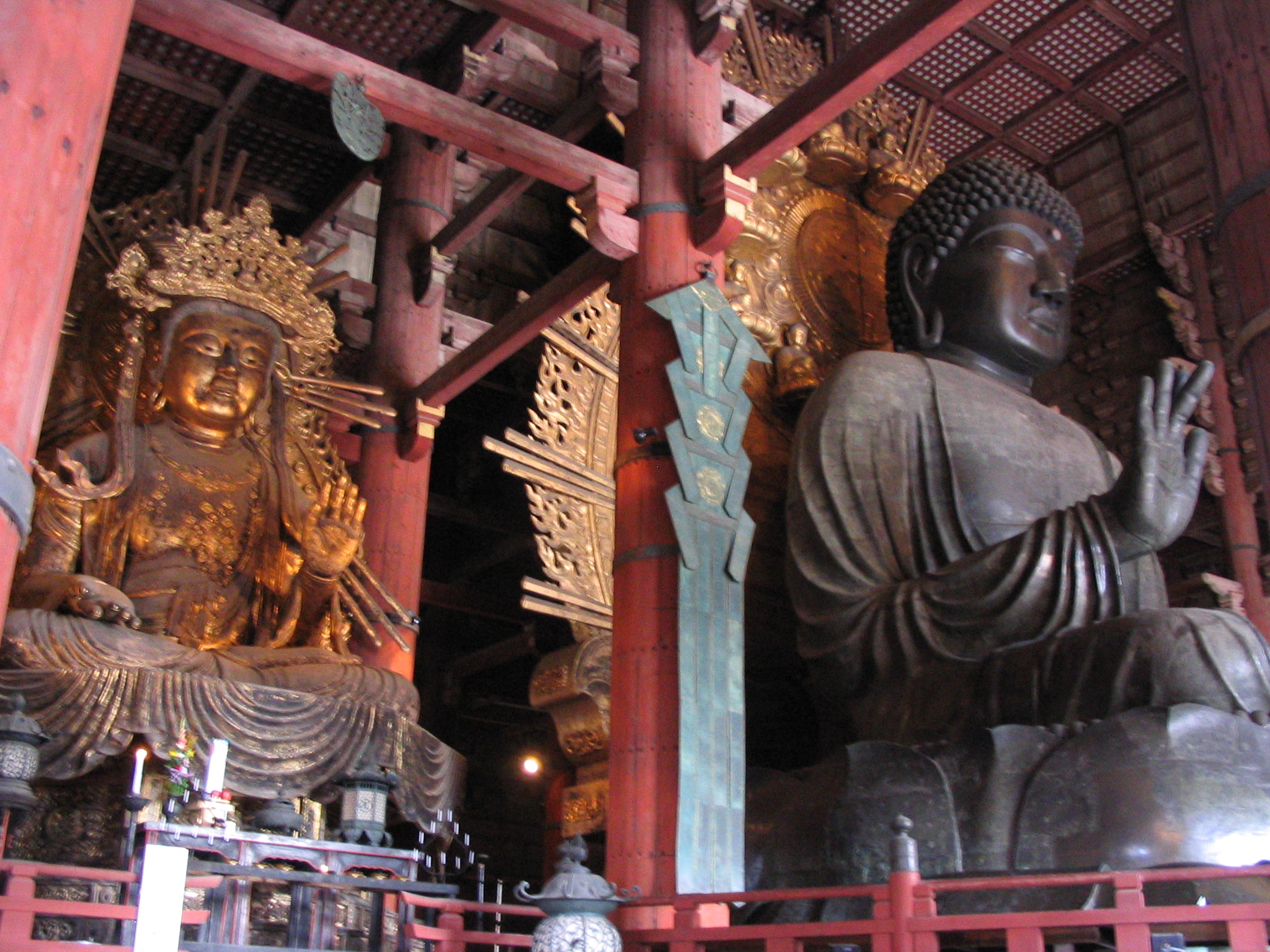
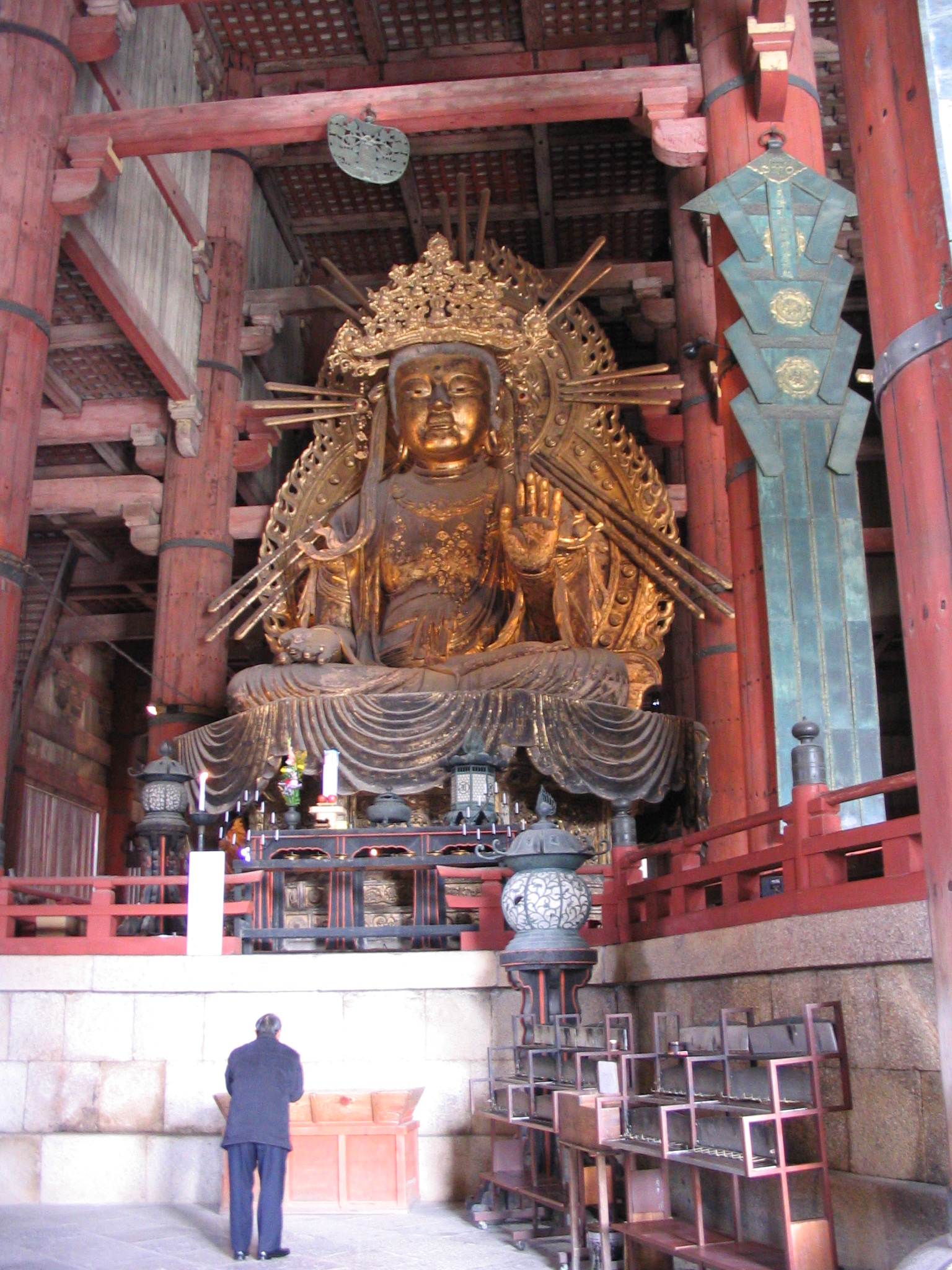
Nyoirin-kannonis next to daibutsu
a pyre outside the main Hall, all these years later I still can’t shake the idea that I botched the angle of this shot
just one man, praying alone, riding the waves of time
If you’ve ever been at sea for a significant time or been a sailor you know the art of the routine is of considerable importance. Routine allows you to get done what you need to get done so you can do actual work, or have fun, or just stare out at the awesomeness of being at sea.
When the routine is busted is when things go bad. During peacetime this can be bad weather, equipment breaks, some dummy does dummy things, etc. War is of course when the routine is shattered by expected or unexpected action.
The Union blockade of the Confederate States was one of the most successful (and least appreciated) acts of the war. By the time the war was halfway over goods might be 20 or 30 times more expensive in parts of the South. By the end, the Confederacy was starving.
Making this blockade happen was the genius of many hands, but much credit is due to Secretary of the Navy Gideon Welles. But for the average Union sailor it was a boring slog of a routine, day after day, sitting off the southern coast watching mostly empty water, in an era where air conditioning didn’t exist.
So on January 31st, 1863 at least it’s not Summer, so the temperature is good. But there’s a blockade runner’s dream in an early morning fog. But it’s not a blockade runner the Union Navy has to worry about, the Confederates are coming out to fight:
Two Confederate rams, the CSS Chicora (Commander John R Tucker) and Palmetto State (Lieutenant John Rutledge) under overall command of Flag Officer Duncan N Ingraham, left Charleston Harbor in an early morning fog and attacked the blockading fleet. The rams successfully destroyed the USS Mercedita (Captain Stellwagen) and the Keystone State (Commander William E LeRoy). General PGT Beauregard commander of the Charleston district, claimed that the blockade had been lifted. More Federal ship arrived.
– Chicora and Palmetto State were modern ironclad rams, arguably two of the most dangerous warships then afloat. Whereas Mercedita and Keystone State were wooden steam ships. In order to blockade such a long coastline, the Union Navy had to rely on hundreds of old model wooden vessels which were fine for chasing down blockade runners but simply couldn’t compete with modern armored warships.
– The reality is the Confederacy didn’t have the industrial base to generate enough modern warships, and those they had were slowly and methodically run down and destroyed as the Union captured Confederate port after port. Chicora and Palmetto State are exceptions in that since Charleston held almost until the end of the war, they lasted all the way until 1865 and were scuttled when Union forces finally took Charleston.
– So this was of course a very one sided battle, at least at the tactical level. Mercedita was hit by gunfire and then rammed to the point that she surrendered. Keystone State was disabled by gunfire afterwards. Contrary to the above text, both ships would survive, be towed away, and continue service for the Union after repairs. Chicora and Palmetto State would exchange gunfire with the rest of the blockade fleet before retiring.
– A one sided affair and a complete tactical victory for the Confederacy, it did nothing to change the overall scope of the war. The Union blockade of Charleston remained intact. Which is, of course, the purpose of an effectively executed blockade.
– All throughout the war are the scattered names of dozens of Union and Confederate generals who are just kind of there. And even when they execute brilliant acts here and there, they’re still just kind of there. They’re just guys. And you ask yourself, why? Beauregard was the co-winner of First Bull Run. Why is he just kind of there for the rest of the war? Well, it’s because of statements like this: ”claimed that the blockade had been lifted”.
– So if you’re some Charleston citizen, and Beauregard says the blockade is over, and two days later you look out over the water and the blockade is still there, you’d be certain that man was an idiot. Here is a perfect example of Southern spirit over common sense. Elan is not enough to win a war, and yet many of the South’s leaders (even those in the most key of positions) figured it would be enough to triumph. It wasn’t. The text above blandly notes: “More Federal ship arrived.” Beauregard’s outlandish view of the war cannot compete with a Union war machine that can replace ships at will, no matter how many are destroyed. And crewed by Union sailors who had one of the hardest, most thankless tasks of the war, but who completed their mission in the end.
On March 10th, 1945, 279 B-29 Superfortress heavy bombers conducted the most devastating conventional bombing raid in human history. Their target was Tokyo. The new tactics they employed had been tested but never implemented on such a large scale.
High altitude precision bombing over Japan had proved difficult compared to Europe due to high altitude winds over Japan. The US Army Air Forces decided to switch tactics, primarily at the behest of Curtis LeMay, although the ideas were not entirely his own.
The tactic of large formations of B-29s conducting high altitude precision bombing using high explosive bombs was completely altered. The attacks would happen at night. The B-29s would attack as a swarm, with each bomber flying individually without formation. The attacks would be conducted from very low altitudes to ensure accuracy and to confound Japanese anti-aircraft defense. Finally, the B-29s would use incendiary bombs instead of high explosive bombs.
The target was Tokyo itself, its people, and the largely wooden based construction of Japanese homes and small businesses. Some bombers carried a small number of high explosive bombs which were the first out of the bay. The idea being to crack open the roofs of structures using high explosives so the follow on incendiary bombs would fall within.
LeMay took extreme risks in the plan. To increase bomb load, all defensive guns on the B-29s were removed except for the tail gun. A lack of defensive formation meant each B-29 would be highly vulnerable to Japanese night fighters without mutual defensive support from other B-29s. Nevertheless, LeMay decided to proceed with the new tactics.
The raid succeeded on a scale few could have imagined. The Japanese were completely taken off guard by the new tactics. No Japanese night fighters were able to engage a single B-29. Japanese anti-aircraft guns did manage to down 14 B-29s with the loss of 96 Americans. But generally, Japanese anti-aircraft fire was ineffective as the gunners were not prepared for a low altitude attack and the low altitude run of the B-29s rendered Japanese radar mostly blind.
The attack started a firestorm throughout Tokyo with a ferocity previously seen in places like Hamburg. However, the wooden base of Japanese construction made the consequences even stronger. An estimated 100,000 Japanese died in one night, almost all of them civilians.
Until the end of the war, the USAAF would continue to employ the nighttime, low altitude, incendiary attacks across all of Japan. And yet, by August 1945 even after five months of firestorm bombing Japan was no closer to surrender. As World War II would demonstrate, no amount of conventional strategic bombing would ever bring an Axis country to surrender.
In Germany, it had taken a complete conquest via ground forces. American plans were in place for a ground invasion of Japan to start on Kyushu which estimates claimed would cost millions of lives. And so the decision was made to try and short circuit such a scenario. The Soviet Union would enter the war, and America would employ atomic weapons in a last attempt to force Japan’s surrender without a ground invasion.
On August 6th, 1945 the first atomic weapon was dropped on Hiroshima with perhaps over 100,000 Japanese killed. And yet, Japan still did not surrender. President Truman did announce to the public and to Japan what had been done. A single plane, with a single bomb, had done what had previously taken hundreds of bombers.
Japan’s leadership was well aware of what had happened, but refused to surrender anyways. The same concept, that the Japanese people could endure anything, and Japan could fight on remained inside their minds. It must be acknowledged that by this point most of the Japanese senior leadership were certifiably insane. It is akin to Hitler’s last moments, where he ordered divisions to attack, that no longer existed.
And so the decision was made to use a second atomic weapon, this time on Nagasaki. For the most part, Nagasaki had avoided conventional bombing throughout the war due to its difficulty as a target. But with an atomic weapon accuracy and raid tactics were essentially irrelevant.
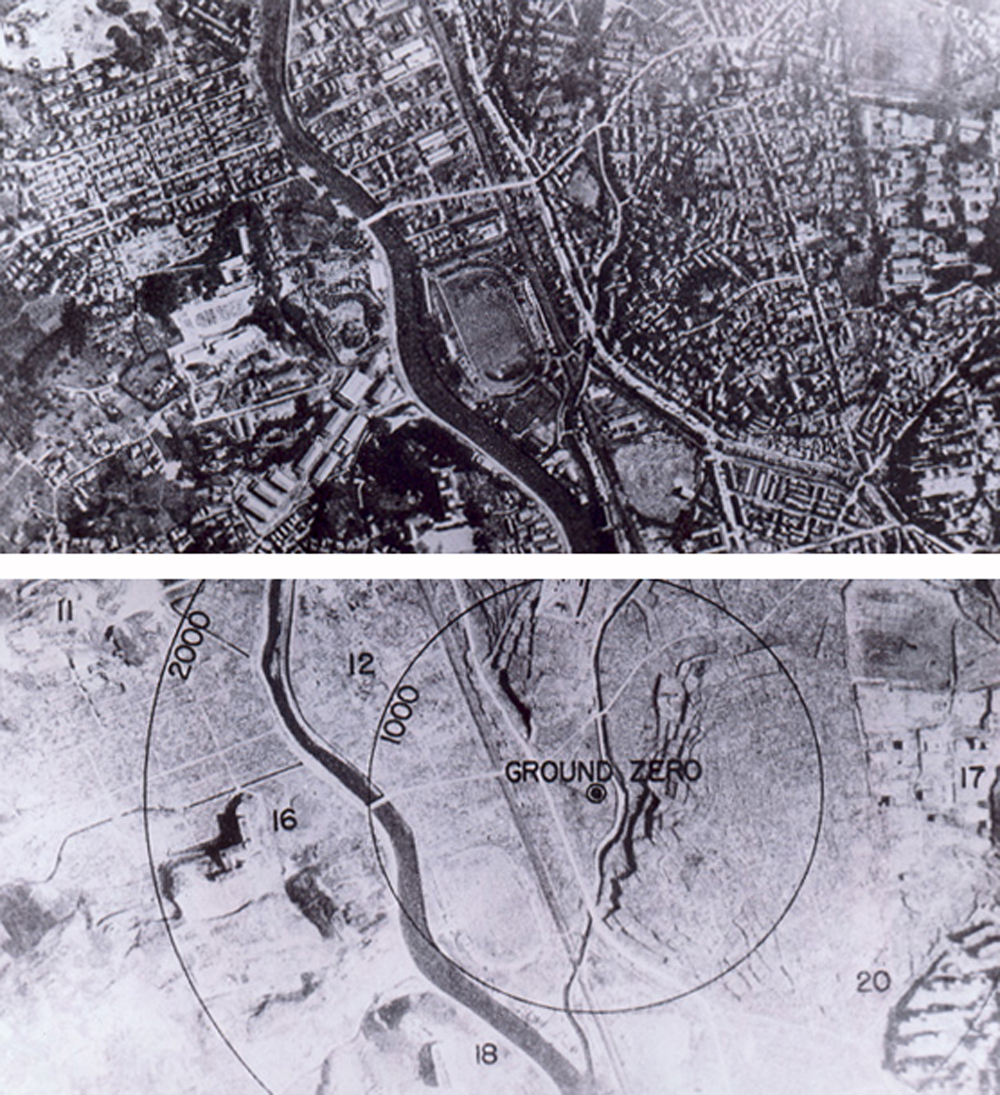
On August 9th, 1945, once again, a single B-29, with a single bomb. At 11:01 in the morning a plutonium core weapon detonated about 2,000 feet above Nagasaki (the airburst setting allowing for the blast wave to not be absorbed by the ground). Approximately 80,000 people died.
The devastation is clear to see, before and after:
Hirohito, finally, seeing the inevitable, and perhaps making one of the braver decisions of his life (there was no guarantee that the militarists would not simply assassinate him and fight on) decided to surrender. When he spoke via radio to the Japanese people it was the first time they’d ever heard his voice.
Nagasaki Peace Park began in 1955 and has a museum and hall adjoining it. It’s hard to explain what it was like to visit the place as an American man in my early twenties. Nuclear war on such scale, such horror, is difficult to comprehend when you haven’t seen it or know personally anybody who did.
I don’t really have any conclusions to draw here. I could probably write a super long post on the morals of strategic bombing done by both sides during the war. Or the ethical decision to use atomic weapons to avoid a horrific ground invasion. But others far wiser than I have written legions of books on these topics.
As to the rest of this post, it’s just about the photos I took while there, and a few words from the Japanese themselves.
ground zero or otherwise known as the hypocenter
some of the ruins were left on purpose inside the park
In going through the few photos I have of Nagasaki, the other major bunch are of the hypocenter or peace park. That post will be a long one on history, with a lot of the photos from the park and my thoughts on the museum. However, today is just one shot. I came across this photo and I was shocked I had it. This is at the hypocenter. I had to go back and look it up, I was in Nagasaki in April of 2004. So this is Nagasaki in the Spring, 59 years after a nuclear weapon exploded right above this location. I’ll leave any conclusions and thoughts to you.
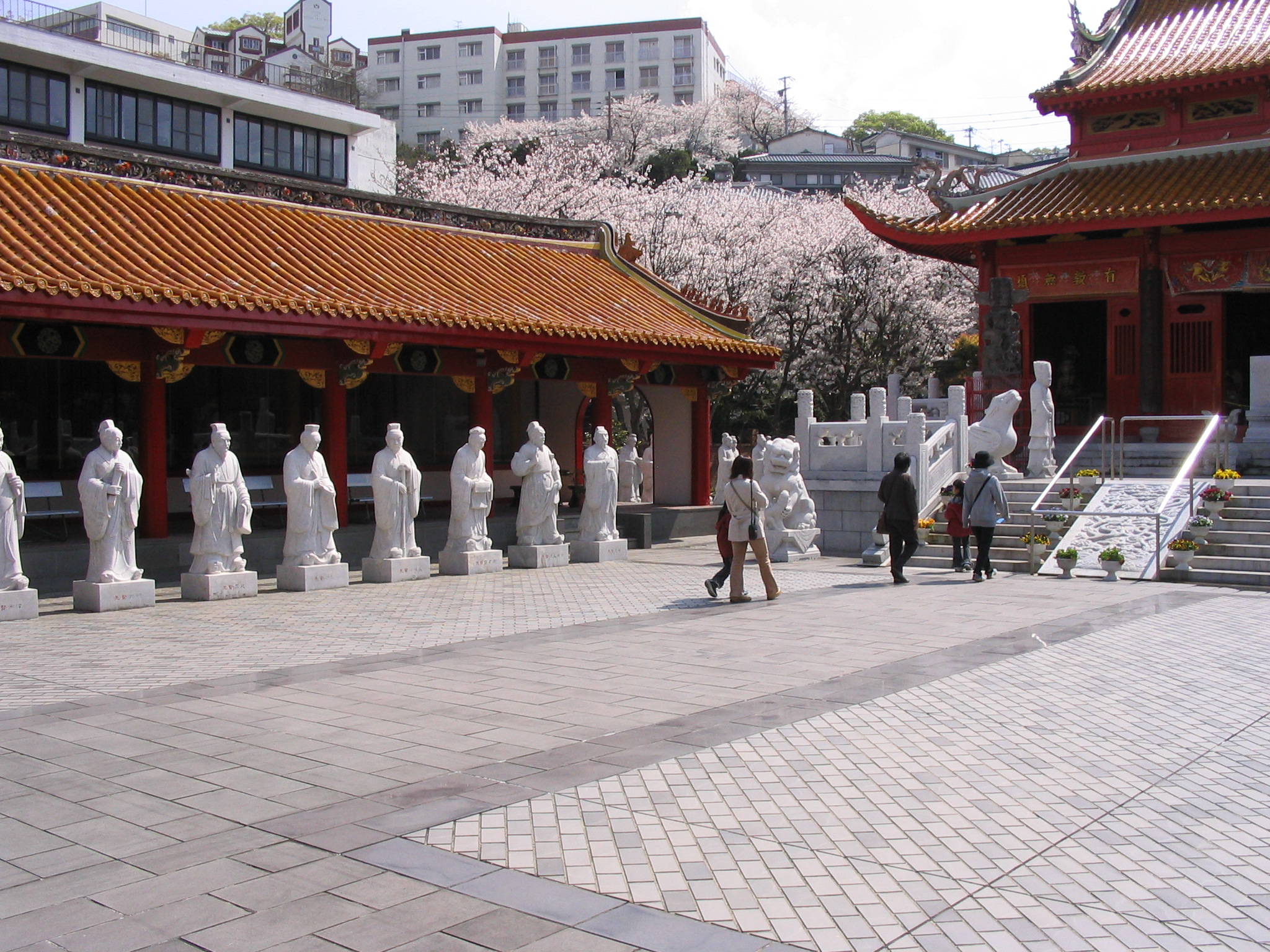
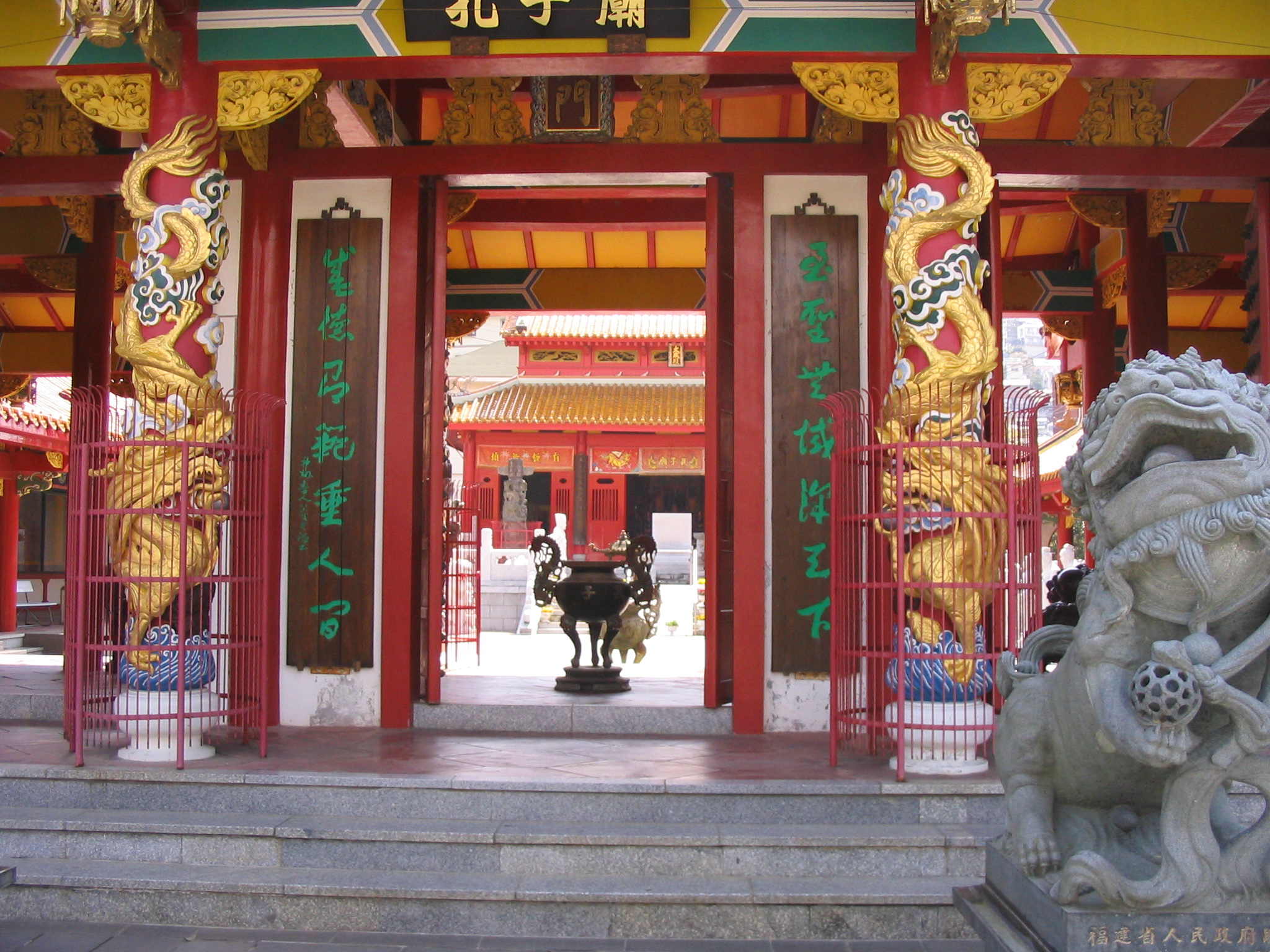
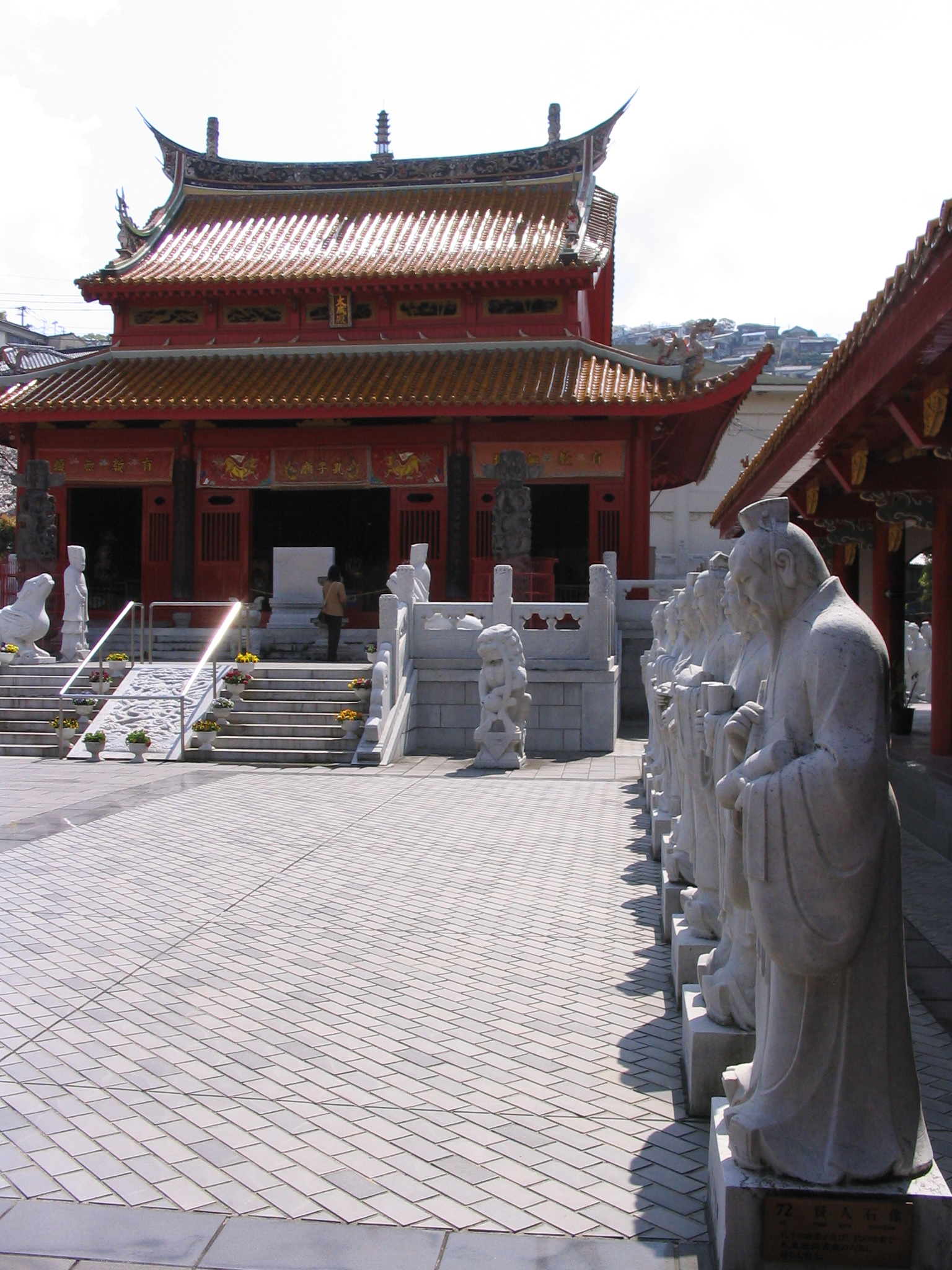
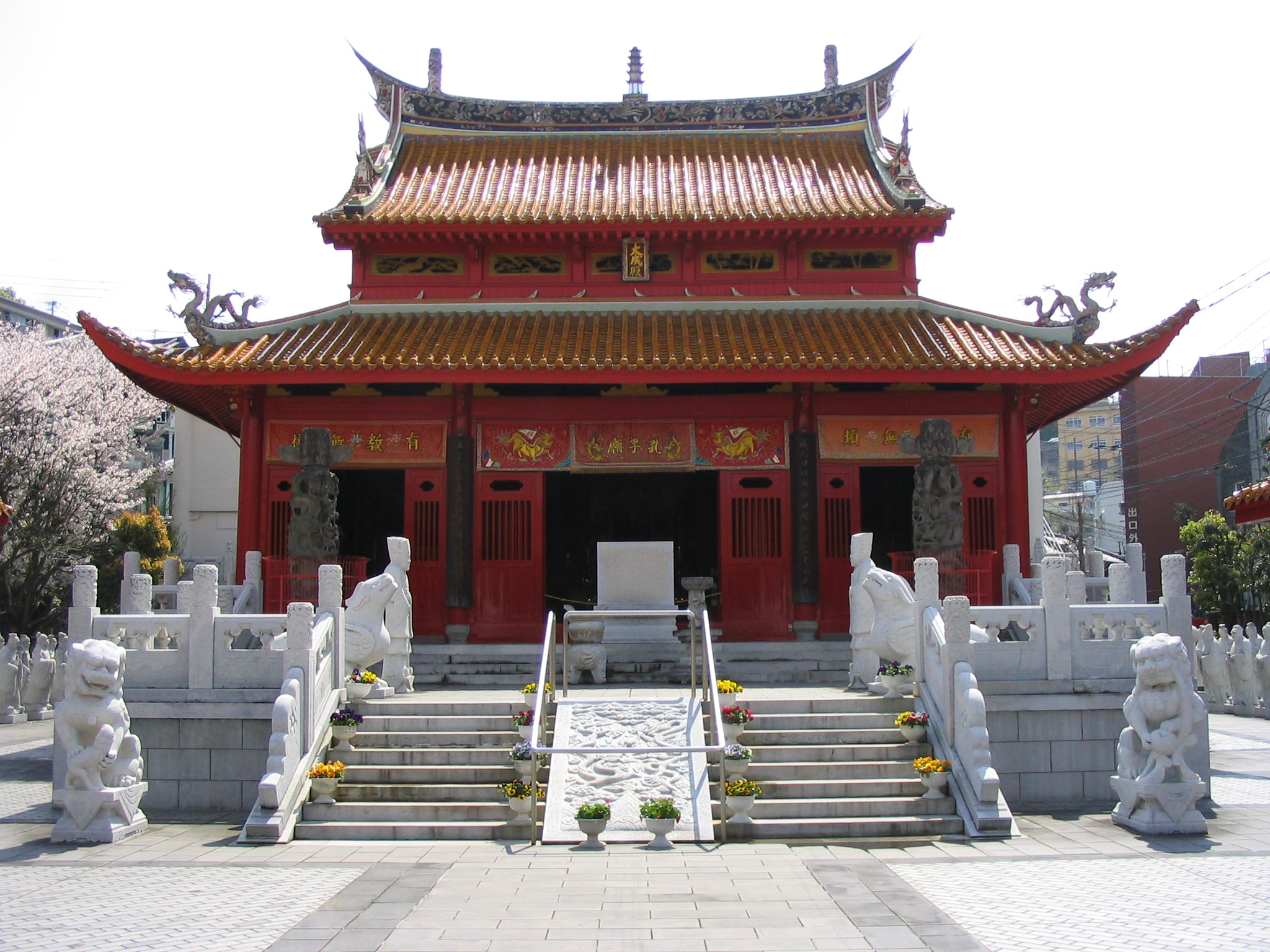
Not sure why I ended up at this Shrine, it’s not entirely popular but I’ve got pictures of it so I guess I went there for a reason. I guess?
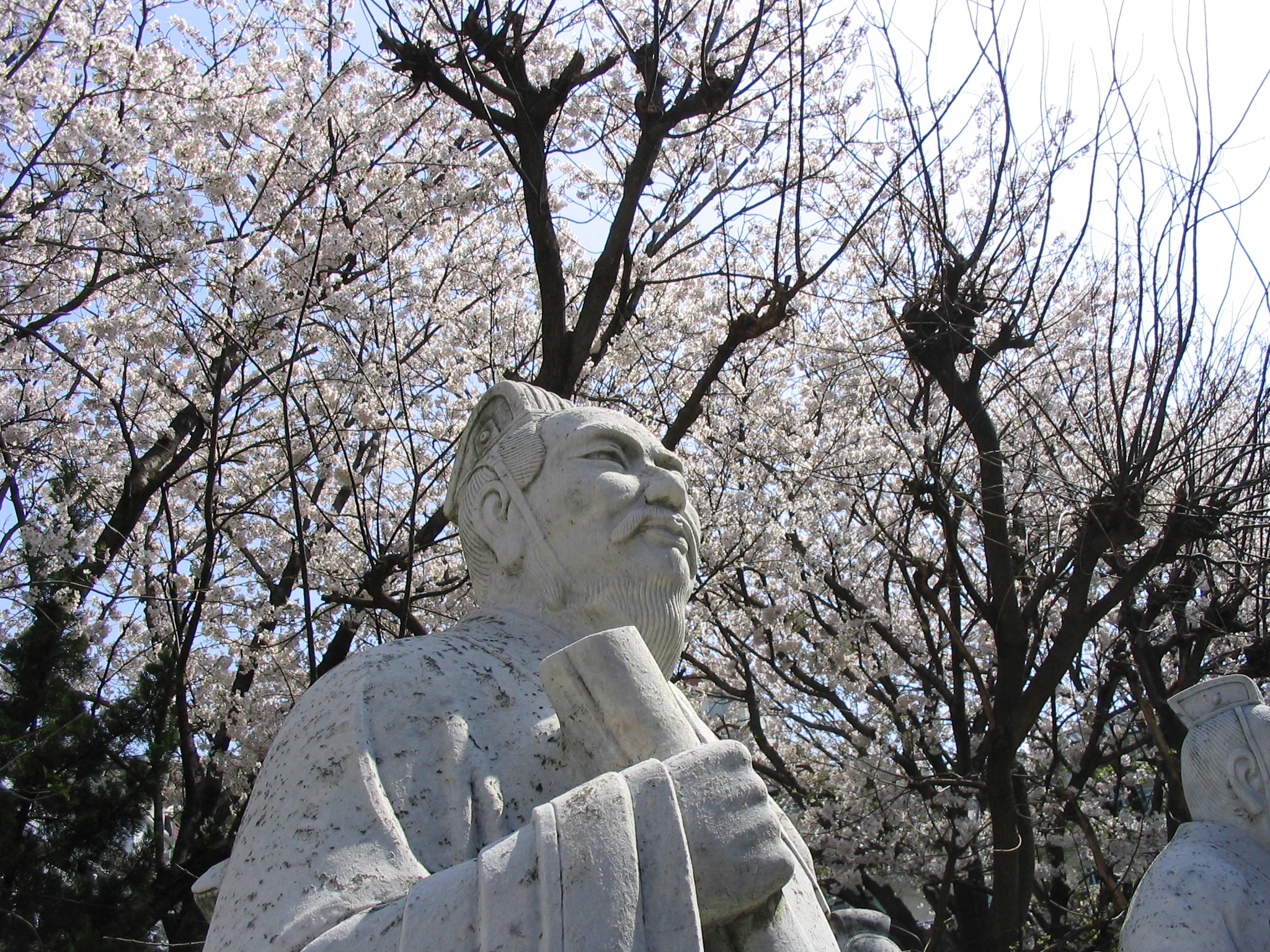
Constructed in 1893 by Nagasaki’s Chinese residents the place has 72 statues of Confucius. It’s a reminder that Nagasaki was always the ancient gateway into Japan.
Note the differences in architecture from Japanese shrines from some of my previous posts.
I just didn’t take as many photos back then, I guess. Go to a temple, take only two shots? I’ve talked about how this can be a good thing. But when I don’t remember all that much about the visit, I guess it can also be a bad thing.
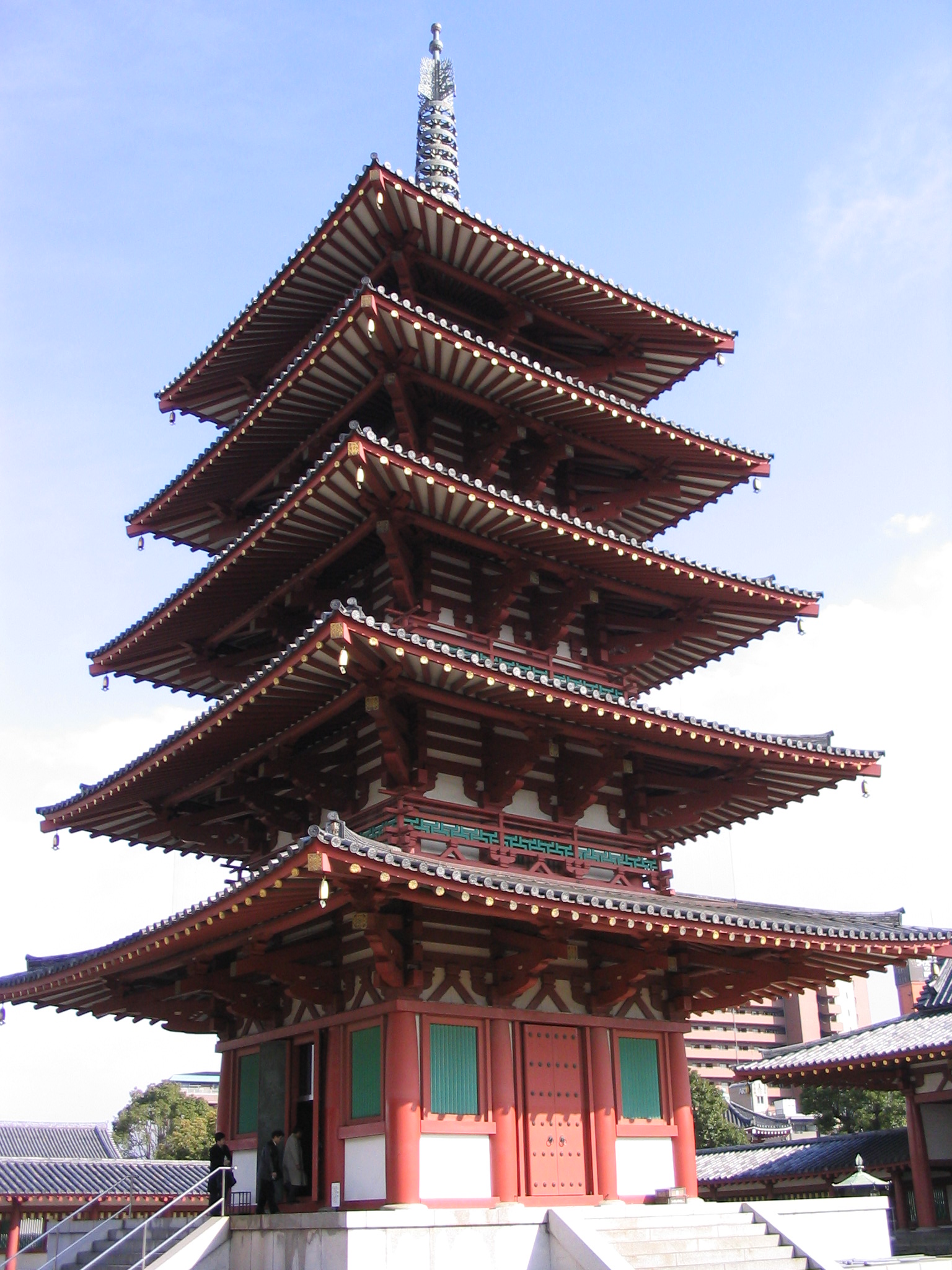
About an hour’s walk from Sumiyoshi-taisha is Shitennō-ji, another very old temple with a long history. It’s beyond my memory, but this is an excellent summary.
Shitennō-ji is said to be the oldest Buddhist temple in Japan but sadly all the buildings date from a 1960’s rebuild. Still worth a short visit.
If you’re in Osaka, you kind of just have to. Osaka’s most famous shrine, seat of all Japan’s Sumiyoshi shrines, and the subject of many legends, Sumiyoshi Taisha is said to have been originally built in 211. Founded by Empress Jingu it’s a shrine to the sea, dedicated to the Sumiyoshi Sanjin or the sea’s three gods. Back then, the shrine was right against the sea itself whereas today it’s somewhat inland.
The appropriately, galactically famous Sorihashi Bridge, one of the most beautiful and quintessential of Japan’s taiko bashi or drum bridges. This is one of my most favorite shots of all time, it was done with my old bad camera, and has its flaws but I still dig it.
The shrine’s west entrance, looking from west to east, with the gate up front, and the bridge in the background.
One of the rarest things I ever saw in Japan, a legit memorial for World War II. The shrine being dedicated to the sea, this of course makes sense. This was tucked away in a corner area and I kind of stumbled into it. I sadly don’t read Japanese in any form anymore, but this is a heavy cruiser. I don’t know the ship name or class, but the painting is an older version of the ship, I think, since the heavy cruiser has only two forward turrets instead of the later installed three.
The secondary temple.
If I’ve got my bearings right, this is the north side of the trio of the three main sanctuary structures. I always love the candid shots I get of just ordinary people happening along their daily lives, unaware or uncaring that this weird dude is taking very serious (bad amateur) photography.